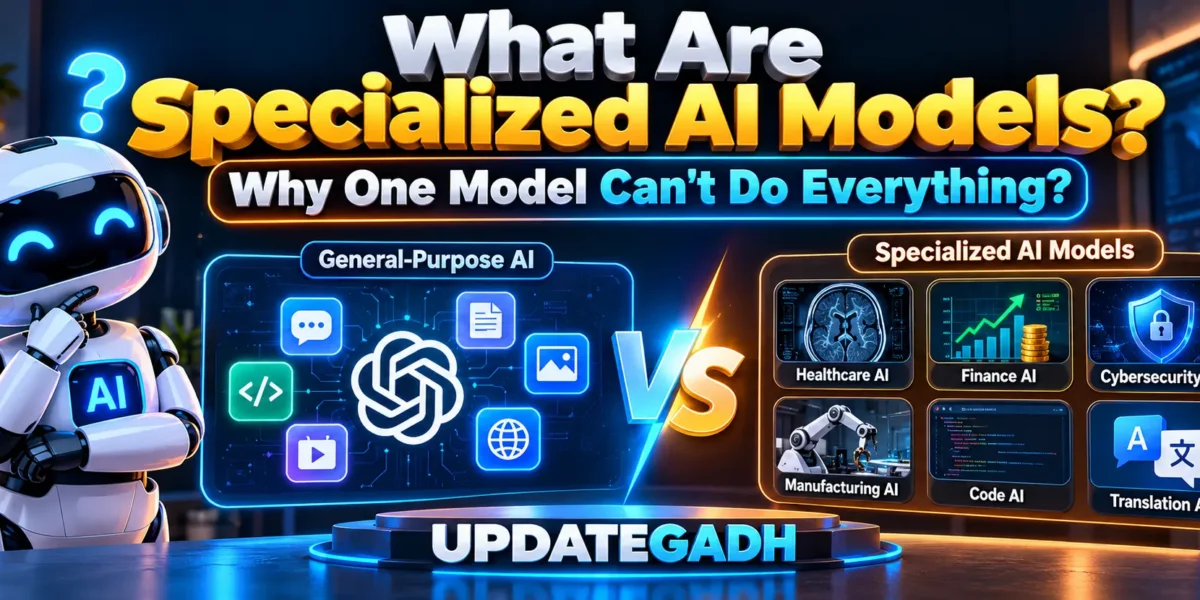
What Are Specialized AI Models
Artificial Intelligence is becoming a major part of modern software, business, education, healthcare, cybersecurity, finance, and many other industries. Large AI models can perform many different tasks, including answering questions, generating content, analyzing information, writing code, understanding images, and processing natural language. However, despite their impressive capabilities, one AI model cannot always be the best choice for every possible task.
This is where specialized AI models become important. Instead of trying to make one model excellent at everything, specialized AI systems are designed and trained to perform particularly well in a specific domain or type of task.
Table of Contents
Complete Advance AI Topics: Click Here
Real Time Projects on YouTube:- DecodeIT
What Are Specialized AI Models?
Specialized AI models are artificial intelligence models designed to solve a particular problem, work within a specific industry, or perform a limited set of tasks with high accuracy and efficiency.
For example, an AI model designed specifically for medical image analysis may be trained using thousands or millions of medical images. Another model may be optimized for detecting fraudulent financial transactions, while another may focus on translating languages or generating computer code.
The main idea is simple: instead of making an AI model good at everything, developers can optimize it to become extremely effective at something specific.
General-Purpose AI vs Specialized AI
General-purpose AI models are designed to handle a wide variety of tasks. They can answer questions, summarize documents, generate text, write code, and perform many other activities.
Specialized AI models have a narrower focus. Their training data, architecture, optimization techniques, and evaluation methods can be specifically selected for a particular use case.
| Feature | General-Purpose AI | Specialized AI |
|---|---|---|
| Primary Goal | Handle many different tasks | Perform specific tasks extremely well |
| Training | Broad and diverse datasets | Domain-specific datasets |
| Flexibility | Very high | More limited |
| Accuracy in a Specific Domain | May vary | Can be highly optimized |
| Resource Requirements | Can be large and expensive | Can be smaller and efficient |
Why Can’t One AI Model Do Everything?
It may seem logical to create one extremely powerful AI model that can perform every task. However, there are several practical reasons why this approach is difficult.
1. Different Tasks Require Different Knowledge
Writing a marketing article, identifying a disease from an X-ray, detecting fraud, and controlling an industrial robot are completely different problems.
Each task requires different types of knowledge, data, reasoning, and performance requirements. A model optimized for one task may not perform equally well on another.
2. Domain-Specific Accuracy Matters
In general applications, an approximate answer may sometimes be acceptable. However, specialized fields such as healthcare, finance, law, engineering, and cybersecurity often require much greater accuracy.
A specialized model can be trained and tested using domain-specific datasets and evaluation methods, allowing developers to focus heavily on the requirements of that particular field.
3. Efficiency and Cost
Large general-purpose AI models can require significant computing resources. If an organization only needs AI for one specific task, using a massive model for every operation may not be the most efficient solution.
A smaller specialized model can sometimes provide the required results while using fewer computational resources, reducing infrastructure costs and improving response speed.
4. Data Requirements Are Different
Different AI applications require different types of training data. A cybersecurity model needs security-related datasets, while a medical AI system requires appropriate medical data.
Using carefully selected domain-specific data can help a specialized model understand terminology, patterns, and situations that are particularly important within its target field.
5. Safety and Control
Specialized AI can also provide greater control over how an AI system is used. Organizations can define the model’s purpose, acceptable inputs, outputs, and evaluation criteria according to their requirements.
This can be especially important when AI is being deployed in sensitive environments where reliability, monitoring, and predictable behavior are essential.
Examples of Specialized AI Models
Specialized AI can be found across many industries and applications.
- Healthcare: AI systems can analyze medical images or assist with specific diagnostic tasks.
- Finance: Specialized models can identify unusual transactions and potential fraud.
- Cybersecurity: AI can analyze network activity and identify suspicious patterns.
- Customer Service: Models can be optimized for specific support workflows and business knowledge.
- Software Development: Coding-focused models can assist with programming, debugging, and code generation.
- Manufacturing: Computer vision models can identify defects in products during production.
- Translation: Language-focused models can be optimized for particular languages or translation tasks.
Advantages of Specialized AI Models
Specialized AI models provide several important benefits:
- Better performance for specific tasks
- Improved domain-specific accuracy
- Lower computational requirements in some use cases
- Faster responses for targeted applications
- Greater control over model behavior
- Better alignment with business requirements
- More focused training and evaluation
Will Specialized AI Replace General AI?
Not necessarily. General-purpose and specialized AI can work together rather than compete with each other.
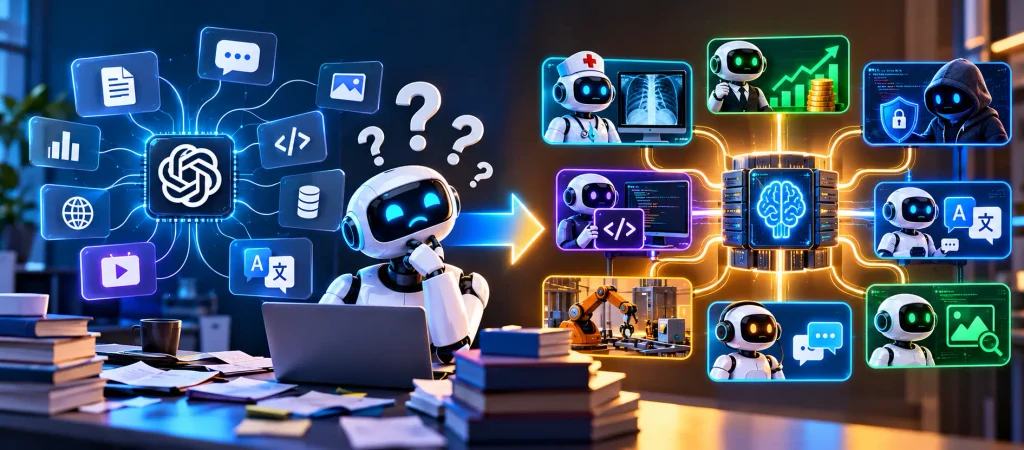
A general AI model can act as a flexible interface for users, while specialized models can handle specific tasks behind the scenes. For example, an AI application might use a general language model to understand a user’s request and then send a particular task to a specialized model designed for document analysis, image recognition, fraud detection, or another domain.
This approach can create an AI ecosystem where different models work together according to their strengths.
The Future of Specialized AI
As AI adoption increases, specialized models are likely to become increasingly important. Businesses and developers do not always need the biggest possible AI model. They need the right model for the right problem.
Future AI systems may therefore combine multiple models, tools, databases, and specialized agents. Instead of expecting a single model to understand every industry and perform every task perfectly, AI applications can dynamically select the technology that is best suited to each individual requirement.
Final Thoughts
Specialized AI models represent an important direction in the development of artificial intelligence. While general-purpose AI provides flexibility and can handle a wide range of tasks, specialized models can deliver highly optimized performance in specific domains.
For students and developers, understanding this difference is important because the future of AI is not simply about building bigger models. It is also about building smarter AI systems that use the right model for the right job.
Keywords: What Are Specialized AI Models, specialized AI models, AI models, specialized artificial intelligence, general AI vs specialized AI, artificial intelligence models, AI technology