What is MCP
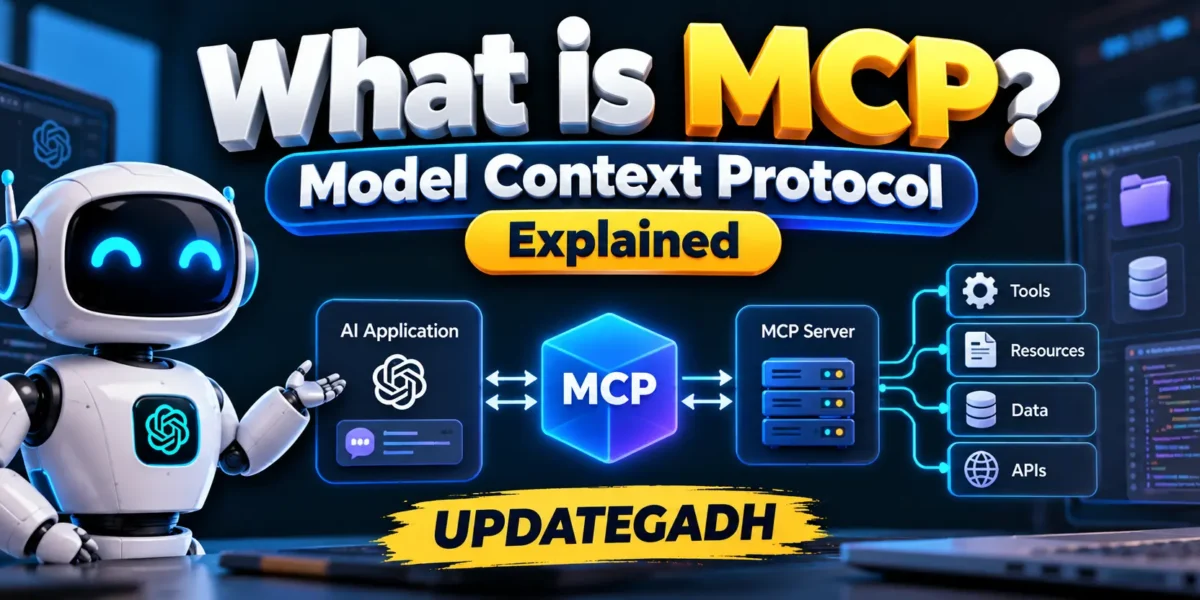
Artificial intelligence is becoming more powerful every day, but modern AI applications often need access to external tools, files, databases, APIs, and other services to perform useful tasks. This is where MCP (Model Context Protocol) comes into the picture.
MCP provides a standardized way for AI applications to connect with external tools and data sources. Instead of creating a separate integration method for every AI model and every application, developers can use a common protocol to make these connections easier to build and maintain.
Table of Contents
Complete Advance AI Topics: Click Here
Real Time Projects on YouTube:- DecodeIT
What is MCP?
Model Context Protocol (MCP) is an open protocol designed to allow AI applications to communicate with external tools, resources, and services in a standardized way.
In simple words, MCP works like a common communication layer between an AI application and the systems it needs to use.
For example, an AI assistant may need to:
- Read information from a database
- Access files
- Search information from an external service
- Call an API
- Perform actions using connected tools
Instead of developing a completely different integration for every capability, MCP provides a structured approach for connecting these systems.
Why Was MCP Created?
AI models are good at understanding and generating information, but they do not automatically have access to every external system. Developers traditionally had to create custom integrations between AI applications and individual tools.
This can become complicated when an application needs to connect with many different services.
MCP aims to solve this integration problem by providing a common protocol that applications can use to discover and interact with available capabilities.
How Does MCP Work?
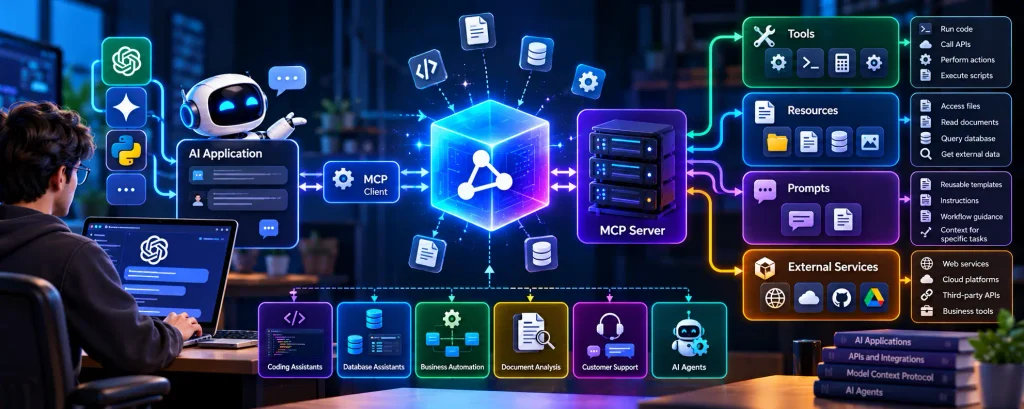
MCP follows a client-server architecture. An AI application acts as an MCP client and communicates with an MCP server that provides access to specific resources or tools.
Basic MCP Architecture
AI Application
      |
      | MCP
      |
MCP Client
      |
      |
MCP Server
   /   |    \
Tools Resources Prompts
   |      |      |
 APIs   Files   Instructions
The MCP server exposes capabilities that an AI application can use. Depending on the implementation, these capabilities can include tools, resources, and prompts.
Main Components of MCP
1. MCP Host
The host is the AI application or environment in which the model operates. It manages the interaction between the AI model and MCP clients.
2. MCP Client
The MCP client establishes and manages communication with an MCP server. It acts as the connection point between the AI application and external capabilities.
3. MCP Server
An MCP server provides access to specific tools, resources, or other capabilities. A server can be designed for a particular service or data source.
4. Tools
Tools are actions that an AI application can request through an MCP server. For example, a tool could perform a database query, call an API, or execute another supported operation.
5. Resources
Resources provide information or data that an AI application can access. These may include documents, files, database information, or other contextual data.
6. Prompts
Prompts can provide reusable instructions or templates that help applications interact with a particular MCP server or workflow.
MCP Example
Imagine you are building an AI-powered customer support application. The AI needs information from your company’s customer database.
Without a standardized integration approach, developers might build custom code specifically connecting the AI application to the database.
With MCP, an MCP server can expose a database-related tool. The AI application can then communicate with that server and request the required information through the MCP protocol.
Customer Support AI
        |
        v
    MCP Client
        |
        v
    MCP Server
        |
        v
 Customer Database
This architecture separates the AI application from the underlying implementation of the external service.
Benefits of MCP
Standardized Integrations
MCP provides a consistent communication approach for connecting AI applications with external capabilities.
Reusable Tools
An MCP server can expose tools that can potentially be used by different compatible AI applications.
Better Context Access
AI applications can access relevant external information instead of relying only on information already available inside the model.
Easier Development
A standardized protocol can reduce the amount of custom integration work developers need to create for individual services.
Flexible Architecture
MCP can be used with different types of tools and resources, making it useful for a wide range of AI applications.
MCP vs Traditional API Integration
Traditional APIs are designed for communication between software applications. MCP focuses specifically on providing a standardized way for AI applications to discover and interact with tools and contextual resources.
An API can expose a service, while MCP can provide a structured interface through which an AI application can understand and use available capabilities.
Where is MCP Used?
MCP can be useful in many AI-powered applications, including:
- AI coding assistants
- Database assistants
- Business automation systems
- Document analysis applications
- AI customer support systems
- Developer tools
- Enterprise AI applications
- AI agents and tool-using applications
Why MCP is Important for AI Agents
AI agents often need to perform actions instead of simply generating text. They may need to search data, access files, call services, or execute tools.
MCP provides a standardized mechanism for exposing these capabilities to compatible AI applications. This makes MCP particularly relevant as AI systems become more agentic and capable of interacting with external environments.
Important Security Considerations
Connecting an AI application to external tools also introduces security considerations. Developers should carefully control which tools are available and what permissions they have.
Authentication, authorization, input validation, access control, data privacy, and safe execution should be considered when designing MCP-based applications.
An AI application should not automatically receive unrestricted access to sensitive systems simply because an MCP server is available.
How Developers Can Learn MCP
Developers interested in MCP should first understand basic concepts such as APIs, client-server architecture, JSON-based communication, authentication, and AI tool calling.
After understanding these fundamentals, developers can explore MCP implementations and create small servers that expose simple tools or resources. Starting with a small project is a good way to understand how AI applications communicate with external capabilities.
Final Thoughts
Model Context Protocol is an important concept in the development of modern AI applications. It provides a standardized approach for connecting AI applications with external tools, resources, and services.
Keywords: What is MCP, Model Context Protocol Explained, MCP in AI, MCP Server, MCP Client, Model Context Protocol, AI Agents, AI Tools, MCP Architecture,What is MCP, What is MCP Model Context Protocol