Mathematics of Neural Network
Neural networks, which are frequently considered the foundation of contemporary artificial intelligence, demonstrate the potent combination of computer science and mathematics. These sophisticated models have transformed numerous domainsfrom computer vision to natural language processingby enabling machines to learn intricate patterns and make decisions akin to human reasoning. However, beneath their impressive capabilities lies a robust mathematical framework that orchestrates their behavior. In this article, well explore the essential mathematics that fuels neural networks, highlighting the key principles that empower them to learn, adapt, and predict.
Table of Contents
Complete Advance AI Topics: Click Here
SQL Tutorial: Click Here
What Are Neural Networks?
Neural networks demonstrate the potent fusion of computer science and mathematics and are frequently considered the foundation of contemporary artificial intelligence. They consist of interconnected units known as neurons, organized into layers. Each neuron processes input data, applies a function, and passes the result to the next layer.
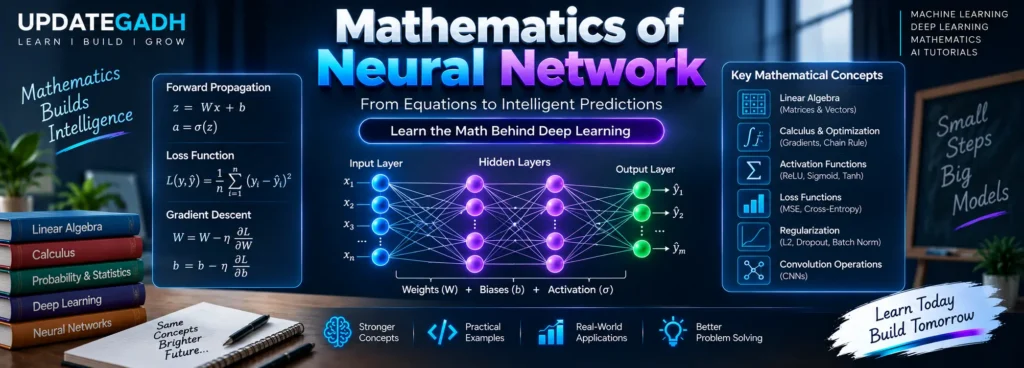
The standard architecture of a neural network includes:
- Input Layer: The raw data is sent to this layer.. Each neuron in this layer typically represents a feature or a dimension of the input vector.
- Hidden Layers: These intermediate layers process and transform the input using weighted connections and non-linear activation functions. Multiple hidden layers give the network its depth and capacity to learn complex representations.
- Output Layer: This produces the final prediction. The structure depends on the taskfor instance, a single neuron with a sigmoid activation for binary classification, or multiple neurons with softmax for multi-class tasks.
During training, the network adjusts internal parametersweights and biasesto minimize the error between its predictions and actual outcomes. This is typically achieved through gradient-based optimization, most commonly gradient descent.
Types of Neural Networks
Neural networks vary in architecture and use case:
- Feedforward Neural Networks (FNNs): The simplest form, where data flows in one directionno cycles or loops.
- Convolutional Neural Networks (CNNs): Ideal for image data, using convolutional layers to extract spatial features.
- Recurrent Neural Networks (RNNs): The network modifies internal parameters, such as weights and biases, during training in order to reduce the discrepancy between its predictions and actual results.
- Long Short-Term Memory Networks (LSTMs): A type of RNN that effectively captures long-term dependencies and mitigates the vanishing gradient problem.
Key Mathematical Concepts Behind Neural Networks
1. Linear Algebra: The Foundation
In order to represent inputs, weights, and transformations, neural networks mostly rely on matrices and vectors.During a forward pass, inputs are multiplied by weight matrices and shifted by biaseslinear algebra operations essential for computing neuron outputs layer by layer.
2. Matrix Multiplication
Matrix multiplication plays a pivotal role during forward propagation:
- Given two matrices, A (inputs) and B (weights), their product C = A × B represents the transformation from one layer to the next.
- This operation allows the network to calculate weighted combinations of input features.
3. Calculus and Optimization
Training a neural network involves finding the best weights and biases to minimize prediction error. This process uses:
- Gradient Descent: An optimization algorithm that updates parameters in the direction of the steepest decrease of the loss function.
- Derivatives: They indicate how much a small change in weights affects the loss. Calculating derivatives helps in adjusting weights to reduce the error.
4. Chain Rule: Backpropagations Backbone
The chain rule of calculus is central to backpropagation. It allows efficient computation of gradients through multiple layers by breaking down complex derivatives into simpler ones. This mechanism enables the network to learn from errors and improve over time.
5. Activation Functions: Introducing Non-Linearity
A neural network would act like a linear model in the absence of activation functions. Common non-linear functions include:
- Sigmoid: converts inputs into a 01 range.
- Tanh: Centers outputs around zero, improving convergence.
- ReLU (Rectified Linear Unit): effective and popular, particularly in deep networks.
These functions help the network learn complex, non-linear patterns in data.
6. Loss Functions: Measuring Performance
The difference between expected and actual values is measured by the loss function.It guides the optimization process. Common choices include:
- Mean Squared Error (MSE): for jobs involving regression.
- Cross-Entropy Loss: For classification problems.
Choosing the right loss function is critical for effective training.
7. Probability and Statistics: Modeling Uncertainty
Neural networks often output probabilities, especially in classification tasks. Statistical methods aid in:
- Maximum Likelihood Estimation (MLE): Helps in finding the most probable model parameters given the data.
- Bayesian Networks: By utilising probability distributions to express uncertainty in weights and predictions, conventional networks can be extended.
8. Regularization Techniques: Preventing Overfitting
When a model does well on training data but poorly on unseen data, this is known as overfitting.Regularization addresses this:
- L2 Regularization (Weight Decay): Penalizes large weights.
- Dropout:During training, neurones are randomly deactivated, compelling the network to provide robust and redundant features.
9. Batch Normalization: Stabilizing Learning
Batch normalization standardizes inputs to a layer by subtracting the mean and dividing by the standard deviation. This improves:
- Training speed
- Model stability
- Gradient flow
Its especially useful in deep networks where gradients can vanish or explode.
10. Learning Rate Scheduling: Fine-Tuning Optimization
The learning rate controls how big the steps are during optimization. Scheduling techniques help manage it effectively:
- Decay Schedules: Reduce the learning rate over time.
- Adaptive Methods (e.g., Adam): Adjust learning rates for each parameter individually, accelerating convergence.
11. Convolution Operations in CNNs
Convolution involves sliding a filter over the input and computing dot products with local regions. This operation:
- Captures spatial hierarchies in image data
- Preserves local features
- Reduces parameters compared to fully connected layers
Pooling layers follow to reduce dimensionality and enhance robustness.
Download New Real Time Projects :- Click here
Conclusion
Neural networks are not just black-box models; they are deeply rooted in mathematical theory. From linear algebra and calculus to probability and optimization, each concept contributes to their structure and function. Understanding these mathematical foundations not only demystifies how neural networks work but also empowers practitioners to design more effective, efficient, and interpretable models.
As artificial intelligence continues to evolve, a strong grasp of these principles will remain essential for anyone looking to build or refine neural network-based solutions.
mathematics of neural networks pdf
mathematics of neural networks book
the complete mathematics of neural networks and deep learning
a beginners guide to the mathematics of neural networks
neural network math example
neural network backpropagation math
mathematical model of artificial neural network
neural network lecture notes
mathematics of neural network notes
mathematics of neural network example
mathematics of neural networks pdf
mathematics of neural networks book
the complete mathematics of neural networks and deep learning
neural network math example
a beginners guide to the mathematics of neural networks
neural network backpropagation math
neural network code
neural network lecture notes
mathematics behind the neural network ppt
mathematics behind the neural network pdf
mathematics behind the neural network example