Time Series Evaluation Metrics
Introduction
In time series forecasting, choosing the right evaluation metric is as important as building the model itself. Metrics not only quantify prediction accuracy but also help in refining models to better suit business goals. From weather forecasting and stock price prediction to demand planning and inventory controlaccuracy determines real-world impact.
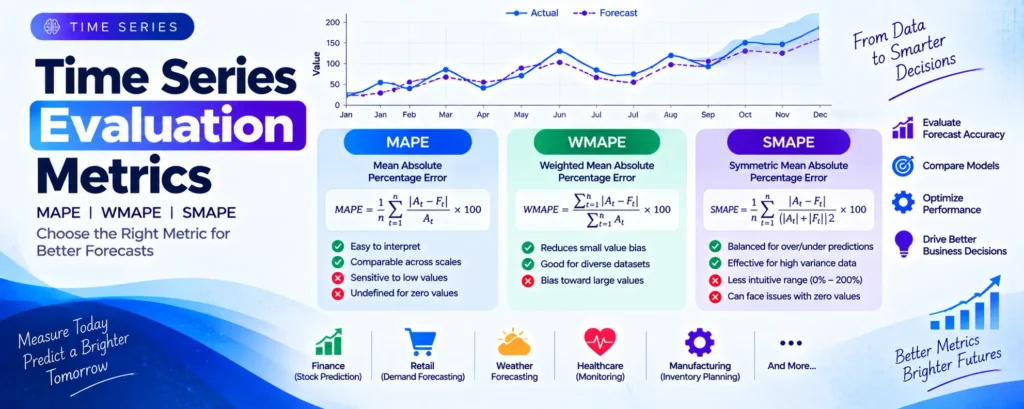
Among the most widely used metrics are Mean Absolute Percentage Error (MAPE), Weighted Mean Absolute Percentage Error (WMAPE), and Symmetric Mean Absolute Percentage Error (SMAPE).
- MAPE expresses forecast error as a percentage, making it easy to interpret, but can exaggerate errors when actual values are small.
- WMAPE adjusts for this by weighting errors according to actual values, reducing distortion from low-value data points.
- SMAPE normalises error using both actual and predicted values, giving a more balanced view of over- and under-predictions.
The right choice depends on the datasets characteristics and the goals of the analysis. Lets break them down.
Complete Advance AI Topics: Click Here
SQL Tutorial: Click Here
1. MAPE Mean Absolute Percentage Error
Definition:
MAPE measures the average absolute percentage difference between forecasted and actual values. Its one of the most popular metrics in forecasting due to its simplicity and intuitive interpretation.
Formula: MAPE=1nt=1nAtFtAt×100MAPE = frac{1}{n} sum\_{t=1}^{n} left| frac{A\_t – F\_t}{A\_t} right| times 100
Where:
- AtA\_t = Actual value
- FtF\_t = Forecast value
How it works:
For each observation, the absolute error is calculated as a percentage of the actual value, and then averaged across all observations.
Advantages:
- Easy to interpret Errors are expressed in percentage terms.
- Comparable across scales Works with different units and magnitudes.
Limitations:
- Division by zero problem Undefined if any actual value is zero.
- Highly sensitive to low values Small actual values can cause inflated percentage errors.
Best suited for:
Datasets with relatively large and consistent actual values.
2. WMAPE Weighted Mean Absolute Percentage Error
Definition:
WMAPE refines MAPE by weighting errors based on actual values. This prevents small actual values from disproportionately influencing the final metric.
Formula: WMAPE=t=1nAtFtt=1nAt×100WMAPE = frac{sum\_{t=1}^{n} |A\_t – F\_t|}{sum\_{t=1}^{n} A\_t} times 100
How it works:
Instead of simply averaging percentage errors, WMAPE divides the total absolute error by the total sum of actual values, making larger values more influential in the accuracy score.
Advantages:
- Reduces small value bias Less distortion from near-zero actuals.
- Good for diverse datasets Works well when actual values vary greatly.
Limitations:
- Bias toward large values May overemphasize accuracy for higher-value observations.
Best suited for:
Sales, revenue, and demand forecasting where the significance of an error depends on the size of the actual value.
3. SMAPE Symmetric Mean Absolute Percentage Error
Definition:
SMAPE modifies MAPE to make the metric symmetric, considering both actual and forecasted values in its calculation. This balances the penalty for over- and under-predictions.
Formula: SMAPE=1nt=1nAtFt(At+Ft)/2×100SMAPE = frac{1}{n} sum\_{t=1}^{n} frac{|A\_t – F\_t|}{(|A\_t| + |F\_t|)/2} times 100
How it works:
The absolute error is divided by the average of actual and forecast values, reducing skew when there are large discrepancies.
Advantages:
- Balanced treatment Equal penalty for over- and under-estimation.
- Effective for high variance data Handles datasets with wide fluctuations better than MAPE.
Limitations:
- Interpretation complexity Ranges from 0% to 200%, which can be less intuitive.
- Zero value issue Can still encounter challenges when both values are zero.
Best suited for:
Financial and economic forecasting where equal weighting of errors in both directions is important.
4. Comparison Table MAPE vs WMAPE vs SMAPE
| MetricFormula BaseRangeBest ForKey Weakness | ||||
|---|---|---|---|---|
| MAPE | % error from actual value | 0% | Datasets with stable, non-zero actual values | Inflated errors for small actuals |
| WMAPE | Weighted by sum of actuals | 0% | Datasets with varying magnitudes | Bias towards large values |
| SMAPE | Normalised by average of actual & forecast | 0% 200% | High variance datasets | Less intuitive range |
5. Practical Use Cases
- MAPE: General forecasting when all actual values are significantly above zero and interpretability is a priority.
- WMAPE: Business cases like retail sales or logistics forecasting where large value predictions carry more importance.
- SMAPE: Financial market predictions or economic indicators where balanced error handling is crucial.
Download New Real Time Projects : Click here
Conclusion
MAPE, WMAPE, and SMAPE each offer distinct advantages depending on the dataset and forecasting goals:
- MAPE is intuitive and easy to explain but struggles with low-value actuals.
- WMAPE adjusts for this, making it better for datasets with wide value ranges.
- SMAPE ensures fairness between over- and under-predictions, ideal for high-variance or volatile data.
Choosing the right metric is not about finding the best one universallyits about aligning the metric with your data characteristics and business objectives.
For stable datasets, MAPE might be all you need. For varied scales, WMAPE is more reliable. And for balanced evaluation across fluctuating data, SMAPE is the go-to choice.
At , our approach to forecasting always begins with selecting the right accuracy metricbecause better measurement leads to better decisions.
time series evaluation metrics in machine learning
time series evaluation metrics python
time series evaluation metrics example
explain performance evaluation with respect to time series forecasting
time series error metrics
autogluon-timeseries
forecast metrics
autogluon metrics time series evaluation metrics time series evaluation metrics in machine learning time series evaluation metrics Python time series evaluation metrics example time series error metrics time series forecasting metrics forecast evaluation metrics