Pooling In Convolutional Neural Networks
In the vast domain of artificial intelligence and deep learning, Convolutional Neural Networks (CNNs) have emerged as the foundation of modern image recognition systems. These powerful architectures owe much of their success to two fundamental operations: convolutions and pooling. When combined, they give machines the ability to accurately sense, process, and interpret visual information.
Lets explore these core concepts in detail and understand how they shape the capabilities of AI systems across industries.
Complete Advance AI Topics: Click Here
SQL Tutorial: Click Here
Convolutions: The Foundation of Feature Extraction
The input data is subjected to a collection of learnable filters, sometimes known as kernels, during a convolution operation. Though these filters are small spatially (such as 3×3 or 5×5), they span the full depth of the input and scan across the image to detect localized patterns like edges, textures, and shapes.
Each filter acts as a specialized lens that focuses on a particular feature. It calculates a dot product between the filter values and the input’s overlapping region as it passes over the input image. The result is a feature map, which highlights the presence of specific visual patterns.
How Convolution Works
- The input image is passed over by the filter.
- The dot product between the input section and the filter is computed at each point.
- The outcome is saved in the feature map at the appropriate location.
- This process continues until all possible positions are covered.
Key Components of Convolution
- Filters/Kernels: These are the core of the convolution operation and are trained during learning to capture specific patterns.
- Feature Maps: The resulting output that shows where specific features appear in the image.
- Stride: Defines the step size of the filter as it moves over the image. Larger strides reduce the spatial dimensions.
- Padding: Involves adding borders to maintain the output size or control the feature map’s dimensions.
- Activation Function: Usually a non-linear function like ReLU is applied after convolution to introduce non-linearity.
Importance of Convolution in Deep Learning
Convolutional layers extract hierarchical features from the input. Early layers might detect edges, while deeper layers identify complex shapes and objects. This capability is what enables CNNs to perform tasks such as image classification, segmentation, and object detection with high precision.
Pooling: Efficient Downsampling
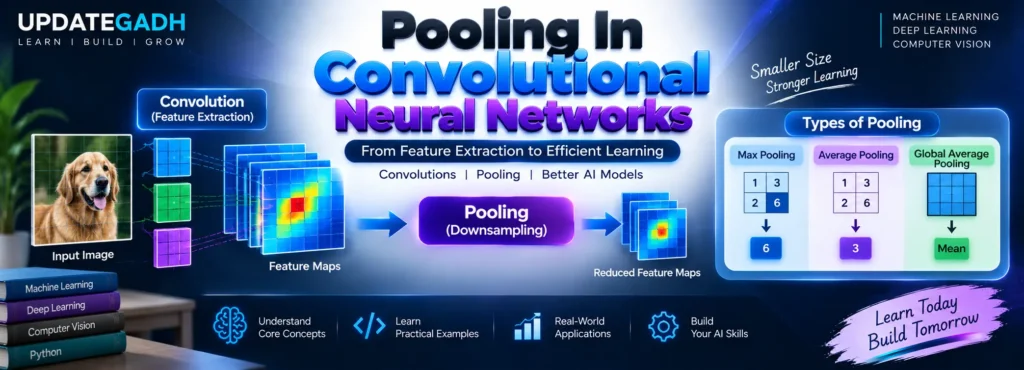
Pooling layers serve to progressively reduce the spatial size of feature maps. This downsampling reduces computing complexity and helps avoid overfitting by simplifying the data while maintaining the most important features.
Pooling condenses the feature maps into smaller representations, ensuring the model retains essential information and discards redundant details.
Types of Pooling
- Max Pooling: Selects the highest value in a pooling window. It emphasizes strong features and suppresses weaker responses.
- Average Pooling: Calculates the average of values within the window, resulting in a smoother and more generalized representation.
- Global Average Pooling: reduces the dimensions of the data by calculating the average of the entire feature map, which is frequently done before the last classification layer.
How Pooling Works
- The input is divided into non-overlapping windows (e.g., 2×2).
- Within each window, a pooling operation (average or maximum) is carried data.
- The outcomes are utilised to create a new, more compact feature map.
Key Components of Pooling
- Pooling Window Size: Common sizes include 2×2 or 3×3.
- Stride: Defines how far the pooling window moves each time. A larger stride results in more aggressive downsampling.
Role of Pooling in Neural Networks
Pooling layers help in:
- Reducing the number of parameters.
- Increasing computational efficiency.
- Enhancing feature robustness.
- Enabling deeper network structures by shrinking spatial dimensions.
Convolutions and Pooling: A Dynamic Duo
Visualize convolutions as detectives examining a scene with magnifying glasses, identifying intricate patterns like edges or curves. Pooling, on the other hand, acts like a planner summarizing these observations, picking only the most important details.
While convolutions capture fine-grained features, pooling simplifies the scene, retaining critical information and discarding less relevant parts. This synergy allows CNNs to build powerful, hierarchical representations from raw data.
Real-World Applications
The combined power of convolutions and pooling has driven innovation across numerous sectors:
- Image Classification
CNNs are at the heart of systems that categorize images from facial recognition to object classification enabling applications in security, e-commerce, and autonomous vehicles. - Medical Imaging
In healthcare, CNNs analyze X-rays, MRIs, and CT scans to detect tumors, classify tissues, and support diagnostic decisions. Pooling helps by minimizing noise and refining critical features. - Natural Language Processing (NLP)
Though CNNs originated in image processing, theyre also effective in NLP. Convolutions detect local patterns in text (like phrases), while pooling summarizes them into meaningful global features. - Video Analysis
CNNs process video frame-by-frame for action recognition, surveillance, and video summarization. Pooling ensures that the network remains computationally efficient without losing important temporal information. - Autonomous Systems
From self-driving cars to delivery drones, CNNs help machines interpret their surroundings. Convolutions extract features like lane markings or pedestrians, and pooling reduces complexity to support real-time decisions. - Virtual & Augmented Reality (VR/AR)
CNNs enhance user experiences in VR/AR by interpreting environments, tracking movements, and overlaying digital content accurately. - Financial Forecasting
In finance, CNNs analyze time-series data for market trend prediction, fraud detection, and risk analysis. The convolutional layers identify key patterns while pooling refines the signal.
Download New Real Time Projects :- Click here
Conclusion
Convolutions and pooling are the cornerstone operations in modern neural network architectures, especially in CNNs. Their combined functionality allows machines to learn robust, hierarchical features from raw data, paving the way for intelligent systems across industries.
As deep learning evolves, understanding these building blocks becomes essential not just for researchers and developers, but for anyone interested in how AI interprets and interacts with the world around us.
types of pooling in cnn
max pooling in cnn
average pooling in cnn
min pooling in cnn
pooling methods in deep neural networks, a review
types of pooling layers
fully connected layer in cnn
max pooling example
max pooling in convolutional neural networks
pooling in convolutional neural networks geeksforgeeks
pooling in convolutional neural networks example