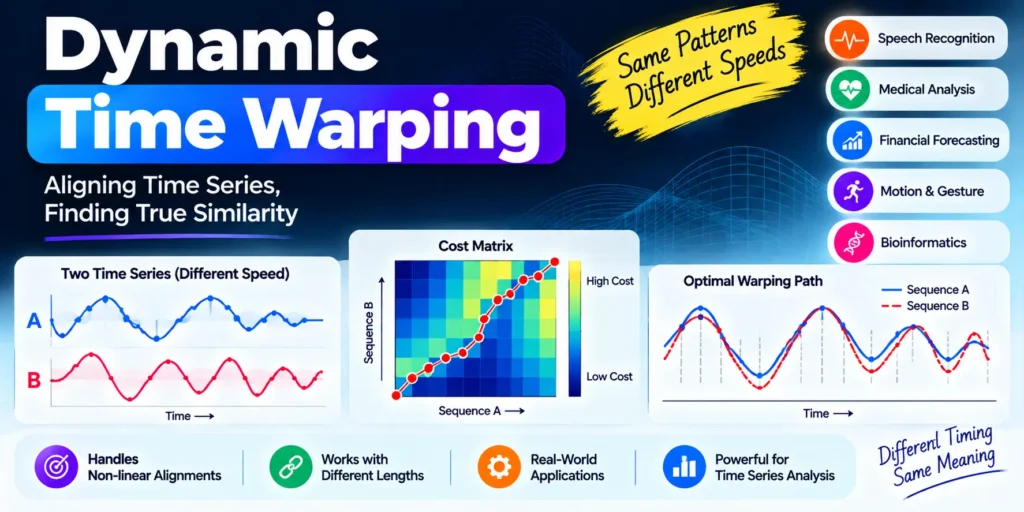
Dynamic Time Warping
Dynamic Time Warping (DTW) is a powerful algorithm primarily used to measure similarity between temporal sequences that may vary in time or speed. Originally developed for speech recognition, DTW has evolved into a versatile tool with applications in bioinformatics, data mining, medical diagnostics, and financial analysis. Its strength lies in its ability to compare time series data that are not perfectly aligned or occur at different rates.
In this article, we’ll explore what DTW is, how it works, its key applications, advantages and limitations, and how it compares to other similarity measures.
Complete Advance AI Topics: Click Here
SQL Tutorial: Click Here
What is Dynamic Time Warping?
Dynamic Time Warping (DTW) is an algorithm that computes an optimal alignment between two time-dependent sequences. Unlike traditional similarity measures such as Euclidean distance, DTW allows for non-linear alignments by “warping” the time axis. This means it can accurately align sequences even when they are out of sync, stretched, or compressed over time.
Why Do We Need DTW?
In real-world data, sequences often vary in timing. Whether it’s speech spoken at different speeds, stock prices that move asynchronously, or biological sequences of varying length, conventional similarity measures fail to capture such temporal distortions. DTW solves this by aligning the sequences in a way that minimizes overall difference, regardless of their speed or duration.
Real-World Examples:
- Speech Recognition: DTW matches audio recordings of the same word spoken at different speeds.
- Motion Analysis: Used to compare gestures or movements, such as athletes performing the same action at different tempos.
- Bioinformatics: Aligns DNA or protein sequences where similar patterns may occur at shifted positions.
- Financial Markets: Detects similar trends in stock movements that occur over different time frames.
How DTW Works
DTW finds the best alignment between two sequences through the following steps:
1. Compute the Cost Matrix
Given sequences A and B, a cost matrix is created where each cell (i,j) represents the squared difference between A[i] and B[j]. This matrix forms the basis for identifying optimal alignment.
2. Determine the Warping Path
The warping path is a sequence of matrix cells that defines how the elements of A and B align. This path must begin at the bottom-left of the matrix and end at the top-right, allowing for insertions, deletions, and matches.
3. Apply Dynamic Programming
DTW computes the minimum cumulative distance using:
D(i,j) = cost(i,j) + min(D(i-1,j), D(i,j-1), D(i-1,j-1))This recursive formula ensures the path chosen minimizes the total cost across the matrix.
4. Backtrack to Find the Optimal Path
Once the matrix is filled, DTW backtracks from the top-right to the bottom-left to determine the optimal alignment between the two sequences.
5. Normalize (Optional)
To make distances comparable across sequences of varying lengths, the total cost can be normalized by the length of the warping path.
Applications of DTW
1. Speech and Audio Recognition
DTW aligns audio waveforms regardless of speech speed, allowing robust word or phoneme matching in voice recognition systems.
2. Handwriting and Signature Verification
DTW matches signatures by analyzing the trajectory of pen movements over time, accounting for speed and pressure variations.
3. Bioinformatics and Genomics
It compares biological sequences, such as gene expression data or protein folding paths, which may not align perfectly in sequence.
4. Gesture and Motion Recognition
In robotics and animation, DTW helps compare movement patterns, even if performed at different speeds or by different individuals.
5. Financial and Economic Analysis
DTW aligns stock price trends or economic indicators that may evolve over different time frames or speeds.
6. Health Monitoring
DTW is used in ECG or EEG pattern analysis to detect abnormalities by comparing patient data with reference patterns.
Advantages of DTW
- Handles Non-linear Distortions: Adapts to variations in timing and speed.
- No Need for Equal Length: Works with sequences of different sizes.
- Intuitive Results: Produces meaningful alignments for real-world time series.
Limitations of DTW
- High Computational Cost: Has time and space complexity of O(N×M), where N and M are sequence lengths. FastDTW is an efficient approximation.
- Sensitive to Noise: Noise in data can mislead the alignment.
- Limited Interpretability: Complex warping paths can make interpretation difficult in large datasets.
DTW vs. Other Similarity Measures
1. DTW vs. Euclidean Distance
- Euclidean: Assumes point-to-point alignment and equal timing.
- DTW: Allows flexible alignment across time.
Use DTW when timing is inconsistent or sequences vary in speed.
2. DTW vs. Pearson Correlation
- Pearson: Measures linear relationship, sensitive to overall trends.
- DTW: Focuses on shape alignment, not linear trends.
Use DTW for pattern comparison; Pearson for trend similarity.
3. DTW vs. Cross-Correlation
- Cross-Correlation: Best for constant time lags.
- DTW: Adapts to non-uniform time shifts.
Use DTW when variable timing differences exist.
4. DTW vs. Cosine Similarity
- Cosine: Compares angular similarity in shape.
- DTW: Aligns sequences based on timing and shape.
Use DTW when exact timing is critical.
5. DTW vs. Hamming Distance
- Hamming: Suitable for categorical, aligned sequences.
- DTW: Handles real-valued sequences with non-linear time differences.
Use DTW for continuous, temporally distorted data.
Download New Real Time Projects : Click here
Conclusion
Dynamic Time Warping is an essential tool for comparing time series data where timing may vary. While it comes with computational and interpretability challenges, its adaptability makes it ideal for tasks involving speech, finance, bioinformatics, and health monitoring. Understanding how and when to use DTW enables professionals to extract deeper insights from complex temporal data.
As time series analysis becomes more integral to modern data science, mastering DTW equips you with a flexible, powerful method for handling real-world variability in sequential data.
dynamic time warping python
dynamic time warping matlab
dynamic time warping in speech recognition
dynamic time warping machine learning
dynamic time warping example
dynamic time warping paper
dynamic time warping in r
dynamic time warping sklearn
hidden markov model
dbscan
dynamic time warping github