Deep Generative Models
In the world of artificial intelligence, one of the most transformative developments in recent years is the rise of Deep Generative Models (DGMs). These advanced neural networks are designed to generate new data samples that closely resemble a given training dataset. From generating hyper-realistic images to composing original music or simulating human-like text, DGMs are changing the way we think about creativity, data augmentation, and machine learning.
This article provides a professional and approachable overview of deep generative models, exploring their key types, real-world applications, core concepts, and associated challenges.
Table of Contents
Complete Advance AI Topics: Click Here
SQL Tutorial: Click Here
What Are Deep Generative Models?
Deep Generative Models are a class of neural networks that learn the underlying structure of input data in order to generate new, similar samples. Unlike discriminative models that are used for tasks like classification or regression, generative models focus on learning the probability distribution of a dataset. Once trained, they can generate new content that statistically resembles the original input whether that be images, text, sound, or even more abstract data types.
These models have become central in domains such as natural language processing, computer vision, reinforcement learning, and synthetic data generation, and have rapidly grown into one of the most actively researched areas in AI.
Key Types of Deep Generative Models
Deep generative modeling encompasses several powerful architectures, each with unique strengths and design philosophies.
1. Variational Autoencoders (VAEs)
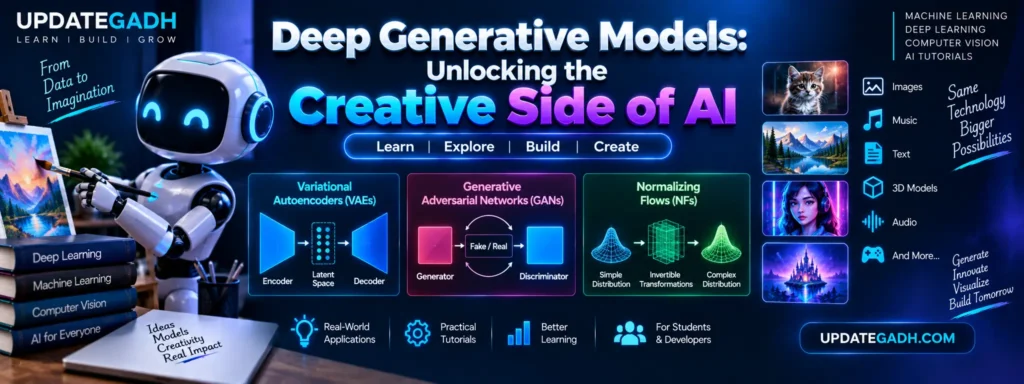
VAEs combine the principles of probabilistic inference and autoencoders. They compress input data into a low-dimensional latent space and then reconstruct it through decoding. What makes VAEs particularly useful is their ability to learn smooth, interpretable latent spaces, which can be used to generate new data points by sampling from a learned distribution.
VAEs are especially effective for interpolation tasks blending attributes between two data samples, such as morphing one image into another with realism and continuity.
2. Generative Adversarial Networks (GANs)
Introduced by Ian Goodfellow, GANs are based on a unique adversarial training paradigm where two neural networks a generator and a discriminator compete with each other. The generator tries to produce convincing fake samples, while the discriminator attempts to distinguish fake data from real. Over time, this competition helps the generator produce strikingly realistic outputs.
GANs have been widely adopted in image synthesis, video generation, and style transfer, with applications ranging from game design to fashion modeling.
3. Normalizing Flows (NFs)
Normalizing Flows are a family of generative models that transform a simple distribution (such as a Gaussian) into a more complex one through a series of invertible functions. These transformations allow NFs to efficiently compute both likelihoods and generate new samples.
They are particularly useful in tasks that require precise control over the output distribution, including density estimation, Bayesian inference, and scientific simulations.
Why Deep Generative Models Matter
The significance of DGMs extends far beyond academic interest. They are becoming vital tools in many practical and emerging fields:
- Data Generation and Augmentation: Synthetic data created by DGMs enhances training datasets, especially in low-data regimes, improving model robustness and performance.
- Unsupervised Learning: DGMs uncover hidden structures in data without needing labeled examples, enabling deeper insights and pattern discovery.
- Anomaly Detection: By modeling what “normal” data looks like, DGMs can identify deviations useful in fraud detection, cybersecurity, and diagnostics.
- Privacy-Preserving Data Analysis: DGMs can generate data that mimics real datasets without revealing sensitive personal information.
- Transfer Learning: They facilitate knowledge transfer between domains, boosting performance when data in a new domain is limited.
- Creative Expression: From composing music to designing 3D assets, DGMs are powering a new era of AI-assisted creativity.
Applications: Beyond the Lab
Deep generative models are increasingly being integrated into real-world workflows:
- Image Generation: AI-generated portraits, artworks, and product mockups.
- Drug Discovery: Molecule generation for faster, cost-effective R&D in pharmaceuticals.
- Speech Synthesis: Creating natural-sounding voices for assistants and dubbing.
- Text Generation: Generating human-like articles, summaries, or chatbot responses.
- Simulation and Forecasting: Modeling complex systems in finance, weather, or logistics.
However, the powerful generative capabilities of these models also bring risks. The misuse of DGMs, particularly for creating deepfakes or synthetic misinformation, has sparked ethical concerns. Responsible usage and development practices are essential.
Challenges in Deep Generative Modeling
Despite their promise, DGMs face several key hurdles:
- Training Instability: Especially in GANs, balancing the generator and discriminator can be difficult, often leading to non-converging or oscillating behavior.
- Mode Collapse: Generators may produce limited variation, failing to capture the full data diversity.
- Evaluation Metrics: There’s a lack of universally accepted metrics to judge the quality and diversity of generative outputs.
- Scalability: Training DGMs on large or high-dimensional datasets requires immense computational resources.
- Interpretability: Understanding how and why certain outputs are generated remains an open research problem.
These challenges highlight the need for continued innovation, robust model design, and interdisciplinary collaboration to ensure that DGMs are both reliable and ethically used.
Download New Real Time Projects :- Click here
Conclusion
Deep Generative Models are reshaping the possibilities of AI by bridging the gap between data understanding and content creation. Their ability to simulate, create, and innovate makes them valuable across industries from entertainment and medicine to finance and research. As the field continues to evolve, the role of DGMs will only grow more prominent, promising a future where AI not only learns from data, but also imagines new ones.
At , we believe in showcasing the transformative power of technology and deep generative models are among the most exciting frontiers today.
deep generative models 2024
deep generative models in deep learning – geeksforgeeks
deep generative models github
deep generative models examples
deep generative models course
deep generative models mit
deep generative models iisc