
Gaussian Distribution
Introduction
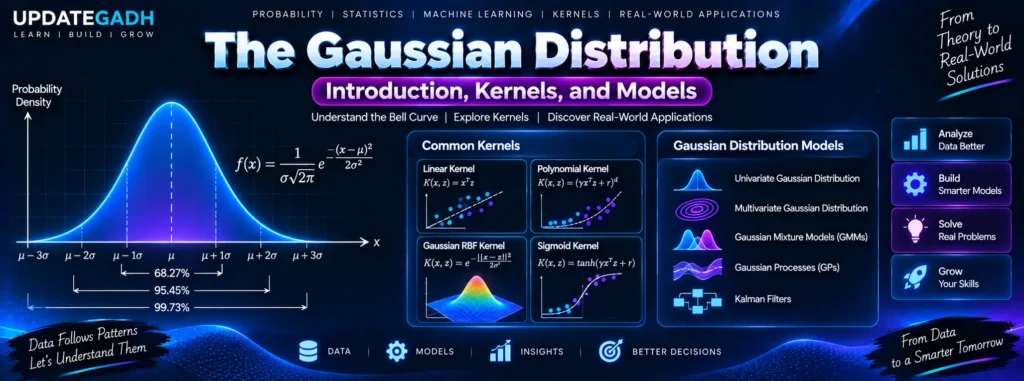
The Gaussian distribution, also known as the normal distribution, is a cornerstone concept in probability theory and statistics. Visually, it appears as a symmetrical bell-shaped curve, with the mean (μ) at the center and the standard deviation (σ) controlling the spread.
From artificial intelligence and materials science to finance, design, and data modeling, the Gaussian distribution finds broad application. It plays a critical role in hypothesis testing, confidence interval estimation, and regression analysis. Due to its elegant shape and mathematical tractability, it also serves as a reliable approximation for various real-world phenomena, including measurement errors, natural behaviors, and population distributions.
Complete Advance AI Topics: Click Here
SQL Tutorial: Click Here
Key Features of the Gaussian Distribution
- Symmetry: The distribution is perfectly symmetrical around its mean. The values on either side mirror each other, reflecting consistent probability density.
- Unimodal Peak: It has a single peak, located at the mean. As we move away from the mean in either direction, the probability density tapers off.
- Equal Mean, Median, and Mode: In a Gaussian distribution, the mean, median, and mode are all equal, emphasizing its balanced structure.
- The Central Limit Theorem (CLT) states that even in cases when the initial variables are not normally distributed, the sum of numerous independent and identically distributed random variables tends to follow a normal distribution.
- Controlled Spread via Standard Deviation: The bell curve’s width or narrowness is determined by the standard deviation (σ). A higher σ means greater variability and a flatter curve.
- Variance Additivity: When combining two independent random variables, the variance of the resulting distribution is the sum of their individual variances.
- Infinite Support: The Gaussian distribution spans the entire real number line, from negative to positive infinity, making it suitable for continuous variables with no fixed bounds.
Mean, Variance, and Standard Deviation
- Mean (μ): Indicates the central tendency or “average” value. The mean also functions as the median and mode for a normal distribution.
- Variance (σ²): Measures the spread of data around the mean. Lower variance implies that data points are closely clustered around the mean.
- Standard Deviation (σ): The square root of variance, indicating how much on average each data point deviates from the mean.
Applications in Statistics and Probability
1. Parameter Estimation
The Gaussian distribution is pivotal in methods like Maximum Likelihood Estimation (MLE) and least-squares fitting, which calculate unknown values (mean, variance) from sample data.
2. Hypothesis Testing
Statistical tests such as t-tests and ANOVA often assume normality to draw inferences about population parameters using sample data.
3. Confidence Intervals
Gaussian distributions form the foundation for confidence interval construction, providing a range in which a population parameter is likely to lie.
4. Regression Analysis
It is expected that residuals, or mistakes, in linear regression have a normal distribution with a mean of zero. Estimation, prediction, and model evaluation are made easier by this assumption.
5. Quality Control
In manufacturing and process control, tools like control charts and capability analysis rely on normal distribution assumptions to monitor deviations from desired performance standards.
Overview of Kernels
In high-dimensional feature spaces, kernels are mathematical functions that quantify how similar data points are to one another. They enable algorithms to transform data into a space where complex, nonlinear relationships become easier to identify.
In machine learning, kernels are core to techniques such as Support Vector Machines (SVMs) and Kernel Ridge Regression. These methods implicitly map data into a higher-dimensional space where linear models can be applied to solve nonlinear problems.
Common Kernel Types:
1. Linear Kernel
Computes the inner product of input vectors. Best suited for linearly separable data and offers computational efficiency.
2. Polynomial Kernel
Introduces polynomial features into the dataset. It captures interactions of varying degrees depending on the selected polynomial order.
3. Gaussian RBF Kernel
Measures similarity based on Euclidean distance, making it ideal for capturing nonlinear relationships. The function decays with distance, focusing on local structures in the data. Controlled by the parameter σ, which determines the kernels width.
4. Sigmoid Kernel
Derived from the hyperbolic tangent function, this kernel maps input into a higher-dimensional space. Often used in neural networks, it is sensitive to parameter choices and may require careful tuning.
Gaussian Distribution Models
1. Univariate Gaussian Distribution
Models a single random variable. Defined by its mean and standard deviation, its widely used for continuous data in disciplines such as biology, finance, and physics.
2. Multivariate Gaussian Distribution
Extends the univariate case to multiple correlated variables. Characterized by a mean vector (μ) and a covariance matrix (Σ), its essential in fields like signal processing and econometrics.
3. Gaussian Mixture Models (GMMs)
Data is modelled by GMMs as a combination of several Gaussian components, each of which represents a subpopulation. They are employed in unsupervised learning, density estimation, and clustering.
4. Gaussian Processes (GPs)
GPs are a non-parametric, Bayesian approach to learning distributions over functions. Particularly powerful for regression, classification, and optimization, they provide uncertainty estimates for predictions.
5. Kalman Filters
A recursive method for estimating the internal state of a dynamic system, especially under noisy measurements. Kalman filters assume both the system and measurement errors follow a Gaussian distribution. Widely used in navigation, tracking, and control systems.
Download New Real Time Projects :- Click here
Final Thoughts
The Gaussian distribution, with its deep theoretical foundation and extensive practical relevance, is an indispensable tool across disciplines. Its integration with kernel methods and advanced modeling techniques such as GMMs, GPs, and Kalman filters only deepens its utility in modern data science and engineering.
At , we believe that understanding these foundational concepts empowers professionals to build more accurate, robust, and interpretable modelsdriving smarter decisions in an increasingly data-driven world.
gaussian kernel
gaussian kernel formula
gaussian kernel python
gaussian kernel example
gaussian kernel function
gaussian kernel matrix
gaussian convolution kernel
gaussian kernel image processing
the gaussian distribution introduction kernels and models pdf
gaussian distribution formula
gaussian distribution pdf
gaussian distribution mean and variance
gaussian distribution vs normal distribution
pdf of normal distribution formula
normal distribution examples and solutions
cdf of normal distribution
5 properties of normal distribution
poisson distribution
normal distribution
gaussian distribution ppt
gaussian distribution python