
Introduction
In todays data-driven world, the complexity of real-world data often defies the assumptions of traditional statistical techniques. Thats where hierarchical modeling, also known as multilevel modeling, comes into play. It is a powerful statistical method used to analyze data that has a nested or grouped structure, such as students within classrooms, patients within hospitals, or repeated measurements over time within individuals.
Hierarchical modeling is especially useful when data points are not entirely independent but are grouped in some meaningful way. By accounting for the structure and variation at multiple levels, hierarchical models provide more accurate and insightful results compared to traditional models that assume independence across all observations.
At its core, hierarchical modeling incorporates fixed effects (which capture the influence of predictors common across all groups) and random effects (which capture variations specific to individual groups or clusters). This dual structure allows researchers to better understand both the general trends and the group-specific nuances within their data.
Hierarchical models are widely applied across fields such as education, healthcare, ecology, sociology, and economics. For instance, in education research, these models can assess how both student-level and school-level factors contribute to academic performance.
Both Bayesian and frequentist frameworks can be used to build hierarchical models, each offering distinct approaches to estimation and inference. Popular tools for implementing these models include R (e.g., lme4, brms), Python (e.g., PyMC3, statsmodels), and Stan, among others.
Complete Advance AI Topics: Click Here
SQL Tutorial: Click Here
Levels of Hierarchical Models
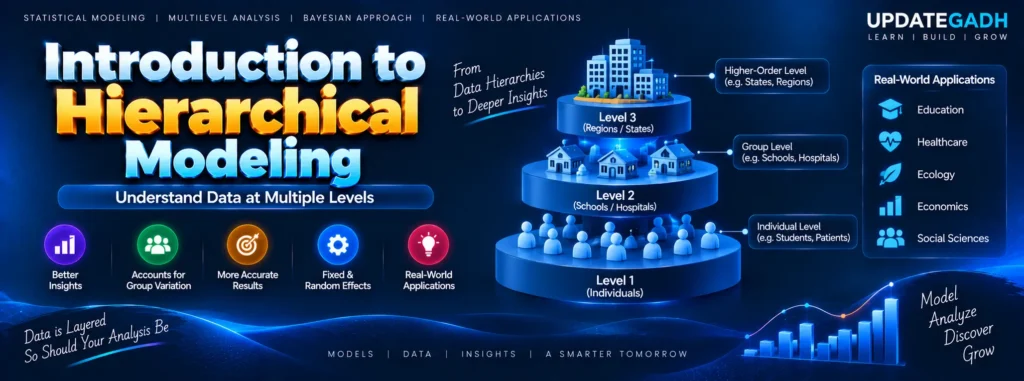
Understanding hierarchical models begins with recognizing the structure of the data, which typically involves multiple levels:
Level 1: Within-Group or Individual Level
This is the base level, representing individual observations. Examples include:
- Students within classrooms
- Patients within hospitals
- Time points within individuals
At this level, variability captures individual-level differences within groups.
Level 2: Group or Intermediate Level
This level aggregates multiple Level 1 units. Examples:
- Classrooms within schools
- Hospitals within healthcare systems
- Households within communities
Random effects are often introduced at this level to account for differences between groups.
Level 3: Higher-Order Group Level
A level beyond Level 2 that clusters intermediate groups. Examples:
- Districts of schools
- Regional health authorities
- States within a country
This level allows for modeling broader structural variations across larger clusters.
Additional Levels
In more complex scenarios, additional layers may be added to capture higher-order aggregations, such as:
- Regions of nations
- Industries within economies
- Continents within global studies
Each added level helps in capturing variability at increasingly abstract scales.
Applications of Hierarchical Modeling
Social Sciences
In fields like education and sociology, hierarchical models allow researchers to understand how both individual-level and group-level variables influence outcomes. For instance:
- Evaluating student performance based on personal and school-level attributes
- Studying social behavior by modeling individuals within families or neighborhoods
Medical Research
Hierarchical modeling is essential in analyzing healthcare data:
- Modeling disease prevalence across hospitals or regions
- Assessing treatment effectiveness across multiple clinical centers
- Improving generalizability and robustness in clinical trials
Ecology
In environmental and ecological studies:
- Modeling animal populations nested within habitats and regions
- Analyzing pollutant levels measured at different sites across time and geography
Hierarchical models support multi-scale ecological inference.
Economics and Business
In labor economics and market analysis:
- Studying wage determinants for employees nested within companies
- Modeling consumer behavior within households and regions
- Capturing firm-level and industry-level variations in performance
Public Health
Hierarchical models help evaluate health service delivery and community-based interventions:
- Assessing patient outcomes across hospitals and healthcare systems
- Evaluating community health programs across administrative regions
Tools and Software for Hierarchical Modeling
R
- lme4
For linear and generalized linear mixed-effects models.
Strengths: Efficient and widely used, especially withlmer()andglmer()functions. - brms
A Bayesian modeling package that uses Stan as the backend.
Strengths: Flexible syntax, excellent diagnostics, and suitable for complex models. - nlme
Older package for linear and nonlinear mixed-effects models.
Strengths: Great for continuous data and advanced correlation structures.
Python
- statsmodels
Offers classes for linear mixed-effects models.
Strengths: Integrates well with pandas and is beginner-friendly. - PyMC3
A probabilistic programming library for Bayesian hierarchical models.
Strengths: Highly customizable and well-suited for MCMC-based inference. - TensorFlow Probability
A library for statistical modeling built on TensorFlow.
Strengths: Scalable, integrates well with deep learning models.
Stan
A high-performance probabilistic programming language for statistical modeling.
Strengths: Efficient sampling and inference methods; integrates with R, Python, and more.
SAS
Robust commercial software supporting a variety of mixed-effects models.
Strengths: Trusted in both academia and industry for advanced statistical modeling.
SPSS
User-friendly software for general linear and hierarchical models.
Strengths: Ideal for users preferring a GUI over coding; intuitive design.
Download New Real Time Projects :- Click here
Conclusion
Hierarchical modeling is a critical tool in modern data analysis, especially when dealing with structured, nested, or grouped data. By accounting for both within-group and between-group variability, it provides richer insights and more reliable conclusions than traditional methods.
Whether you’re working in education, medicine, ecology, business, or public health, hierarchical models can unlock a deeper understanding of your data. Tools like R, Python, Stan, and SPSS make it easier than ever to implement these models, regardless of your preferred programming environment.
As data structures continue to grow in complexity, hierarchical modeling will remain a cornerstone of thoughtful, statistically sound analysis.
hierarchical model example
bayesian hierarchical model
hierarchical model psychology
hierarchical models machine learning
hierarchical model statistics
hierarchical model key features
hierarchical linear modeling
hierarchical model advantages and disadvantages
introduction to hierarchical modeling ppt
introduction to hierarchical modeling pdf
introduction to hierarchical modeling notes