Skip to content
  • SiteMap
  • Our Services
  • Frequently Asked Questions (FAQ)
  • Support
  • About Us

UpdateGadh

Update Your Skills.

  • Home
  • Projects
    •  Blockchain projects
    • Python Project
    • Data Science
    •  Ai projects
    • Machine Learning
    • PHP Project
    • React Projects
    • Java Project
    • SpringBoot
    • JSP Projects
    • Java Script Projects
    • Code Snippet
    • Free Projects
  • Tutorials
    • Ai
    • Machine Learning
    • Advance Python
    • Advance SQL
    • DBMS Tutorial
    • Data Analyst
    • Deep Learning Tutorial
    • Data Science
    • Nodejs Tutorial
  • Blog
  • Contact us
  • Toggle search form
AutoEncoder vs Variational AutoEncoder

AutoEncoder vs Variational AutoEncoder

Posted on June 20, 2025 By Rishabh saini No Comments on AutoEncoder vs Variational AutoEncoder

AutoEncoder vs Variational AutoEncoder

In the evolving landscape of machine learning and artificial intelligence, Autoencoders (AE) and Variational Autoencoders (VAE) stand out as powerful unsupervised learning tools. While both are neural network-based architectures used for feature extraction, dimensionality reduction, and generative modeling, their inner workings and capabilities differ significantly.

Whether you’re working on compressing data or generating new images from learned distributions, understanding the differences between AE and VAE is crucial. Let’s dive into what sets them apart.

Machine Learning Tutorial:-Click Here
Data Science Tutorial:-Click Here
Complete Advance AI topics:- CLICK HERE
DBMS Tutorial:-CLICK HERE

🔍 What is an Autoencoder?

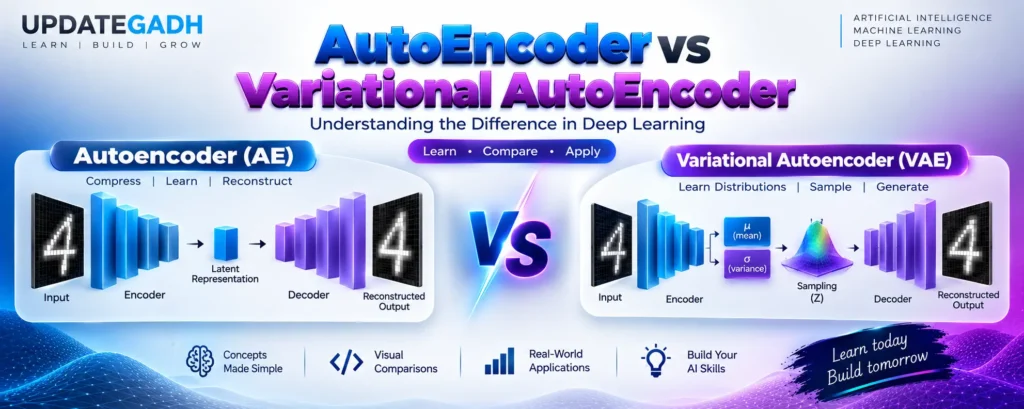
An Autoencoder is a type of artificial neural network designed to learn a compact representation of input data—typically for tasks like data compression, noise reduction, or feature extraction. It consists of two primary components:

  • Encoder: Transforms input data into a compressed, lower-dimensional latent representation.
  • Decoder: Reconstructs the original data from this latent space.

The autoencoder learns by minimizing the difference between the input and the reconstructed output. This is often done using Mean Squared Error (MSE), a simple loss function that quantifies how closely the output matches the input.

Loss Function (AE): Error=1N∑i=1N∥Xi−X^i∥2\text{Error} = \frac{1}{N} \sum_{i=1}^{N} \| X_i – \hat{X}_i \|^2

This structure makes AEs useful in scenarios where identifying hidden patterns or compressing data is key.

🎲 What is a Variational Autoencoder?

A Variational Autoencoder (VAE) is an advanced version of the traditional autoencoder with a twist—it introduces a probabilistic layer into the model.

VAEs learn a distribution over the latent space, typically modelled as a Gaussian (normal) distribution with a mean and variance, as opposed to learning a single fixed latent representation. During training, the model takes samples from the parameters of this distribution that are output by the encoder. To keep the distribution near a conventional normal, Kullback-Leibler (KL) Divergence is used to regularise this sampling.

Loss Function (VAE): Error(VAE)=−EQ(Z∣X)[log⁡P(X∣Z)]+DKL(Q(Z∣X)∥P(Z))\text{Error(VAE)} = -\mathbb{E}_{Q(Z|X)}[\log P(X|Z)] + D_{KL}(Q(Z|X) \| P(Z))

This approach enables VAEs to generate new, unseen data by sampling from the latent space, making them powerful tools for generative tasks such as image synthesis and data augmentation.

🧭 Key Differences: AE vs. VAE

FeatureAutoencoder (AE)Variational Autoencoder (VAE)
ObjectiveCompress and reconstruct input dataModel data distribution and generate new samples
Latent SpaceFixed and deterministicProbabilistic; modeled as a distribution
Loss FunctionReconstruction loss (e.g., MSE)Combination of reconstruction loss + KL divergence
SamplingNot applicable; deterministic encodingSamples from latent space during training
Generative AbilityLimited; can’t generate novel dataHigh; can generate new data points
ApplicationsDenoising, dimensionality reduction, feature extractionImage synthesis, generative modeling, data augmentation

Complete Python Course with Advance topics:-Click Here
SQL Tutorial :-Click Here

Download New Real Time Projects :-Click here

Conclusion

Autoencoders and Variational Autoencoders share a foundational principle—learning to encode and decode data. However, their purpose, design, and capabilities diverge in important ways.

  • Use Autoencoders when your primary goal is to compress or clean data.
  • Choose VAEs when you need to generate new content or model data uncertainty.

Understanding these nuances helps you select the right model architecture for your machine learning workflow—whether you’re working on anomaly detection, generative art, or deep feature learning.

📚 For more deep dives into AI, machine learning, and neural networks, keep following Updategadh—your trusted platform for clear and professional tech insights.


autoencoder vs variational autoencoder
variational autoencoder paper
variational autoencoder tutorial
variational autoencoder explained
variational autoencoder loss function
variational autoencoder generative model
vq-vae
variational autoencoder math
autoencoder ae and variational autoencoder vae example
variational autoencoder paper
variational autoencoder loss function
variational autoencoder tutorial
variational autoencoder generative model
vq-vae
variational autoencoder math
introduction to variational autoencoders
compare and contrast variational autoencoders (vaes with standard autoencoders)
autoencoder
kl divergence
autoencoder vs variational autoencoder reddit
autoencoder vs variational autoencoder example
autoencoder vs variational autoencoder python
autoencoder vs variational autoencoder
adversarial autoencoder vs variational autoencoder
denoising autoencoder vs variational autoencoder
convolutional autoencoder vs variational autoencoder
sparse autoencoder vs variational autoencoder
masked autoencoder vs variational autoencoder
conditional variational autoencoder vs variational autoencoder
difference between variational autoencoder and autoencoder
variational autoencoder vs autoencoder
variational autoencoder vs convolutional autoencoder

    Post Views: 420
    Deep Learning Tutorial Tags:autoencoder, building variational autoencoder, difference autoencoder variational autoencoder, how variational autoencoder works, understanding variational autoencoder, variational auto encoder, variational autoencoder, variational autoencoder (vae), variational autoencoder decoder, variational autoencoder example, variational autoencoder generative model, variational autoencoder tutorial, variational autoencoders, what is variational autoencoder

    Post navigation

    Previous Post: Types of Databases
    Next Post: Best Online Shopping Store Web App in PHP

    More Related Articles

    Advanced Techniques for Fine-Tuning Transformers Advanced Techniques for Fine-Tuning Transformers Deep Learning Tutorial
    Deep Learning Tutorial Deep Learning Tutorial Deep Learning Tutorial
    Echo State Network Echo State Network Deep Learning Tutorial

    Leave a Reply Cancel reply

    Your email address will not be published. Required fields are marked *

    You may also like

    1. Introduction to 3D Deep Learning
    2. What is Geometric Deep Learning?
    3. Deep Stacking Network
    4. Introduction to Hierarchical Modeling
    5. Siamese Neural Networks
    6. What is the Difference Between DQN and DDQN

    Most Viewed Posts

    1. Top Large Language Models in 2025
    2. Online Shopping System using PHP, MySQL with Free Source Code
    3. login form in php and mysql , Step-by-Step with Free Source Code
    4. Flipkart Clone using PHP And MYSQL Free Source Code
    5. News Portal Project in PHP and MySql Free Source Code
    6. User Login & Registration System Using PHP and MySQL Free Code
    7. Top 10 Final Year Project Ideas in Python
    8. Blog Site In PHP And MYSQL With Source Code || Best Project
    9. Online Bike Rental Management System Using PHP and MySQL
    10. E learning Website in php with Free source code
    • AI
    • ASP.NET
    • Blockchain
    • ChatCPT
    • code Snippets
    • Collage Projects
    • Data Science Project
    • Data Science Tutorial
    • DBMS Tutorial
    • Deep Learning Tutorial
    • Final Year Projects
    • Free Projects
    • How to
    • html
    • Interview Question
    • Java Notes
    • Java Project
    • Java Script Notes
    • JAVASCRIPT
    • Javascript Project
    • JSP JAVA(J2EE)
    • Machine Learning Project
    • Machine Learning Tutorial
    • MySQL Tutorial
    • Node.js Tutorial
    • PHP Project
    • Portfolio
    • Python
    • Python Interview Question
    • Python Projects
    • PythonFreeProject
    • React Free Project
    • React Projects
    • Spring boot
    • SQL Tutorial
    • TOP 10
    • Uncategorized
    • Real-Time Medical Queue & Appointment System with Django
    • Online Examination System in PHP with Source Code
    • AI Chatbot for College and Hospital
    • Job Portal Web Application in PHP MySQL
    • Online Tutorial Portal Site in PHP MySQL — Full Project with Source Code

    Most Viewed Posts

    • Top Large Language Models in 2025 (8,616)
    • Online Shopping System using PHP, MySQL with Free Source Code (5,225)
    • login form in php and mysql , Step-by-Step with Free Source Code (4,875)

    Copyright © 2026 UpdateGadh.

    Powered by PressBook Green WordPress theme