
What is Multidimensional Scaling?
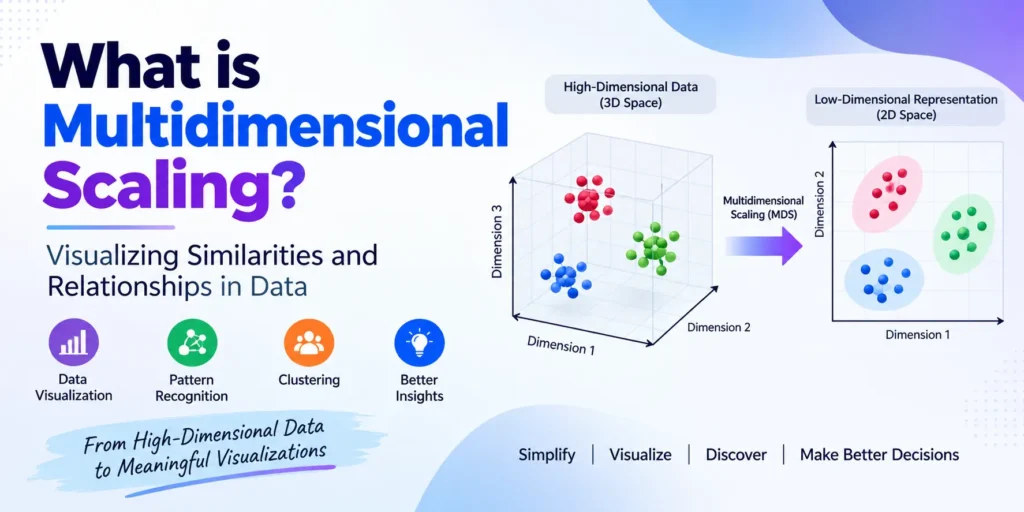
Multidimensional Scaling (MDS) is a statistical technique used to visualize the level of similarity or dissimilarity between a group of objects. It converts pairwise distances between data points into a lower-dimensional space, commonly two or three dimensions, making it easier to identify patterns, clusters, and relationships.
AI Powered Resume Screening System Using Python with NLP, Machine Learning, OCR, OpenCV, Streamlit, and SQLite to analyse and rank resumes.
Complete Advance AI Topics: Click Here
SQL Tutorial: Click Here
Understanding the Concept
The main idea behind MDS is to represent data points as objects in a geometric space, where the distance between objects indicates how similar or different they are. This method is especially useful when the data does not naturally have coordinate-based representations, such as consumer preferences, psychological perceptions, or qualitative survey responses.
How MDS Works
- Input Data (Dissimilarity Matrix): MDS starts with a dissimilarity matrix that represents the perceived distances between objects. These values can be exact, such as geographical distances, or abstract, such as similarity ratings collected through a survey.
- Choose the Number of Dimensions: A 2D or 3D space is generally selected because it is easier to visualize and interpret. Higher-dimensional spaces can preserve distances more accurately but are more difficult to understand.
- Optimization Process: The algorithm assigns coordinates to objects in the selected dimensional space. It attempts to minimize a stress function, which measures how accurately the distances in the reduced space represent the original dissimilarities. Iterative optimization methods are used to adjust the positions of objects until a suitable solution is obtained.
- Final Output: The resulting spatial map places similar objects closer together and dissimilar objects farther apart. This makes it easier to identify hidden patterns, clusters, and relationships within complex datasets.
Types of Multidimensional Scaling
1. Metric MDS (Classical MDS)
- Preserves actual numerical distances.
- Based on Principal Coordinate Analysis (PCoA) and eigenvalue decomposition.
- Works well with measurable distances, such as distances between cities.
- Useful for physical, financial, and scientific data where actual distance values are important.
2. Non-Metric MDS
- Focuses on preserving the rank order of similarities instead of exact distances.
- Suitable for ordinal data, such as consumer preferences or psychological rankings.
- Useful when precise numerical distance values are not available.
- Commonly applied in market research, psychology, and sociology.
3. Individual Differences Scaling (INDSCAL)
- Extends MDS to work with data collected from multiple individuals or groups.
- Captures both common structures and individual differences.
- Useful in consumer behavior research and cultural comparison studies.
4. Generalized MDS (GMDS)
- Can work with non-Euclidean and curved spaces.
- Useful in advanced fields such as computational biology, neuroscience, and geometry.
- Can represent nonlinear structures that traditional MDS may not capture effectively.
Steps in Multidimensional Scaling
- Collect and Prepare the Dissimilarity Matrix: Ensure that the data is properly organized, symmetric, and has zero values along the diagonal.
- Decide the Number of Dimensions: Select a suitable dimensionality, usually 2D or 3D for easier interpretation.
- Apply the MDS Algorithm: The algorithm assigns coordinates to the objects and attempts to minimize stress.
- Compute the Stress Value: A lower stress value generally indicates that the reduced-dimensional solution represents the original dissimilarities more effectively.
- Visualize the Results: Plot the final spatial map to identify clusters, similarities, and patterns.
- Validate the Solution: Examine stress values, compare the solution with other methods, and check its consistency with the research objective.
Applications of MDS
Market Research and Consumer Behavior
- Creates perceptual maps of brands and products.
- Helps identify market gaps and positioning strategies.
Psychology and Social Sciences
- Analyzes how people perceive emotions, colors, and social issues.
- Can be used in cognitive and clinical psychology research.
Bioinformatics and Genetics
- Visualizes genetic similarities and evolutionary relationships.
- Supports the analysis of DNA sequences and disease-related research.
Machine Learning and Data Science
- Reduces high-dimensional data into interpretable 2D or 3D representations.
- Supports clustering, pattern recognition, and feature similarity analysis.
Healthcare and Medical Research
- Helps identify groups of patients with similar symptoms.
- Can be applied in neuroscience, epidemiology, and clinical studies.
Linguistics and Text Analysis
- Studies relationships between languages, dialects, and word meanings.
- Can be used in semantic analysis and text mining.
Political Science and Sociology
- Maps ideological positions of political candidates or parties.
- Helps analyze social networks and group behaviors.
Advantages and Limitations
Advantages
- Provides an intuitive visual representation of complex relationships.
- Can work with both metric and non-metric data.
- Helps reveal hidden clusters and structures.
Limitations
- Can become computationally demanding when working with large datasets.
- Requires an appropriate choice of distance or dissimilarity measure.
- Interpretation can vary depending on the research domain and available knowledge.
Download New Real Time Projects: Click here
Conclusion
Multidimensional Scaling is a versatile statistical technique that simplifies the visualization of complex datasets by representing similarities and dissimilarities in an intuitive geometric space. It can be applied in areas such as market research, genetics, psychology, healthcare, linguistics, and political science to uncover patterns and relationships that may otherwise be difficult to identify.
For researchers, analysts, and data scientists, MDS is an important technique for transforming complex relationships into meaningful visual representations and gaining useful insights from data.
Related Multidimensional Scaling Questions
- Multidimensional scaling example
- What is multidimensional scaling in research methodology?
- Multidimensional scaling PDF
- Multidimensional scaling in psychology
- Multidimensional scaling PPT
- Types of multidimensional scaling
- Multidimensional scaling in SPSS
- Multidimensional scaling in marketing research
- What is multidimensional scaling with example?
- What is multidimensional scaling PDF?
- What is multidimensional scaling MDS?