
Introduction
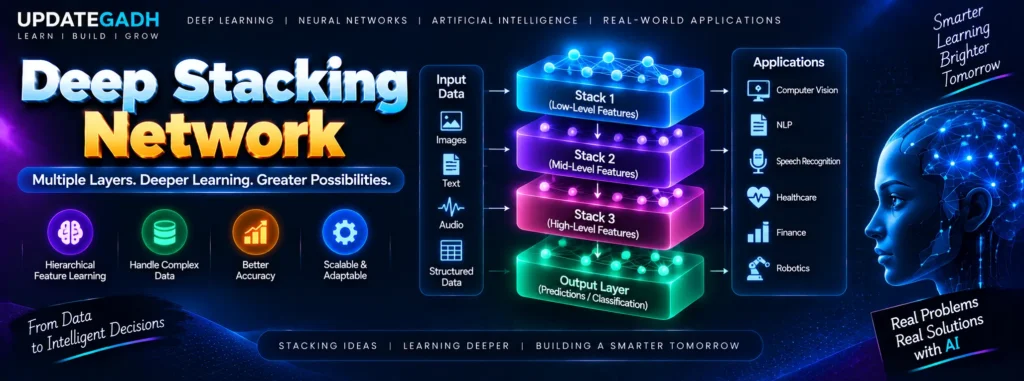
Deep learning continues to revolutionize various industries, and Deep Stacking Networks (DSNs) stand out as a powerful advancement in this field. Unlike traditional deep neural networks that utilize a single monolithic architecture, DSNs are designed using multiple stacked modules or blocks. Each stack is trained in a supervised or unsupervised manner and contributes to hierarchical feature learning.
This architectural strategy allows Deep Stacking Networks to handle more abstract, complex, and high-dimensional data with ease. By organizing networks into meaningful layers that learn progressively abstract representations, DSNs enhance a models ability to generalize, making them well-suited for tasks such as image recognition, natural language processing, and generative modeling.
Complete Advance AI Topics: Click Here
SQL Tutorial: Click Here
Why Deep Stacking Networks?
1. Hierarchical Feature Learning
DSNs inherently support hierarchical representation learning, enabling models to abstract features layer by layer from raw input. While traditional shallow networks often struggle with complex relationships in data, the stacked design of DSNs allows the model to construct deep, expressive representations that are more biased and feature-rich.
2. Handling Complex and High-Dimensional Data
In practical applications like medical diagnostics or financial forecasting, datasets are often intricate and multidimensional. DSNs thrive in these settings by leveraging layer-wise abstraction, enabling each layer to build upon the representations learned by the previous one. This leads to more meaningful modeling of real-world phenomena.
3. Improved Generalization and Accuracy
Deep stacking structures typically outperform shallow models in many areas including image classification, speech recognition, and text analytics. The added depth allows for capturing subtle patterns, improving accuracy without relying on handcrafted features.
4. Data-Driven Feature Engineering
Manual feature extraction can be time-consuming and domain-dependent. DSNs automate this process, learning features directly from unprocessed input. This not only saves time but also enhances adaptability in dynamic environments.
5. Scalability and Adaptability
Whether the data is structured, unstructured, text-based, audio, or visual, DSNs offer the flexibility to be customized to different tasks. Their modular architecture makes them easily scalable across domains.
Architecture of Deep Stacking Networks
Input Layer
The model receives raw data in the form of text, audio, images, or numerical entries. Each value represents a specific feature of the input sample.
Hidden Layers
The core of a DSN lies in its hidden layers, typically composed of fully connected or sparsely connected nodes. These layers apply linear transformations followed by nonlinear activation functions (e.g., ReLU, sigmoid, tanh) to extract increasingly abstract representations from the input.
Inter-Layer Connectivity
In fully connected DSNs, each unit in one layer connects to every unit in the next. This design enables deep integration of information across layers. Alternatives like sparse connections or skip connections can also be implemented to ease training, especially in very deep networks.
Output Layer
The final layer translates high-level features into predictions or classifications. Depending on the task, it might include softmax functions (for multiclass classification) or a linear unit (for regression).
Training Mechanism
DSNs are trained using backpropagation and gradient descent algorithms. Optimization techniques such as Adam, RMSProp, or Stochastic Gradient Descent (SGD) adjust weights to minimize a defined loss function. Regularization strategies like dropout, L1/L2 penalties, and batch normalization are used to enhance generalization.
Training a Deep Stacking Network
- Data Preprocessing: Normalize and encode features to stabilize training and speed up convergence.
- Initialization: Use schemes like Xavier or He initialization to avoid vanishing or exploding gradients.
- Forward Propagation: Input flows through layers, and activations are computed.
- Loss Calculation: Use appropriate loss functionscross-entropy for classification, mean squared error for regression.
- Backpropagation: Calculate gradients using the chain rule to adjust weights.
- Parameter Updates: Apply optimizers to update weights and biases.
- Regularization: Implement dropout, early stopping, or L2 regularization to prevent overfitting.
- Hyperparameter Tuning: Adjust learning rate, batch size, depth, and activation functions for optimal performance.
- Model Evaluation: Use unseen test data to validate generalization.
- Iteration: Repeat training cycles until convergence or a stopping criterion is met.
Applications of Deep Stacking Networks
1. Computer Vision
DSNs are applied in image classification, segmentation, and object detection. By learning directly from pixel data, they can identify detailed patterns and structures in images.
2. Natural Language Processing
In tasks such as sentiment analysis, named entity recognition, and machine translation, DSNs can extract both semantic and syntactic features, making them valuable for complex language models.
3. Speech Recognition
DSNs enhance automatic speech recognition systems by learning temporal and spectral features from raw waveforms or spectrograms, improving accuracy in voice-to-text tasks.
4. Healthcare
From disease prediction to medical imaging, DSNs support diagnostics by interpreting patient records and complex imaging data, enabling early interventions and personalized care.
5. Finance
In applications like fraud detection, risk assessment, and market forecasting, DSNs can identify irregular patterns and predict outcomes with high precision.
6. Robotics and Automation
For autonomous navigation, object manipulation, and robot control, DSNs allow machines to process environmental input and respond intelligently in real time.
Benefits and Challenges
Benefits
- Hierarchical Learning: DSNs extract high-level abstractions for improved decision-making.
- Improved Generalization: With better feature extraction, DSNs outperform traditional networks in real-world settings.
- Scalability: Suitable for handling large and complex datasets.
- Transfer Learning: Pre-trained DSNs can be adapted to new tasks with minimal retraining.
- Reduced Need for Manual Feature Engineering: Automatically extract features from raw data.
Challenges
- Vanishing/Exploding Gradients: Deep architectures may face gradient instability during training.
- Overfitting: Requires regularization and sufficient data to prevent memorizing instead of learning.
- Computational Cost: DSNs demand significant resources for training.
- Hyperparameter Tuning: Finding optimal configurations can be time-consuming.
- Interpretability: DSNs often act as black boxes, making it hard to explain predictions.
Download New Real Time Projects :- Click here
Conclusion
Deep Stacking Networks are at the forefront of modern AI applications, providing a scalable, adaptable, and efficient way to learn from high-dimensional and unstructured data. Their ability to extract hierarchical features, reduce reliance on manual engineering, and adapt across domains makes them an invaluable tool in todays data-driven world.
By embracing these architectures, organizations can push the boundaries of what’s possible in artificial intelligence, machine learning, and real-world automation.
deep stacking network
tensor deep stacking network
stacking deep set networks and pooling by quantiles
deep stack vs short stack poker
what is stacking in networking
layers of network stack
deep stacking networks
deep stacking network
stacking deep set networks and pooling by quantiles
deep stack vs short stack poker
what is stacking in networking
deep networks with stochastic depth