ER Design Issues in DBMS
In our earlier discussions on data modeling, we explored the design of Entity-Relationship (ER) diagrams, including the fundamentals of defining entity sets and their relationships. We also covered the various notations used to represent entities, attributes, and connections. However, despite having a basic understanding, many users often face challenges while applying these concepts in practice. These challenges arise primarily from misinterpreting the design elements, which leads to unnecessarily complex structures that fail to accurately reflect the real-world enterprise model.
In this article, we focus on some core ER design issues commonly encountered during schema creation:
Table of Contents
Complete Advance AI Topics: Click Here
SQL Tutorial: Click Here
1. Entity Set vs. Attribute
One frequent mistake is using an entity’s primary key as an attribute of another entity set, rather than establishing a proper relationship. This undermines the semantics of the data model. The choice between an attribute and an entity set should be based on the structure and meaning of the data being modeled. If a particular attribute has its own properties or can be independently identified, it should be modeled as an entity set, not just an attribute.
Additionally, while primary keys are implicitly part of relationship sets, it’s important to explicitly define them where clarity is needed.
2. Entity Set vs. Relationship Set
Another common issue arises when deciding whether to represent something as an entity set or as a relationship set. The key guideline here is to use a relationship set when describing an action or interaction between two or more entities. For instance, if you are modeling a works_on scenario between an employee and a project, it should be treated as a relationship rather than an entity set. Confusing the two leads to a muddled schema and potential loss of clarity in the models intent.
3. Binary vs. N-ary Relationship Sets
Most relationships in ER modeling are binary; that is, they involve two entities. However, certain real-world scenarios require relationships among three or more entities, leading to n-ary (e.g., ternary) relationships.
For example, consider a “parent” relationship involving a child, mother, and father. While this can be modeled as a ternary relationship, it’s also possible to decompose it into two binary relationships: motherchild and fatherchild. The decision depends on whether the association among all three entities holds specific semantics that can’t be captured by separate binary relationships
4. Placement of Relationship Attributes
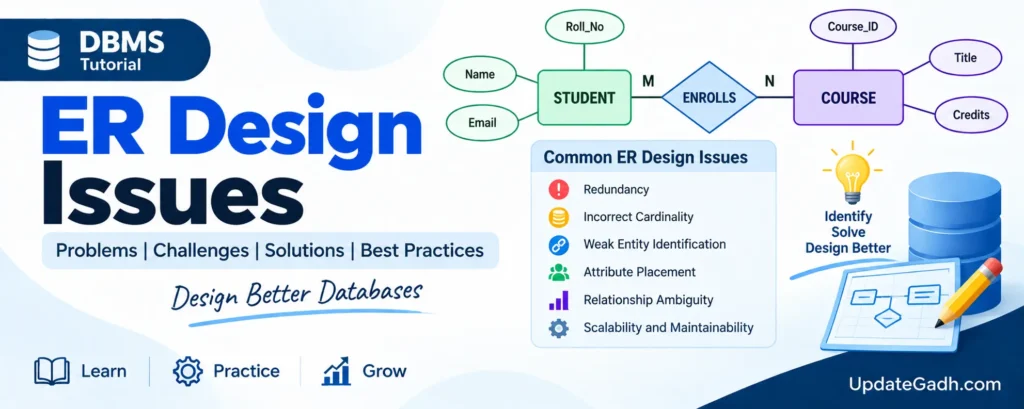
Choosing where to place attributeseither with an entity or a relationshipdepends largely on the cardinality of the relationship. In one-to-one or one-to-many cases, attributes can usually be attached to the participating entity set. However, in many-to-many relationships, attributes that depend on both participating entities should be placed in the relationship set itself.
For example, suppose a student entity and a course entity are related via an enrolls relationship. If you want to store the grade a student receives, it should be part of the enrolls relationship, not the student or course entity.
Download New Real Time Projects :-Click here
Conclusion
Designing an ER diagram is not just about applying notations; it demands a thoughtful analysis of the real-world system being modeled. Every design choicewhether its defining an entity, choosing a relationship type, or placing attributesmust reflect the actual structure and semantics of the enterprise.
Avoiding these common design issues can significantly improve the clarity, scalability, and effectiveness of your data model.
entity-relationship design issues pdf
entity-relationship design issues ppt
design issues in dbms
extended er features in dbms
design issues in dbms – geeksforgeeks
er diagram examples with solutions
er model in dbms pdf
er model diagram
er design issues pdf
er design issues in dbms
er design issues examples
entity relationship design issues ppt
er design issues
explain er design issues
er design issues in dbms
er design issues in dbms with examples
er diagrams naming conventions and design issues
explain the basic design issues of er model
er design limitations
er designs