DQN and DDQN
Machine learning in complicated contexts has been revolutionised by deep reinforcement learning.Two of the most notable algorithms in this space are Deep Q-Networks (DQN) and Double Deep Q-Networks (DDQN). Both are built upon Q-learning principles and use neural networks to handle large state-action spaces, but they differ significantly in how they handle action evaluation and learning stability.
In this article, well explore what DQN and DDQN are, how they work, and their key differences.
Complete Advance AI Topics: Click Here
SQL Tutorial: Click Here
What is DQN (Deep Q-Network)?
In 2015, DeepMind unveiled the Deep Q-Network (DQN), a revolutionary advancement in reinforcement learning. Action values for each state-action combination were stored in a Q-table in traditional Q-learning.This approach became impractical in environments with massive or continuous state spaces, such as video games.
By substituting a deep neural network for the Q-table, DQN was able to overcome this restriction. Instead of storing Q-values explicitly, the network learns to approximate them directly from state inputs. This made it possible to train agents that could achieve human-level performance in complex tasks like Atari games.
How DQN Works
DQN integrates several innovations to ensure learning stability:
- Neural Network Approximation
- Input: the current state.
- Output: Q-values for all possible actions.
- Experience Replay
- Stores past interactions as
(state, action, reward, next_state)tuples. - Random sampling from this memory breaks correlations between sequential experiences, improving training efficiency.
- Stores past interactions as
- Target Network
- A copy of the main Q-network that is updated less frequently.
- Helps stabilize training by providing consistent targets for a number of steps.
- Epsilon-Greedy Exploration
- Balances exploration and exploitation by occasionally choosing random actions.
- Over time, epsilon decreases, leading to more exploitation of learned strategies.
By combining these elements, DQN created a robust way to train agents in environments with high-dimensional inputs.
What is DDQN (Double Deep Q-Network)?
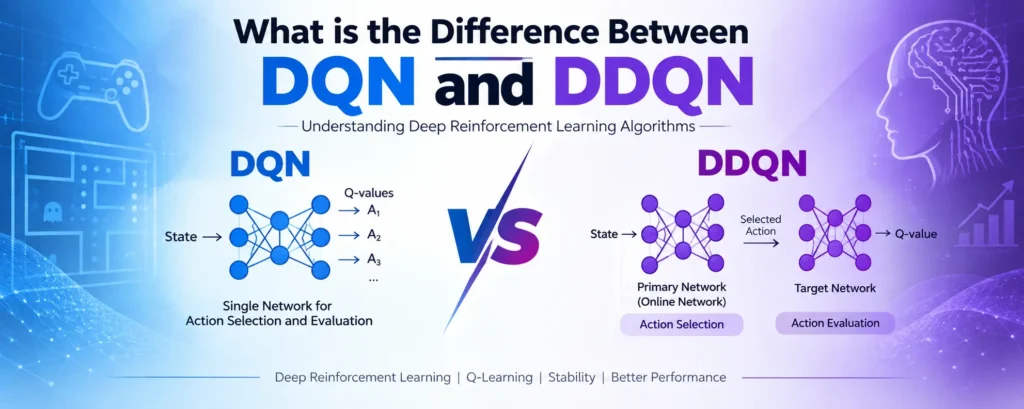
While DQN was revolutionary, it had a significant flaw: overestimation bias. Since the same network was responsible for both selecting and evaluating actions, it often overestimated Q-values, leading to unstable learning.
Researchers came up with the Double Deep Q-Network (DDQN) as a solution. Decoupling action evaluation from action selection was the main innovation.
How DDQN Works
DDQN introduces a slight but powerful modification to DQNs update rule:
- Primary Network (Online Network)
- used to decide which course of action is best for the following condition.
- Target Network
- used to assess the principal network’s selected action’s Q-value.
The agent is unable to inflate Q-value estimates because of this separation. As a result, learning becomes more accurate and stable.
In practice, DDQN requires almost no extra computation compared to DQN, since the two networks already exist. The only difference lies in how the target Q-value is computed.
Key Differences Between DQN and DDQN
1. Action Selection vs. Action Evaluation
- DQN: The optimal course of action is selected and assessed by the same network.
- DDQN: The action is chosen by the primary network and assessed by the target network.
This decoupling reduces bias in Q-value estimates.
2. Overestimation Bias
- By keeping selection and evaluation distinct, DDQN reduces overestimation and produces predictions that are more trustworthy.
- DQN: prone to overestimating Q-values, particularly in noisy or unclear settings.
3. Training Stability
- DQN: May exhibit unstable learning due to inflated Q-values.
- DDQN: Produces smoother training curves and faster convergence by reducing bias.
4. Performance
- DQN: Performs well in simpler tasks but struggles in environments with delayed or sparse rewards.
- DDQN: Consistently outperforms DQN in complex, real-world tasks such as robotics, autonomous navigation, and strategy-based games.
5. Computational Complexity
- DQN: Standard implementation with two networks (online and target).
- DDQN: Requires the same infrastructure, with only a minor change in the update step. Practically no additional cost.
Example Scenario
Consider a game where the agent must choose between two actions:
- Action A: High reward potential but very risky.
- Action B: More stable reward but less attractive initially.
- With DQN, the model may overestimate Action As value and keep choosing it, even if its not optimal in the long run.
- With DDQN, the evaluation is more balanced, so the agent is more likely to identify Action B as the better choice over time.
Download New Real Time Projects : Click here
Final Thoughts
Both DQN and DDQN are foundational in deep reinforcement learning.
- DQN made it possible to apply reinforcement learning to high-dimensional spaces, proving its potential in complex tasks.
- DDQN built upon DQN by addressing its biggest limitationoverestimation biasleading to more stable and accurate learning.
If youre working on reinforcement learning problems where stability and precision are crucial, DDQN is generally the better choice.
As reinforcement learning continues to evolve, understanding these core algorithms remains essential for building reliable AI systems.
dqn and ddqn dueling dqn dueling dqn vs double dqn rainbow dqn double q-learning difference between dqn and ddqn pdf difference between dqn and ddqn example double dqn vs dqn dueling dqn dueling dqn vs double dqn rainbow dqn double q-learning what is the difference between dqn and ddqn qui difference between dqn and ddqn dqn explaineddqn dqn dqn algorithm explained dqn algorithm dqn full form dqn and ddqn pdf dqn and ddqn examples