Reinforcement Learning
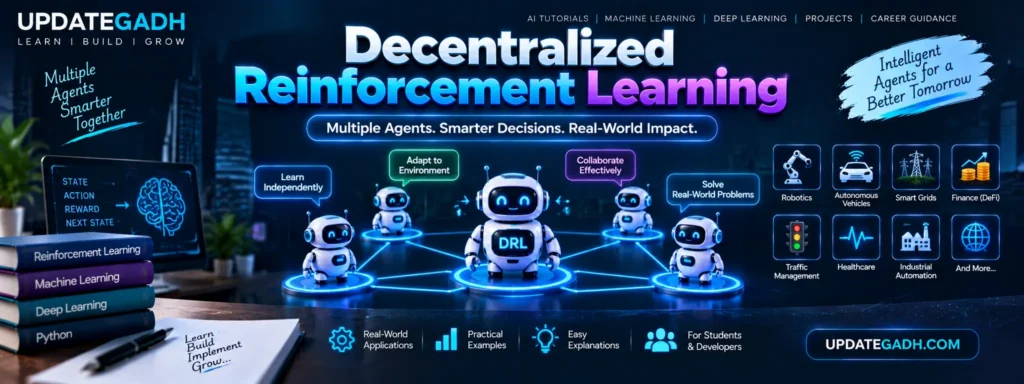
In the ever-evolving landscape of artificial intelligence, Decentralized Reinforcement Learning (DRL) is rapidly emerging as a transformative paradigm. It extends the foundational principles of reinforcement learning into decentralized environments, enabling multiple agents to learn, interact, and make decisions independently. As industries seek scalable, adaptive, and autonomous solutions, DRL is proving to be a game-changer across sectors such as robotics, finance, transportation, and industrial automation.
Complete Advance AI Topics: Click Here
SQL Tutorial: Click Here
Understanding Decentralized Reinforcement Learning
At its core, DRL addresses the complexities of decision-making in environments where centralized control is either impractical or undesirable. It draws inspiration from natureconsider a colony of ants or a flock of birds, where individuals make local decisions that contribute to the collective behavior without any central authority.
In DRL, numerous agents operate simultaneously, each with its own learning algorithm and limited knowledge of the global system. These agents learn through local observations and minimal communication with peers, optimizing their policies for local or shared rewards. This makes DRL well-suited for large-scale, distributed systems where scalability, privacy, and autonomy are crucial.
DRL vs Traditional Reinforcement Learning
Traditional reinforcement learning (RL) typically assumes a single agent interacting with an environment, guided by a central controller optimizing a global objective. While this model is effective in isolated or well-controlled settings, it struggles with scale, complexity, and dynamic interactions in multi-agent systems.
In contrast, decentralized reinforcement learning removes the dependence on a central coordinator. Each agent learns from its environment, occasionally coordinating with neighboring agents to enhance cooperation. This approach shines in scenarios like:
- Limited Central Control: For instance, drones navigating cluttered terrain must make real-time decisions locally.
- Privacy Preservation: Sensitive agent data can remain localized, reducing security and privacy risks.
- Scalability: As the number of agents increases, DRL prevents bottlenecks by distributing the learning process.
Key Approaches in DRL
Several methodologies enable effective decentralized learning and coordination:
- Self-directed Learning: Each agent independently updates its policy through personal experience. It’s simple and scalable, but may lead to uncoordinated actions.
- Centralized Training, Decentralized Execution (CTDE): A shared critic is trained using global experiences during training, but agents act independently during execution. This balances coordination and scalability.
- Multi-Agent Actor-Critic (MAAC): Combines the actor-critic framework with multiple agents. Agents have local actor networks and share a centralized critic, enhancing performance in cooperative settings.
- Communication-Based Systems: Agents explicitly or implicitly share information to align strategies. While effective, this can introduce communication overhead and complexity.
- Hierarchical DRL: Organizes agents into tiers where higher-level agents manage lower-level ones. This structure helps in complex environments with layered decision-making.
- Adversarial Learning: Agents compete with each other, often leading to more robust and adaptive behaviors. However, stability can be a concern.
- Meta-Learning: Agents learn how to learn, enabling rapid adaptation to new tasks. This is especially useful in dynamic or unfamiliar environments.
Each approach has its own strengths and is selected based on the nature of the task, communication constraints, and computational capacity.
Real-World Applications of DRL
The versatility of DRL makes it applicable across a wide range of domains:
- Multi-Agent Robotics: In search-and-rescue, warehouse automation, and collaborative exploration, DRL allows robot teams to operate efficiently without centralized supervision.
- Autonomous Vehicles: Vehicles can negotiate paths, avoid collisions, and optimize routes based on local information and limited interaction with others.
- Decentralized Control Systems: In industrial automation, DRL helps manage complex processes by coordinating distributed components for higher efficiency and lower downtime.
- Traffic Management: Traffic signals and vehicles acting as agents can dynamically optimize traffic flow, reduce congestion, and minimize emissions.
- Decentralized Finance (DeFi): Trading bots and market agents can manage portfolios, execute trades, and assess risks autonomously, improving liquidity and market responsiveness.
- Smart Grid and Resource Distribution: Agents in sensor networks or energy grids learn to allocate resources and balance demand in real time.
- Simulations and Training Games: From military simulations to complex strategy games, DRL supports intelligent agent behavior that adapts and evolves over time.
- Communication Networks: DRL helps optimize routing, bandwidth allocation, and reduce network congestion without a centralized protocol manager.
The Road Ahead for DRL
As research in decentralized systems continues, DRL is poised to become a foundational technology for next-generation AI. With increasing demands for autonomy, resilience, and scalability, the shift towards decentralized models will become not just an optionbut a necessity.
Future innovations in DRL will likely focus on improving agent cooperation, ensuring system stability, enhancing generalization capabilities, and developing standardized frameworks for deployment across domains.
Download New Real Time Projects :- Click here
Conclusion
Decentralized reinforcement learning is more than a theoretical conceptit’s a practical framework for building intelligent systems capable of operating independently yet harmoniously in complex environments. Its potential to transform industries is immense, as it promotes autonomy, flexibility, and efficient decision-making.
As we progress toward an interconnected world, DRL will play a critical role in shaping the future of artificial intelligenceempowering agents to act intelligently, independently, and cooperatively.
reinforcement learning example
reinforcement learning algorithms
reinforcement learning in machine learning
reinforcement learning course
reinforcement learning vs supervised learning
what is reinforcement learning in psychology
reinforcement learning llm
reinforcement learning types
supervised learning
unsupervised learning
reinforcement learning python
reinforcement learning book