
What Are Linear Mixed Models?
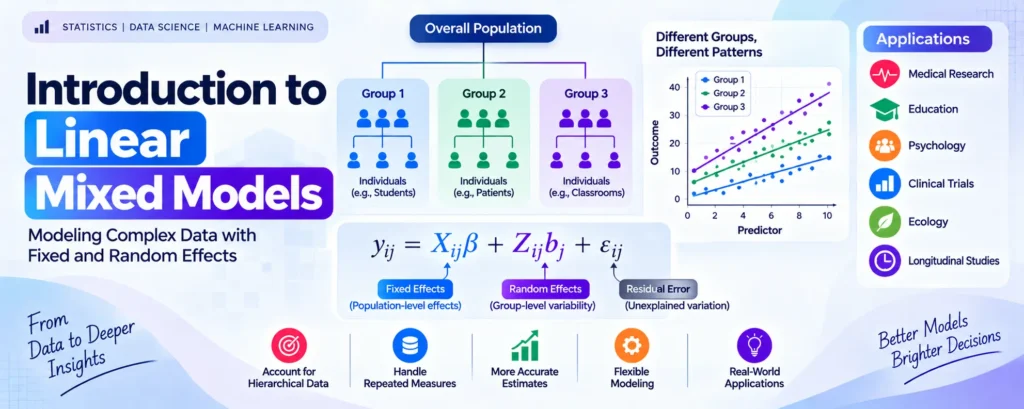
Linear Mixed Models (LMMs) are an extension of traditional linear regression models that are particularly well-suited for analyzing data with hierarchical or clustered structures. These models incorporate both fixed effects (which are constant across individuals or groups) and random effects (which vary across individuals or groups). By doing so, they offer a flexible framework for modeling complex datasets commonly found in fields like biology, psychology, education, and medical research.
In contrast to standard linear models, LMMs can account for correlations within clusters (such as students in classrooms, patients in hospitals, or repeated measures on the same subject), providing more accurate and generalizable results.
Complete Advance AI Topics: Click Here
SQL Tutorial: Click Here
Key Components of Linear Mixed Models
- Fixed Effects: Represent consistent, population-level effects (e.g., the overall impact of a treatment).
- Random Effects: Capture variability at the group or individual level (e.g., differences among patients or classrooms).
This dual structure allows researchers to account for both systematic influences and group-specific deviations, which is essential in multi-level study designs, longitudinal studies, and repeated measurement settings.
Types of Linear Mixed Models
1. Random Intercept Models
These models allow the baseline outcome to vary across groups by including a random intercept. For instance, when analyzing student test scores, a random intercept per school can account for baseline performance differences among schools.
2. Random Slope Models
Here, both the intercept and the slope (the effect of a predictor) are allowed to vary across groups. This is useful when the effect of a variable (like income on spending) differs by region.
3. Random Intercept and Slope Models
Combining the above, these models account for group-level variation in both the baseline and the effect of predictors. For example, treatment effectiveness and recovery rates may vary across hospitals in a healthcare study.
4. Hierarchical Models
Used for deeply nested data structures (e.g., students within classes within schools), hierarchical models include multiple layers of random effects to reflect this complexity.
5. Crossed Random Effects Models
When observations belong to more than one grouping factor (e.g., essays rated by multiple raters), crossed random effects models are used to account for both sources of variation simultaneously.
6. Growth Curve Models
A subset of LMMs used in longitudinal studies to track changes over time. These models capture both average trajectories and individual deviationsfor example, tracking a childs weight gain over several years.
Model Selection and Evaluation
Selecting the Right Model
- Start with a Clear Research Question:
Identify which effects are of primary interest (fixed) and which are due to clustering or individual differences (random). - Build Models Iteratively:
Begin with simpler models and increase complexity graduallyadding random slopes, interaction terms, or more grouping levels as needed. - Evaluate Random Effects:
Use statistical tools like Likelihood Ratio Tests (LRT) to assess whether including random effects improves model fit. - Assess Fixed Effects:
Selection techniques like stepwise selection or metrics such as adjusted R² can guide which fixed effects to retain. - Balance Complexity and Simplicity:
Avoid overfitting. A model should explain the data well without being unnecessarily complex.
Model Comparison Techniques
- Likelihood Ratio Test (LRT): Used for comparing nested models to determine whether added complexity significantly improves fit.
- Akaike Information Criterion (AIC): Lower AIC indicates a better trade-off between model complexity and goodness of fit.
- Bayesian Information Criterion (BIC): Like AIC but more conservative, especially with larger samples. Lower BIC is preferred.
- Marginal and Conditional R²: These metrics measure the variance explained by fixed effects alone (marginal R²) and by both fixed and random effects (conditional R²).
- Cross-validation: Use predictive accuracy on new or simulated data to assess model generalizability.
When Should You Use Linear Mixed Models?
LMMs are particularly effective in the following situations:
- Hierarchical/Nested Data: For instance, students in schools, patients in hospitals, or repeated trials on participants.
- Repeated Measures: When subjects are measured multiple times, such as before and after treatment or across time points.
- Longitudinal Data: LMMs model both within-subject (time-related) and between-subject (individual) variation.
- Random Variation Between Units: When units like classrooms or patients show random variation, random intercepts and slopes capture this variability.
- Complex Experimental Designs: Ideal for studies with multiple levels of grouping or experimental interventions across varied settings.
Pros and Cons of Linear Mixed Models
Advantages
- Handle Hierarchical and Repeated Data: Excellent for modeling clustered and time-based observations.
- Flexible Random Effect Structures: Random intercepts and slopes allow better fit and variance modeling.
- Robust to Missing Data: LMMs can accommodate unbalanced data without excluding entire cases.
- More Accurate Estimates: By modeling individual and group-level effects, parameter estimates are more precise.
- Better Generalization: Random effects account for variability, improving the models external validity.
Limitations
- Increased Complexity: LMMs are more complicated to specify and interpret than standard linear models.
- Assumptions Matter: Violation of assumptions like normality of residuals or homoscedasticity can impact reliability.
- Computational Intensity: Fitting complex models with large datasets can be resource-intensive.
- Interpretation Challenges: Understanding fixed and random effect interactions can be non-intuitive for new users.
- Risk of Overfitting: Overly complex models, especially with small group sizes, may reduce model robustness.
Real-World Applications of Linear Mixed Models
- Longitudinal Medical Research: Monitoring patients’ health indicators (like blood pressure) over time, accounting for individual variability.
- Educational Assessment: Evaluating how different teaching methods affect student outcomes across various classrooms or schools.
- Clinical Trials and Public Health: Modeling drug effectiveness across hospitals while accounting for institutional and patient-level variation.
- Psychological Experiments: Measuring cognitive response times across different sessions and conditions while considering individual behavior differences.
- Ecological Studies: Assessing biodiversity or environmental impact while accounting for spatial and temporal nesting of observations.
Download New Real Time Projects : Click here
Conclusion
Linear Mixed Models are an indispensable statistical tool for analyzing data that involves groupings, repeated measures, or longitudinal designs. By including both fixed and random effects, they allow for more flexible and realistic modeling of complex datasets. While their complexity demands careful model specification and validation, the insights they offerespecially in real-world, structured dataare profound.
mixed effects models explained linear mixed model in r linear mixed model example mixed effects model example mixed effects model in r linear mixed model spss linear mixed model vs linear regression
linear mixed model assumptions introduction to linear mixed models pdf linear mixed models in r mixed effects models explained linear mixed model example linear mixed model vs linear regression linear mixed model spss generalized linear mixed models linear mixed model assumptions mixed effects model in r anova linear regression linear mixed models example slinear mixed models formula