How Neural Networks are Trained
Because of the brain’s extraordinary capacity for learning and adaptation, neural networks continue to lead the way in artificial intelligence developments. From image identification and natural language processing to financial modelling and medical diagnostics, these potent computing systems have revolutionised a wide range of industries. One crucial procedure is at the core of their success: training.
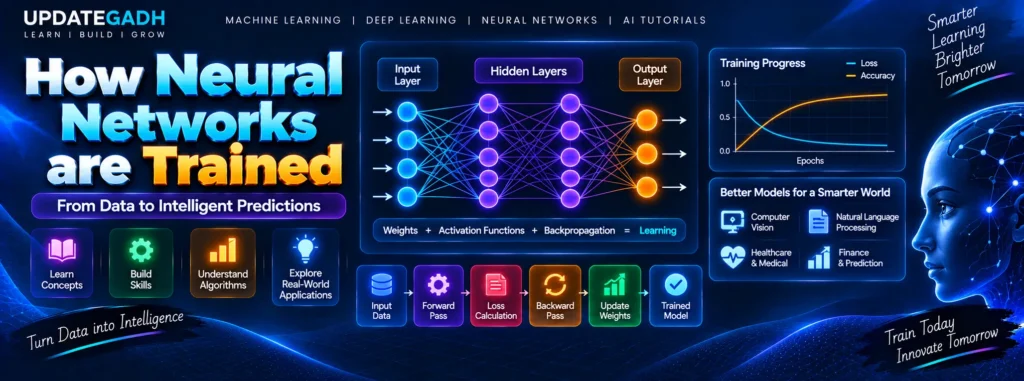
Complete Advance AI Topics: Click Here
SQL Tutorial: Click Here
Introduction to Neural Networks
In the fast-evolving world of artificial intelligence, neural networks serve as foundational structures that emulate the intricate mechanisms of the human brain. These networks, which consist of layers of interconnected nodes, or “neurones,” can recognise patterns, learn from data, and make well-informed predictions.
A typical neural network architecture consists of three main types of layers:
- Input Layer: This is the entry point where data is fed into the network. A feature of the input dataset is represented by each neurone in this layer.
- Hidden Layers: These intermediate layers carry out complex computations. They transform and abstract input data into higher-level features.
- Output Layer: This layer delivers the final predictions or classifications based on the information processed through the network.
Weights and biases are parameters that control how information moves through the network and influence connections between neurones. These parameters are fine-tuned during training to reduce the gap between predicted and actual outputsa process known as learning.
Furthermore, the network can describe intricate relationships in the data thanks to the non-linearity introduced by activation functions like ReLU, sigmoid, tanh, and softmax.
The Training Process: Backpropagation in Action
Training a neural network is a step-by-step process that involves fine-tuning weights and biases to achieve optimal performance. This is achieved through an algorithm known as backpropagation, combined with gradient descent for optimization.
1. Initialization
Training begins with the random initialization of weights and biases. These parameters are refined as training progresses.
2. Forward Pass
Input data is passed through the network, layer by layer. Each layer applies transformations to the data, gradually converting it into a meaningful output.
3. Loss Calculation
A loss function measures how far the network’s predictions are from the actual targets. Common loss functions include mean squared error for regression and cross-entropy for classification.
4. Backward Pass
Using the chain rule of calculus, the network computes gradients of the loss function with respect to each parameter. The amount that each parameter should be changed is indicated by these gradients.
5. Gradient Descent
Using optimisation methods such as Adam or stochastic gradient descent (SGD), the network gradually adjusts its parameters to minimise loss.
6. Iterative Refinement
Over a number of epochseach of which is a complete run of the training datathis training cycle is repeated. With each iteration, the model becomes more accurate in its predictions.
7. Validation and Testing
To ensure the model doesn’t overfit the training data, it’s evaluated on a separate validation set. Final performance is tested on unseen data, ensuring real-world applicability.
Techniques to Improve Training
Several techniques enhance the training process and improve the reliability of neural networks:
Regularization
Methods like L1/L2 regularization, dropout, and batch normalization help reduce overfitting and enhance generalization.
Hyperparameter Tuning
Hyperparameters such as learning rate, batch size, and network depth are fine-tuned to optimize performance.
Data Augmentation
Especially important in computer vision tasks, data augmentation techniques like rotation, flipping, and cropping artificially expand the training dataset, making the model more robust.
Transfer Learning
In this approach, a model pre-trained on large datasets (e.g., ImageNet) is fine-tuned for specific tasks. This is highly effective when task-specific data is limited.
Early Stopping
Training is halted when performance on the validation set stops improving, thus avoiding unnecessary computations and overfitting.
Monitoring and Visualization
Metrics like loss and accuracy are tracked throughout training. Visualization tools help analyze training curves and feature maps to diagnose potential issues.
Parallel and Distributed Training
For large datasets or deep networks, training is accelerated using parallel processing across multiple GPUs or distributed systems, often with frameworks like TensorFlow or PyTorch.
Download New Real Time Projects :- Click here
Conclusion
Training neural networks is both a science and an art, involving mathematical precision and strategic decision-making. Through backpropagation, gradient descent, and a suite of modern techniques, neural networks become capable of solving complex problems across various domains. As advancements continue, the future of artificial intelligence will be increasingly shaped by how efficiently we train and deploy these powerful models.
neural network training example
training neural network in deep learning
training a neural network with backpropagation
neural network training algorithms
training of neural network could consist of supervised or unsupervised
training of neural network could consist of supervised and uses regression algorithm
backpropagation in neural network
how to train a neural network in python
how neural networks are trained in deep learning
how neural networks are trained github