Advanced Techniques for Fine-Tuning Transformers
Introduction
Fine-tuning pre-trained transformer models like BERT, GPT, or T5 has become a cornerstone in developing efficient and accurate natural language processing (NLP) systems. These models, initially trained on vast corpora such as Wikipedia and Common Crawl, capture general language representations. However, to perform well on specific tasks like sentiment analysis, question answering, or machine translation, they must be further adapted through a process known as fine-tuning.
Fine-tuning allows the model to retain the broad language understanding from pre-training while learning the nuances of a specific task. By applying transfer learning, this approach requires significantly less data and computational resources compared to training a model from scratch. Through strategies like controlled learning rates, careful regularization, and layer freezing, practitioners can fine-tune transformers effectively without losing the original models general knowledge. The result is a high-performing model tailored for particular applications while preserving the richness of its pre-trained base.
Complete Advance AI Topics: Click Here
SQL Tutorial: Click Here
Understanding the Fine-Tuning Process
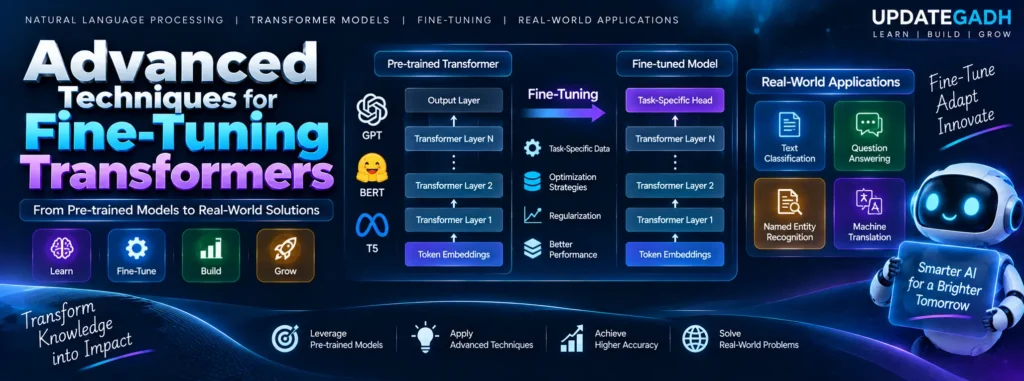
Fine-tuning refers to customizing a pre-trained transformer model for a particular downstream task, such as text classification, named entity recognition (NER), or machine translation. Rather than starting from zero, it uses the already-learned weights and representations from pre-training, which significantly accelerates the adaptation process.
Key Stages in the Fine-Tuning Workflow
1. Pre-training vs. Fine-tuning
- Pre-training: The model learns general language features from massive datasets. This stage builds the foundation by capturing grammar, semantics, and world knowledge.
- Fine-tuning: The model is further trained on a smaller, task-specific dataset to adapt its language understanding to the requirements of a specific application.
2. Model Initialization
The process begins with loading a pre-trained model. This gives the model a head start by leveraging previously acquired knowledge, reducing the amount of task-specific data needed.
3. Data Preparation
Input data must be tokenized and encoded to match the model’s expected input format. This step ensures the dataset reflects the real-world use case and provides relevant learning signals.
4. Adding Task-Specific Heads
A custom classification or regression layer is appended to the model to handle the downstream task. This head is initialized randomly and learns to map the models outputs to task-specific labels during fine-tuning.
5. Training with Backpropagation
Model parameters are updated using backpropagation on the task-specific dataset. A smaller learning rate is typically used to prevent overwriting the foundational knowledge gained during pre-training.
6. Optimization and Regularization
To prevent overfitting and improve stability, techniques such as dropout, weight decay, and gradient clipping are applied. Optimizers like AdamW are commonly employed to enhance generalization.
7. Evaluation and Iteration
The model is validated on a held-out dataset. Hyperparameterslike learning rate and batch sizeare fine-tuned through iterative experiments to achieve optimal performance.
Optimization Strategies
Learning Rate Schedules
Learning rate scheduling controls how fast the model updates during training. One common approach includes:
- Warm-up Phases: Gradually increase the learning rate from a small value to stabilize early training.
- Decay Schedules: Reduce the learning rate progressively using linear or exponential decay to refine the model’s learning.
- Cyclic Schedules: Oscillate between a minimum and maximum learning rate, allowing the model to escape local minima and converge more effectively.
Optimizer Selection
Choosing the right optimizer is critical:
- AdamW: Widely used for transformer models due to its ability to decouple weight decay from the gradient update, promoting better generalization.
- LAMB: Suitable for large-scale training; it scales learning rates layer-wise.
- SGD with Momentum: Although less common in transformers, it can be helpful in smoothing updates and accelerating convergence in specific contexts.
Gradient Clipping
To avoid exploding gradients, especially in deep models, gradient clipping is used to cap gradient values at a defined threshold. This stabilizes training and ensures consistent model updates.
Batch Size Considerations
- Smaller Batches: Lead to noisier gradients, which can help explore better generalizations.
- Larger Batches: Offer more stable gradients and faster convergence, but require careful adjustment of learning rates to maintain performance.
Regularization Techniques
- Dropout: Randomly disables units in the neural network during training to promote robust feature learning.
- Weight Decay: Penalizes large weights to reduce overfitting, encouraging the model to maintain simpler solutions.
Advanced Training Techniques
Layer-Wise Learning Rates
Later layers are often more task-specific, so assigning them higher learning rates while keeping lower rates for earlier layers can improve fine-tuning efficiency.
Layer Freezing and Gradual Unfreezing
Freezing early layers helps retain generic language knowledge, while gradually unfreezing deeper layers allows the model to adapt to new tasks incrementally. This staged approach balances stability and adaptability.
Practical Applications and Case Studies
Text Classification
Fine-tuned transformers are widely used in sentiment analysis, spam detection, and topic classification. For instance, a model like BERT fine-tuned on customer reviews can accurately identify sentiments, supporting decision-making in marketing and customer support.
Question Answering
Models such as T5 or RoBERTa, fine-tuned on datasets like SQuAD, deliver precise and context-aware answers, making them ideal for customer support bots, virtual assistants, and educational platforms.
Named Entity Recognition (NER)
In domains like healthcare or law, transformers fine-tuned on specialized corpora can identify domain-specific entities like drug names, diseases, or legal terms. This supports automated document processing and data anonymization.
Machine Translation
Multilingual transformers like mBART or GPT, when fine-tuned on parallel corpora, offer high-quality translations. They capture linguistic nuances and grammar, significantly improving machine translation for global communication.
Download New Real Time Projects :Click here
Conclusion
Fine-tuning transformers bridges the gap between general-purpose language understanding and high-performance task-specific applications. By leveraging pre-trained models, optimizing training processes, and using advanced techniques like layer freezing and learning rate scheduling, developers can build state-of-the-art NLP solutions efficiently.
As more industries embrace language AI, mastering the art of fine-tuning will be essential for delivering scalable, intelligent, and context-aware applications.
fine-tune transformer for text classification
fine-tune transformer models for question answering on custom data
fine-tuning table transformer
the ultimate guide to fine-tuning llms from basics to breakthroughs
llm fine-tuning best practices
fine-tune transformer for object detection
fine-tuning models
how to evaluate fine-tuned llm
advanced techniques for fine tuning transformers pdf