
Introduction
Echo State Networks (ESNs) are a unique type of recurrent neural network (RNN) designed specifically for processing temporal data. They fall under the broader paradigm of reservoir computing, where the internal recurrent connections are fixed, and only the output layer is trained. Unlike conventional RNNs, which require complex backpropagation through time (BPTT), ESNs streamline the training process, making them more computationally efficient.
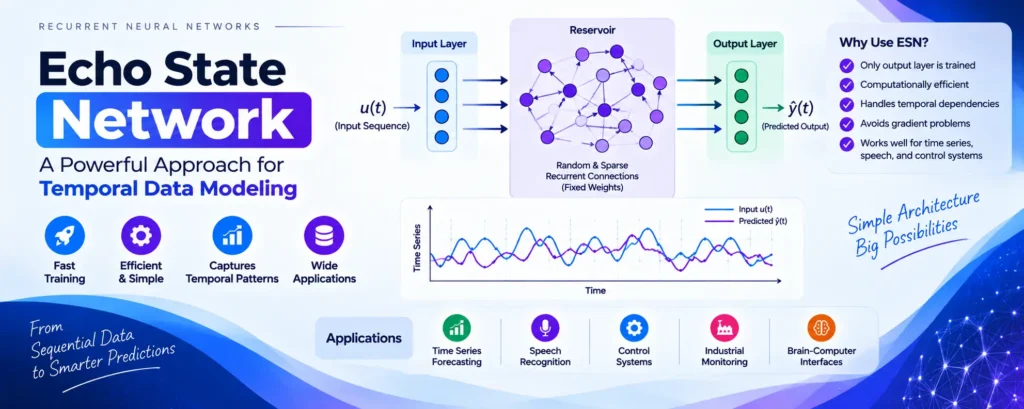
An ESN is composed of three main layers: the input layer, the reservoir, and the output layer. The reservoir is a sparsely connected, randomly initialized recurrent network that captures temporal patterns by transforming input signals into a high-dimensional representation. The output layer, typically trained using linear regression, maps these representations to the desired output.
ESNs are well-suited for tasks such as time series prediction, speech recognition, and system modeling. Their efficiency lies in the fact that only the output weights require training, significantly reducing computational overhead. Proper tuning of reservoir parameters, however, is essential to achieve optimal performance.
Complete Advance AI Topics: Click Here
SQL Tutorial: Click Here
Core Concepts of Echo State Networks
Reservoir Computing
ESNs rely on the principle of reservoir computing. A randomly initialized reservoir serves as a fixed recurrent neural network. By transforming input signals into a high-dimensional space, the reservoir captures temporal dependencies without the need for extensive training, enabling the network to extract meaningful features efficiently.
Random and Sparse Connectivity
Neurons in the reservoir are sparsely connected with randomly assigned weights. This ensures that the network retains useful information over time while maintaining computational efficiency. Random connections also enhance generalization in sequential tasks by allowing diverse input patterns to be represented in the reservoir.
Echo State Property (ESP)
A crucial requirement for ESNs is the Echo State Property (ESP), which ensures that the network’s response remains stable over time as the effect of previous inputs gradually fades. Without ESP, the network may become unstable or fail to retain important historical information. Achieving this balance involves carefully tuning the reservoir weights and the spectral radius (the largest absolute eigenvalue of the reservoir weight matrix).
Fixed Internal Weights
Unlike traditional RNNs, ESNs do not update their input or reservoir weights during training. Only the output layer is optimized, often using methods like linear regression. This reduces computational complexity while leveraging the reservoirs ability to represent rich features.
Nonlinear Transformations
The reservoir applies nonlinear transformations to the input signals, enabling the network to model complex temporal dependencies. Factors such as spectral radius, activation functions, and reservoir structure determine the richness of these transformations, allowing ESNs to capture chaotic or highly dynamic patterns.
Ridge Regression for Training
The output layer of an ESN is trained using ridge regression or other linear optimization methods. Adding a regularization term prevents overfitting and ensures better generalization. Training is significantly faster than BPTT-based methods used in conventional RNNs.
Computational Efficiency
ESNs are computationally efficient because only the output weights are trained. They do not require repeated backpropagation, making them ideal for large-scale temporal datasets or real-time applications where quick learning and inference are essential.
How Echo State Networks Work
Input Layer Processing
Incoming data first passes through the input layer, where weights between the input and reservoir neurons are randomly initialized. This transforms even simple input patterns into a higher-dimensional space, improving feature extraction.
Reservoir Dynamics
The reservoir is a moderately connected recurrent network that retains information about past inputs. At each time step, the reservoir updates its internal state based on prior states and current inputs, creating a dynamic representation of temporal data. Nonlinear activations produce a rich set of features suitable for learning complex patterns.
Output Layer Training
Instead of training all network layers, only the output layer is optimized. The output layer receives transformed signals from the reservoir and maps them to desired outputs. This approach significantly reduces training time compared to traditional deep learning models.
Prediction and Forecasting
Once trained, the ESN can predict new input sequences. The reservoir continuously updates its state with incoming data, while the trained output layer generates predictions in real time. Because the reservoir remains fixed, ESNs are highly effective in streaming and online applications.
Advantages of Echo State Networks
- Fast and Efficient Training: Only the output layer is trained, eliminating the need for complex BPTT. ESNs can quickly learn from large datasets using simple linear regression.
- Avoids Exploding and Vanishing Gradients: Fixed internal weights prevent the gradient issues commonly seen in traditional RNNs.
- Captures Temporal Dependencies: The reservoir acts as a dynamic memory, retaining past input information without requiring explicit memory mechanisms like LSTMs.
- Low Computational Cost: ESNs consume fewer resources than LSTMs or Transformers, making them suitable for embedded systems and real-time applications.
- Simple Implementation: The modular architecture allows rapid experimentation without complex training procedures.
Limitations
- Sensitivity to Reservoir Parameters: Performance heavily depends on input scaling, sparsity, and spectral radius, requiring careful manual tuning.
- Fixed Reservoir: The reservoir does not adapt to the task during training, which may limit performance on highly complex datasets.
- Limited Scalability: ESNs are less effective for large-scale tasks like language modeling or image sequence processing.
- Handling Non-Stationary Data: Datasets with changing distributions may require frequent reservoir adjustments.
- Memory Constraints: Reservoir size and structure limit how much temporal information can be stored and recalled.
Download New Real Time Projects :Click here
Applications
- Time Series Forecasting: Energy consumption, weather prediction, and financial market trends.
- Audio and Speech Processing: Speaker identification, voice recognition, and real-time speech applications.
- Control Systems and Robotics: Adaptive behavior learning, motion control, and trajectory prediction.
- Industrial Systems: Anomaly detection and predictive maintenance in manufacturing, aerospace, and energy sectors.
- Brain-Computer Interfaces (BCIs): Analysis of EEG and EMG signals for neurofeedback, prosthetic control, and epilepsy detection.
echo state network python
echo state network pytorch
echo state network architecture
echo state network paper
echo state network in deep learning
echo state network vs lstm
echo state property
echo state network tutorial
deep belief network
reservoir computing
echo state network pdf
echo state network example