
Aleatoric and Epistemic Uncertainty
In the evolving world of deep learning and artificial intelligence, understanding uncertainty is not just an academic exerciseits a necessity. Whether its a self-driving car navigating through fog, a diagnostic system analyzing medical scans, or a financial model forecasting volatile markets, uncertainty plays a defining role in how AI systems perform in the real world. Despite the impressive capabilities of deep neural networks, they are not infallible. Recognizing and quantifying uncertainty is critical to ensure reliable, safe, and trustworthy AI systemsespecially in high-stakes environments.
This article from explores two fundamental types of uncertainty in deep learning: aleatoric and epistemic. Well dive into what they mean, how they differ, why they matter, and how they can be modeled.
Complete Advance AI Topics: Click Here
SQL Tutorial: Click Here
What is Uncertainty in Deep Learning?
Uncertainty in deep learning refers to the degree to which a model is unsure about its predictions. This uncertainty can emerge from noisy data, incomplete training, or the inherent unpredictability of certain outcomes.
There are two primary types of uncertainty in deep learning:
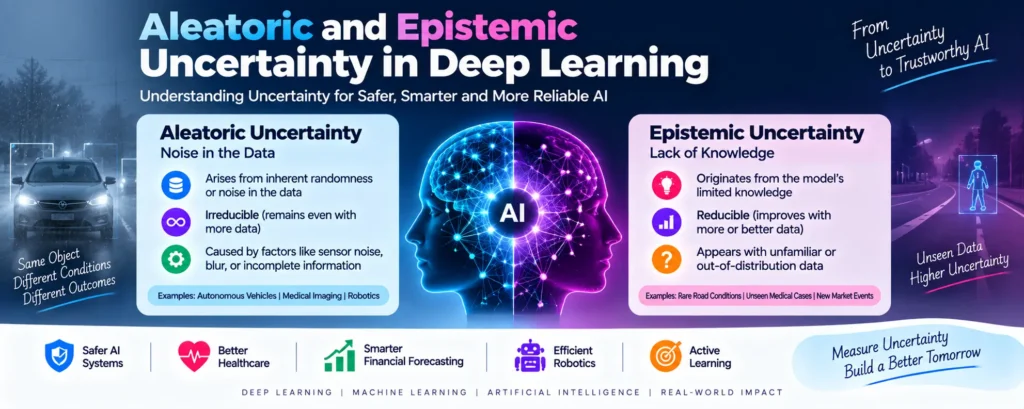
- Aleatoric Uncertainty: Arises from inherent randomness or noise in the data. It is irreducible and persists regardless of how much data the model sees.
- Epistemic Uncertainty: Originates from the models limited knowledge or lack of exposure to certain data. It is reducible with more diverse and representative training data or improved model architectures.
Aleatoric Uncertainty: Noise in the Data
Aleatoric uncertainty captures the variability in outcomes that cannot be explained away, even with unlimited data. This kind of uncertainty is embedded in the data itself and is often encountered when measurements are noisy, environments are unpredictable, or multiple outcomes are equally likely.
Key Characteristics:
- Data-Dependent: It is caused by noise in input features, such as blurry images, sensor inaccuracies, or incomplete information.
- Irreducible: No matter how sophisticated a model is or how large the dataset becomes, this uncertainty will remain.
- Task-Specific: The level of aleatoric uncertainty can vary based on the problem. For example, object detection in a clear image has lower uncertainty than in a foggy or dimly-lit one.
Modeling Aleatoric Uncertainty:
In practice, aleatoric uncertainty is modeled by predicting a probability distribution over outputs instead of single-point predictions. For regression tasks, this often involves predicting both the mean and variance. The loss function is adapted accordinglycommonly using the negative log-likelihood to account for varying degrees of uncertainty in each prediction.
In classification, the model can provide probabilistic outputs, where the confidence scores reflect uncertainty.
Real-World Applications:
- Autonomous Vehicles: Weather-related noise in sensors (rain, snow) causes aleatoric uncertainty in perception systems.
- Medical Imaging: Variations in scan quality due to patient movement or machine differences introduce unavoidable data noise.
- Robotics: Obstacle detection using noisy depth sensors results in predictions affected by real-world randomness.
Epistemic Uncertainty: Lack of Knowledge
Unlike aleatoric uncertainty, epistemic uncertainty stems from what the model does not know. It reflects ignorance or uncertainty about the model’s parameters or structure due to limited or unrepresentative training data.
Key Characteristics:
- Model-Dependent: It is related to the limitations of the models understanding or capacity.
- Reducible: By incorporating more diverse or better-quality data, epistemic uncertainty can be minimized.
- Appears with Unfamiliar Data: Often observed when the model is presented with data outside of its training distribution.
Modeling Epistemic Uncertainty:
Several techniques are used to capture epistemic uncertainty:
- Bayesian Neural Networks (BNNs): Learn distributions over weights rather than fixed parameters, enabling uncertainty estimation.
- Monte Carlo Dropout: During inference, dropout is applied repeatedly to sample predictions and measure variance.
- Deep Ensembles: Multiple independently trained models with different initializations offer diverse predictions. Disagreement among them signals high epistemic uncertainty.
Real-World Applications:
- Autonomous Driving: Encountering rare road conditions or objects can lead to high epistemic uncertainty.
- Medical Diagnosis: Uncertainty increases when the model is asked to interpret unusual or rare conditions.
- Finance: Unseen market events (e.g., geopolitical shifts) can expose limitations in models trained on historical trends.
Why Modeling Uncertainty Matters
Understanding both types of uncertainty allows AI systems to be more transparent and reliable. Below are key benefits of incorporating uncertainty into machine learning models:
1. Improved Safety and Reliability
Systems that recognize their limitations can avoid making overconfident decisions. This is vital in areas like autonomous navigation, where a cautious response to uncertain inputs can prevent accidents.
2. Informed Decision-Making in Healthcare
Knowing when a model is uncertain can assist doctors in deciding whether to trust AI-based diagnoses or conduct additional tests.
3. Better Risk Management in Finance
By accounting for both inherent market noise (aleatoric) and model limitations (epistemic), financial institutions can make more robust and cautious forecasts.
4. Active Learning
Epistemic uncertainty helps models identify which data points they are most unsure about, allowing for targeted data labeling and more efficient learning.
Applications of Uncertainty Modeling
| Domain | Aleatoric Uncertainty | Epistemic Uncertainty |
|---|---|---|
| Autonomous Vehicles | Sensor noise due to rain, fog, or glare | Encountering rare driving conditions not seen in training |
| Medical Imaging | Inconsistent image quality, patient movement | Diagnosing rare or previously unseen conditions |
| Financial Forecasting | Market volatility, unpredictable economic fluctuations | Unfamiliar events like pandemics or policy changes |
| Robotics | Uncertain sensor readings due to moving obstacles | Operating in a novel environment or configuration |
Download New Real Time Projects : Click here
Conclusion
Aleatoric and epistemic uncertainty are fundamental to understanding and improving the performance of deep learning models in the real world. While aleatoric uncertainty is inherent and unavoidable, epistemic uncertainty can be addressed through better model design and more comprehensive training data.
Incorporating uncertainty estimation leads to AI systems that are not only intelligent but also aware of their limitations. This self-awareness is crucial for building safe, accountable, and human-centric AI technologies.
As deep learning continues to be integrated into critical systems, research and development in uncertainty quantification will be key to ensuring that these technologies act not only intelligentlybut responsibly.
aleatoric and epistemic uncertainty in deep learning example
aleatoric and epistemic uncertainty in deep learning python
aleatoric uncertainty
aleatoric vs epistemic uncertainty
aleatoric uncertainty deep learning
a deeper look into aleatoric and epistemic uncertainty disentanglement
rethinking aleatoric and epistemic uncertainty
aleatory and epistemic uncertainty examples