Introduction
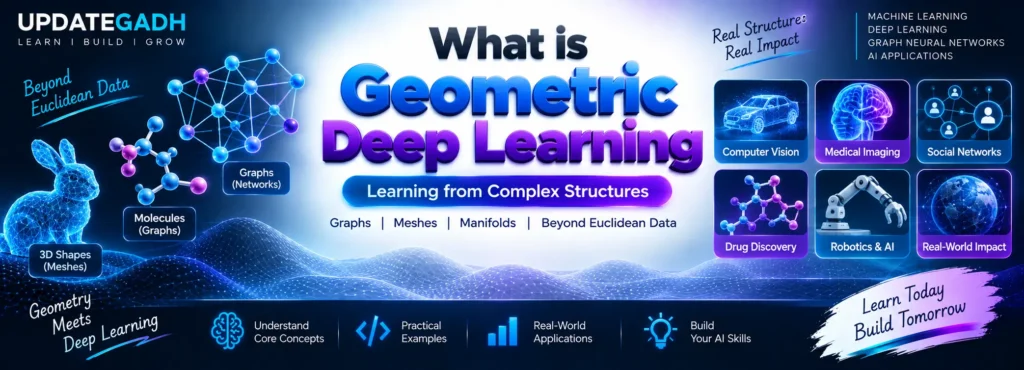
Geometric Deep Learning (GDL) is an emerging area of artificial intelligence that combines advanced deep learning methods with the geometric structure of data. Unlike traditional deep learning, which works effectively with Euclidean data like images, sequences, and text, GDL is designed to handle non-Euclidean data such as graphs, meshes, and manifolds which are commonly found in real-world applications like social networks, molecular modeling, and 3D shapes.
GDL bridges the gap by creating models that understand spatial and relational structures. It incorporates principles from graph theory, topology, and differential geometry to extract meaningful patterns from structured data. These models recognize spatial relationships, symmetries, and invariances by embedding geometric priors directly into the learning process.
As GDL evolves, it opens new possibilities in areas ranging from social network analysis and drug discovery to 3D object detection and medical imaging.
Complete Advance AI Topics: Click Here
SQL Tutorial: Click Here
Understanding Geometric Structures
To appreciate how GDL works, one must first understand the foundational geometric structures it builds upon:
1. Topology
Focuses on properties that remain invariant under continuous deformations. It’s essential for modeling global data structures, such as connectedness in graph-based systems.
2. Differential Geometry
Studies smooth shapes and surfaces through tools like geodesics and tangent spaces. It helps analyze the local behavior of data that exists on curved spaces.
3. Graph Theory
Examines the relationships between entities using nodes and edges. Graphs serve as a universal tool for representing everything from chemical compounds to recommendation systems.
4. Manifold Learning
Reduces high-dimensional data into lower-dimensional manifolds while preserving its intrinsic geometry. Techniques like UMAP and t-SNE fall under this category.
5. Symmetry and Invariance
Incorporating these concepts allows models to remain robust under transformations such as rotation, scaling, and translationcritical in real-world scenarios.
Deep Learning in Geometric Data Analysis
Learning Representations
Deep models can learn hierarchical representations of geometric data, enabling them to extract intricate patterns from complex domains such as graphs and point clouds.
Feature Extraction
GDL models are designed to derive powerful features from raw geometric data. This allows them to excel in tasks like object recognition, shape classification, and molecular structure prediction.
Predictive Modeling
By training on labeled geometric datasets, deep learning models can learn spatial correlations and make predictions for classification, regression, and segmentation tasks.
Scalability and Efficiency
Modern deep learning frameworks are scalable. With the support of GPUs and TPUs, GDL models can handle large-scale geometric datasets efficiently.
Integration with Traditional Methods
GDL complements classical geometric and statistical methods, providing deeper insights and enhancing model interpretability and generalization.
Applications of Geometric Deep Learning
Computer Vision
Used for pose estimation, 3D object detection, and shape analysis. GDL can interpret spatial information in point clouds, meshes, and voxel data.
Biomedical Imaging
Enhances tasks like organ segmentation and disease detection by integrating geometric understanding into diagnostic models.
Graph and Network Analysis
Powers social network modeling, transportation systems, and biological networks. Graph Neural Networks (GNNs) perform node classification, link prediction, and community detection.
Natural Language Processing
By modeling sentences and structures as graphs, GDL captures semantic and syntactic relationships for tasks like sentiment analysis and parsing.
Robotics and Autonomous Systems
Equips robots with the ability to reason spatially, plan movement, and interact with their environment more effectively.
Chemistry and Material Science
Accelerates drug discovery and material property prediction by modeling molecules as graphs or 3D structures.
Challenges in Geometric Deep Learning
Data Representation
Accurately modeling geometric structures like surfaces, graphs, and point clouds remains a complex challenge.
Scalability
Training GDL models on large datasets can be computationally expensive and often requires specialized infrastructure.
Generalization
GDL models sometimes struggle to adapt across datasets and domains, particularly when labeled data is limited.
Symmetry Integration
While essential for stability and generalization, effectively encoding symmetries and invariances into models is still an active research area.
Interpretability
As with many deep learning systems, GDL models are often viewed as black boxes. Improving their transparency and interpretability remains a key concern.
Core Methods and Algorithms in GDL
Graph Neural Networks (GNNs)
These networks aggregate information from a nodes neighborhood to learn meaningful node and graph-level representations.
Graph Convolutional Networks (GCNs)
A type of GNN that applies convolution operations on graphs, helping in tasks such as semi-supervised learning and graph classification.
Mesh-based Deep Learning
Techniques like MeshCNN and MeshNet handle 3D surfaces through mesh representations for classification and segmentation.
Point Cloud Processing
Models like PointNet and PointNet++ directly process unordered 3D points for tasks including segmentation and reconstruction.
Manifold Learning Techniques
Tools like UMAP and t-SNE help visualize high-dimensional geometric data by preserving local and global structures during dimensionality reduction.
Future Prospects of Geometric Deep Learning
Hierarchical Representations
Building models that understand geometry at multiple levels of abstraction, enabling better generalization across scales.
Learning Geometric Priors
Developing architectures that can learn symmetries, invariances, and spatial relationships directly from data.
Dynamic and Temporal Graphs
Expanding GDL to handle graphs that evolve over time, useful for modeling real-time systems like traffic and social interactions.
Meta-Learning in GDL
Adapting models to new geometric tasks with minimal labeled data, enhancing flexibility and transfer learning capabilities.
Uncertainty Estimation
Incorporating uncertainty into predictions makes GDL models more reliable, especially in high-risk areas like healthcare and autonomous driving.
Download New Real Time Projects :- Click here
Conclusion
Geometric Deep Learning is revolutionizing how machines interpret data that exists beyond traditional formats. By incorporating mathematical structures and spatial awareness, GDL extends the frontier of what deep learning can achieve. As researchers continue to innovate in this field, the blend of geometry and machine learning is set to drive breakthroughs in a wide range of domains.
Stay tuned with UpdateGadh as we bring you more insights into emerging AI technologies and their real-world impact.
geometric deep learning pdf
geometric deep learning course
geometric deep learning book
geometric deep learning reddit
geometric deep learning bronstein
applications of geometric deep learning
geometric deep learning: grids, groups, graphs, geodesics, and gauges
geometric deep learning introduction
what is geometric deep learning in machine learning
what is geometric deep learning in neural network
what is geometric deep learning with example
what is geometric deep learning pdf
what is geometric deep learning python