
Model Calibration
Introduction
In the domain of machine learning, model calibration plays a pivotal role in ensuring that a model’s predicted probabilities align closely with real-world outcomes. Unlike accuracywhich measures the percentage of correct predictionscalibration focuses on how well the predicted probabilities represent the true likelihood of an event occurring. For instance, if a model forecasts a 70% chance of rain, ideally, it should actually rain 70% of the time in such cases. This alignment is what calibration aims to achieve.
Model calibration is particularly crucial in high-stakes applications such as risk assessment, healthcare diagnostics, and financial forecasting. Inaccurate probabilities can lead to poor decision-makingeither by overestimating risks and missing opportunities or underestimating risks and facing severe consequences.
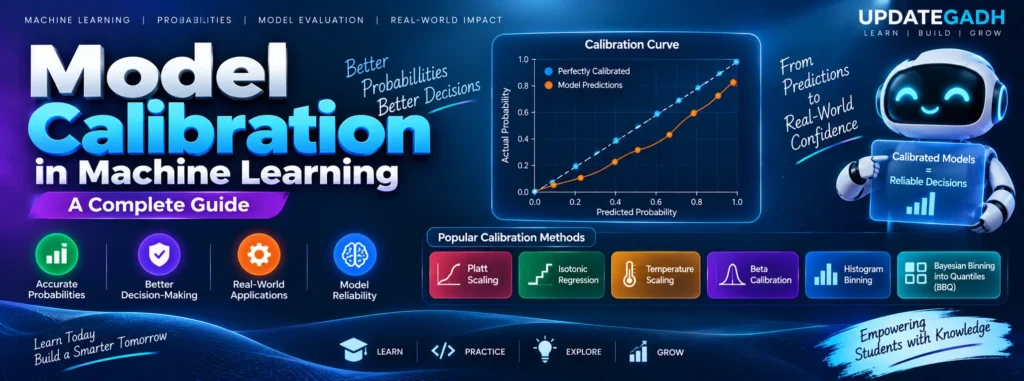
Common techniques such as Platt Scaling, Isotonic Regression, and Temperature Scaling are used to recalibrate a models outputs. Calibration quality is typically evaluated using calibration curves and metrics like Brier Score and Expected Calibration Error (ECE).
Complete Advance AI Topics: Click Here
SQL Tutorial: Click Here
Common Methods for Model Calibration
1. Platt Scaling
Platt Scaling involves fitting a logistic regression model to the outputs of an already-trained classifier. It is especially effective with binary classifiers such as Support Vector Machines (SVMs). This method assumes a linear relationship between the classifier’s output and the true probability, making it both simple and efficient. It is a go-to option when dealing with models that tend to be overconfident.
2. Isotonic Regression
Isotonic Regression is a non-parametric method that fits a monotonic piecewise function to the predicted probabilities. Unlike Platt Scaling, it doesnt assume a linear relationship, making it more flexible and suitable for models like decision trees and random forests. However, it can be prone to overfitting, particularly with small or noisy datasets.
3. Temperature Scaling
Temperature Scaling is a simple yet powerful technique used primarily in neural networks. It modifies the logits (raw model outputs) by a single scalar (temperature) before applying the softmax function. This method effectively reduces the confidence of overconfident predictions without altering the relative ranking of outputs. It is highly favored in deep learning, especially in tasks such as image classification.
4. Bayesian Binning into Quantiles (BBQ)
BBQ is a more sophisticated calibration technique that divides predicted probabilities into quantiles and applies Bayesian analysis within each. It offers improved calibration in complex distributions where traditional methods might struggle. However, due to its computational complexity, its less commonly used in practice.
5. Beta Calibration
An extension of Platt Scaling, Beta Calibration fits a Beta distribution to the predicted probabilities, allowing for more flexible adjustments. It is particularly helpful when the calibration curve deviates significantly from a logistic form. Though more accurate, it involves greater complexity and requires careful parameter tuning.
6. Histogram Binning
Histogram Binning is a straightforward method where the probability range is divided into bins, and probabilities within each bin are adjusted based on observed frequencies. Its easy to implement and works well on smaller datasets, but may underperform in complex modeling scenarios with intricate probability structures.
Popular Tools and Libraries for Model Calibration
Scikit-learn
Scikit-learn provides CalibratedClassifierCV, a utility to apply Platt Scaling or Isotonic Regression. It supports cross-validation to reduce overfitting and includes tools to visualize calibration curves and compute calibration scores.
TensorFlow
TensorFlow allows manual implementation of calibration techniques like Temperature Scaling. Though it doesnt offer built-in utilities, its flexibility and extensibility make it ideal for customizing calibration, especially in deep learning architectures.
PyTorch
Similar to TensorFlow, PyTorch supports custom implementation of calibration methods like Isotonic Regression and Temperature Scaling. With its dynamic computation graph, PyTorch is popular among researchers testing novel calibration techniques in neural networks.
NetCal
NetCal is a specialized Python library for calibration, supporting advanced techniques including Beta Calibration, Histogram Binning, and BBQ. It provides tools for evaluation and visualization, making it suitable for users seeking granular control over model calibration.
Calibration Tools in R
In R, libraries like caret, PlattScaling, and IsotonicRegression provide tools for calibration. Additionally, mlr3 and e1071 offer flexible interfaces to incorporate calibration into various machine learning workflows.
H2O.ai
H2Os AutoML platform includes built-in support for Isotonic Regression and Platt Scaling, streamlining calibration in both small and large-scale machine learning applications. Its integration with Python and R makes it a versatile choice.
StatsModels
Though not calibration-specific, StatsModels supports logistic regression and other statistical models that can be used for calibration. It is best suited for researchers who require statistical rigor and transparency in model adjustments.
Applications of Model Calibration
1. Risk Assessment and Management
In sectors like finance and insurance, calibration ensures accurate estimation of risks such as loan defaults or insurance claims. Proper calibration enables businesses to allocate capital effectively and avoid either underestimating or overestimating risk, both of which carry financial consequences.
2. Healthcare and Diagnostics
In healthcare, calibrated models help clinicians make informed decisions based on diagnostic probabilities. Miscalibrated models may lead to under-treatment or over-treatment, both of which can compromise patient outcomes.
3. Customer Behavior Prediction
In e-commerce and marketing, models that predict churn, purchase intent, or click-through rates benefit from calibration. Accurate probabilities allow businesses to personalize experiences, optimize campaigns, and increase ROI through better-targeted strategies.
4. Weather Forecasting
Calibrated models enhance the reliability of probabilistic weather forecasts, such as predicting precipitation likelihood or severe weather. This is crucial for public safety, agricultural planning, and emergency management.
5. Financial Services and Credit Scoring
In credit scoring, calibration aligns predicted default probabilities with actual outcomes, helping lenders set interest rates, approve loans appropriately, and mitigate risk in their portfolios.
6. Robotics and Autonomous Systems
In autonomous vehicles and robotics, calibrated models support safe navigation by accurately estimating the probability of obstacles, pedestrian movement, or traffic behavior. Calibration here is directly tied to safety and functionality.
Download New Real Time Projects :Click here
Conclusion
Model calibration is a critical but often overlooked component of building reliable machine learning systems. From simple logistic adjustments to complex Bayesian methods, the choice of calibration technique depends on the use case, model complexity, and available data. Leveraging appropriate tools and methods not only improves trust in predictions but also enhances real-world decision-making, especially in high-impact domains.
For more detailed tutorials and practical guides on machine learning topics, stay connected with UpdateGadhyour trusted source for modern tech education.
model calibration example
model calibration python
what is model calibration
model calibration vs validation
model calibration sklearn
model calibration deep learning
model calibration isotonic regression
calibration plot machine learning
model calibration in machine learning python