
Introduction to ER Model in DBMS
When working with databases, one of the foundational tools used for conceptual database design is the Entity-Relationship (ER) model. This model helps in outlining the data elements and their relationships in a visual format. The result is the ER diagram, which serves as a blueprint for the logical structure of a database.
In this article by , we will delve into the key concepts of the ER model, its components, properties, and how it’s essential for effective database design.
Table of Contents
Complete Advance AI Topics: Click Here
SQL Tutorial: Click Here
What is the ER Model?
The ER model (Entity-Relationship model) is a high-level data model used to define and structure data elements and their relationships. It plays a crucial role in building a conceptual design of the database, making the view of data simple, clear, and systematic.
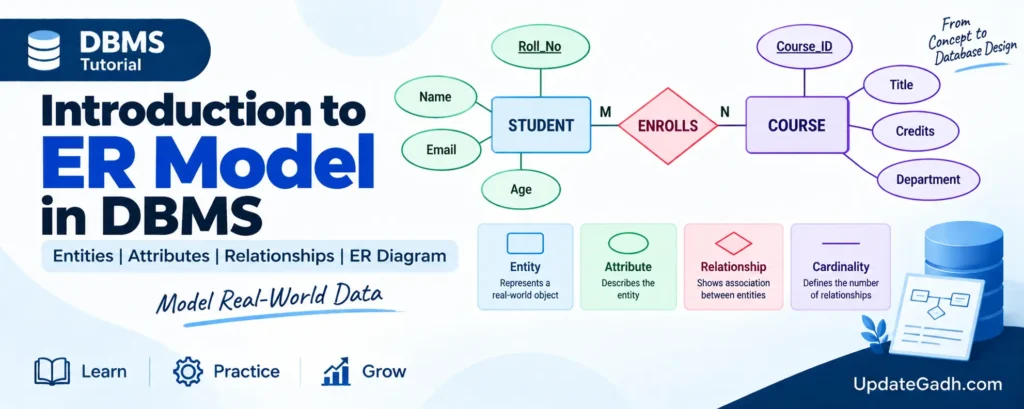
Entities, their characteristics, and the connections between them are all graphically represented in an ER diagram. For instance, in a school database, entities might include Student, Teacher, or Address. Each entity has attributeslike Student has ID, Name, Age, Address, etc. If Address is also treated as an entity, then a relationship between Student and Address is established.
Key Properties of the ER Model
- Easily convertible into the relational model.
- Uses a top-down approach for database design.
- Simplifies the design process, especially for developers and analysts.
- Provides a standardized and logical way to visualize and understand data.
- Ensures clarity and reduces ambiguity, making it easy for both technical and non-technical stakeholders.
Terminologies in the ER Model
| Term | Description |
|---|---|
| Entity | Object or concept with data stored about it (e.g., Student, Room). |
| Attribute | Attributes of an entity, such as its name or age. |
| Relationship | logical connection between things. |
| Degree | Number of entities in a relationship. |
| Cardinality | Number of instances of one entity related to another. |
| Connectivity | Relationship types include 1:1, 1:N, N:M, and others. |
| Direction | Parent-child nature of relationship, showing flow between entities. |
Components of ER Diagram
1. Entity
An entity represents a real-world object or concept. It is depicted as a rectangle in the ER diagram.
Examples:
- In a company: Employee, Manager, Department are entities.
- The characteristics of every entity characterise it.
Types of Entities
- Strong Entity
Possesses a primary key and is capable of existing on its own. Represented by a single rectangle. - Weak Entity
Cannot exist without a related strong entity and has no primary key. Represented by a double rectangle.
| Feature | Weak Entity | Strong Entity |
|---|---|---|
| Primary Key | No | Yes |
| Representation | Double rectangle | Single rectangle |
| Key Attribute | Partial key (dashed underline) | Primary key (solid underline) |
| Relationship Line | Double line | Single line |
| Participation Constraint | Always total | May or may not be total |
2. Entity Type and Entity Set
- Entity Type: A collection of entities that share the same attributes but differ in values (e.g., All Students).
- Entity Set: Collection of instances of an entity type at any given point in time.
3. Attributes
Attributes are properties or characteristics of an entity. These are represented by ellipses.
Types of Attributes
- Key Attribute: Uniquely identifies each entity (e.g., Student_ID).
- Composite Attribute: Made up of multiple attributes (e.g., Full Name = First Name + Last Name).
- Multivalued Attribute: May contain more than one value (e.g., Phone Numbers).
- Derived Attribute: A person’s age can be inferred from their date of birth, for example.
- Simple Attribute: atomic characteristics (like price) that are indivisible.
4. Relationships
Relationships define how entities are connected to one another. Represented by a diamond (rhombus) symbol.
Types of Relationships
- One-to-One (1:1):
One entity instance is associated with one of another.
Example: One passport per person. - One-to-Many (1:N):
One entity instance is associated with many of another.
Example: One teacher teaches many students. - Many-to-One (N:1):
Many entity instances are associated with one of another.
Example: Many employees work in one department. - Many-to-Many (M:N):
Many instances of both entities are related.
Example: Many students enroll in many courses.
5. Degree of Relationship
Defines how many entities are involved in a relationship.
| Degree Type | Description |
|---|---|
| Unary | Relationship within the same entity (e.g., employee supervises employee). |
| Binary | Between two entities (most common). |
| Ternary | Among three entities. |
| Quaternary | Among four entities (rare; usually split into binary). |
6. Cardinality of Relationship
The minimum and maximum number of times an entity can be linked to another is known as cardinality.
- Represented in (min, max) format.
- Example: (0,20) next to Department and (1,1) next to Employee means:
- A department can have 0 to 20 employees.
- An employee is only allowed to work in one department.
Types:
- Optional (0 cardinality): Not required.
- Mandatory (min 1): Must exist.
7. Direction of Relationship
Defines the flow between related entities.
- The parent entity initiates the relationship.
- The child entity receives it.
- Direction helps determine dependency and navigation paths in the database.
Download New Real Time Projects :-Click here
Final Thoughts
The ER diagram is a vital component in designing robust, scalable, and logical database systems. By understanding and implementing entities, attributes, and relationships effectively, developers can build efficient databases aligned with real-world requirements.
Whether you’re building a school management system or a complex enterprise solution, mastering the ER model equips you with the clarity and precision needed for successful database design.
er model in dbms
er model in dbms pdf
er diagram examples with solutions
features of er model in dbms
er diagram in dbms examples
er diagram symbols
entity relationship diagram example
components of er diagram
introduction of er model in dbms
introduction of er model with example
introduction of er model pdf
introduction of er model in database
introduction of er model in sql