DBMS Aggregation
Introduction
In the world of databases, managing complex relationships between data elements efficiently is vital. One such method that simplifies these complexities is Aggregation in DBMS. Aggregation allows treating the relationship between two entities as a higher-level entity. This article by Updategadh explores the concept of DBMS aggregation, its use cases, and how it enhances database design and operations.
Imagine a coaching center offers different courses. A visitor who approaches the center is likely to inquire about both the center and its courses togethernot in isolation. In this context, the Center and Course entities can be aggregated and treated as a single unit when establishing a relationship with the Visitor entity.
What is Aggregation in DBMS?
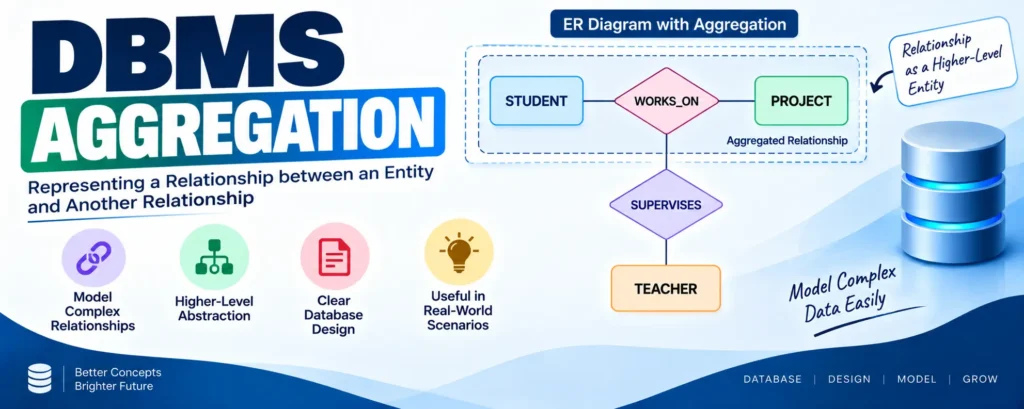
Aggregation in a DBMS refers to the process where relationships themselves are treated as higher-level entities. When individual entities or their relationships do not provide sufficient context or meaning on their own, aggregation helps by combining them to form a meaningful abstraction.
It essentially allows a relationship set to participate in another relationship. This is particularly useful when the relationship between two entities must be connected to a third entity.
For example, if a Patient visits a Doctor for a Diagnosis, this relationship can be aggregated into one entity, say Patient_Diagnosis, which then interacts with the Hospital Filing System. Without such aggregation, representing this flow of information in the database would be overly complex and less intuitive.
Complete Advance AI Topics: Click Here
SQL Tutorial: Click Here
Aggregation Functions in DBMS
DBMS also uses aggregate functions to summarize and analyze data. These functions simplify data processing and are essential for reporting, data mining, and decision-making.
- SUM: Adds all the numeric values in a column.
- AVG: Calculates the average of numeric values.
- MIN: Finds the smallest value in a dataset.
- MAX: Identifies the largest value in a dataset.
- COUNT: Counts the number of entries in a column.
- DISTINCT: Returns the count of unique entries.
- HAVING: Filters aggregated data after grouping, similar to a post-group filter.
Real-Life Example of Aggregation
Lets consider a simplified hospital system:
- Entities: Patient, Doctor, Diagnosis
- Relationships: Filing, Diagnosis
Here, the Doctor provides a Diagnosis after examining the Patient. This diagnosis, along with the patients history, is stored for future reference. The Diagnosis is not meaningful without the Patient, and the Doctor cannot make a diagnosis without the Patients History. Hence, the DoctorDiagnosisPatient relationship is aggregated and linked to the Filing System, forming a higher-level entity.
When is Aggregation Required?
There are several use cases in DBMS where aggregation becomes essential:
1. Complex Relationship Modeling
When a relationship itself needs to participate in another relationship, aggregation becomes a necessity. For instance, in a university database, the Enrollment relationship between Students and Courses may need to be related to Grades.
2. Data Analysis & Business Intelligence
Aggregated data helps in:
- Generating reports
- Running statistical analyses
- Making informed business decisions
- Enhancing visualization (charts, graphs, dashboards)
3. Redundancy Management
Aggregation helps consolidate duplicate or trivial entities, making data governance more efficient. For example, several trivial room entities can be grouped to form a Hotel entity.
4. Handling Trivial Entities
Entities that lack standalone significance (like Dependents of an Employee) can be made meaningful by aggregating them with parent entities for various operations like insurance or payroll.
5. Optimization of Relationships
Some relationships are not directly translatable into entity-relationship models. Aggregation allows these relationships to be effectively modeled for seamless integration within the system.
Applications of Aggregation in DBMS
a. Information Tracking
Used in logs, records, and historical tracking for healthcare, education, and financial systems.
b. Interview & Assessment Analysis
Effective in gathering and organizing candidate data for assessments or feedback reviews.
c. Performance Optimization
Pre-computing aggregated values reduces computational load during query execution, leading to faster data retrieval.
Aggregation in ER Models
Aggregation is best visualized through Entity-Relationship (ER) diagrams. It involves the following types of relationships:
- One-to-One: A single entity is related to only one other entity. (e.g., One manager heads one department)
- One-to-Many: One entity is associated with multiple others. (e.g., One teacher teaches many students)
- Many-to-One: Many entities relate to a single entity. (e.g., Many students attend one school)
- Many-to-Many: Multiple entities from both sides relate to each other. (e.g., Students enrolling in multiple courses)
In a DBMS aggregation flow, entities A and B are first connected via relationship R1. This entire combination is then aggregated and connected to entity C via a new relationship R2. This structured abstraction enhances data modeling, especially in systems requiring hierarchical relationships.
Why Aggregation is Important in DBMS
- Efficient Data Management: Reduces data clutter and simplifies structure.
- Improved Query Performance: Pre-aggregated data allows faster searches.
- Simplified Reporting: Enhances dashboards and summaries for decision-makers.
- Enhanced Privacy: Helps in anonymizing data while retaining insights.
- Support for Statistical Computation: Essential for average, sum, and count analyses.
Frequently Asked Questions
1. What does aggregation mean in an ER model?
Aggregation in an ER model allows a relationship to be treated as an entity, enabling it to participate in other relationships, simplifying complex scenarios.
2. Where is aggregation used in DBMS?
Aggregation is used in reporting, SQL queries, data warehousing, OLAP systems, and wherever data simplification and summarization are required.
3. Why is aggregation important?
It allows better data organization, enables complex relationship modeling, speeds up queries, and supports data analysis and visualization.
4. What are the drawbacks of DBMS aggregation?
While aggregation offers several benefits, it can lead to:
- Increased storage requirements
- Loss of detailed data
- Maintenance challenges
- Overhead during aggregation calculations
Download New Real Time Projects :-Click here
Conclusion
Aggregation is a foundational concept in modern database systems. It offers a scalable, efficient, and logical approach to managing complex relationships between data entities. Whether used for simplifying database design, enhancing query performance, or improving business intelligence, aggregation empowers DBMS users to make informed and structured decisions. As organizations handle increasingly complex datasets, the importance of aggregation continues to growensuring that data remains usable, insightful, and optimized for performance.
For more such insights, keep exploring your go-to destination for tech tutorials and database fundamentals.
what is aggregation in dbms with example
types of aggregation in dbms
generalization in dbms
specialization in dbms
aggregation diagram in dbms
composition in dbms
normalization in dbms