Finding the Sum of Digits
Finding the sum of the digits of a number is one of the most useful beginner-level programming exercises. Although the problem looks simple, it introduces several important programming concepts, including loops, arithmetic operators, integer division, functions, and number manipulation.
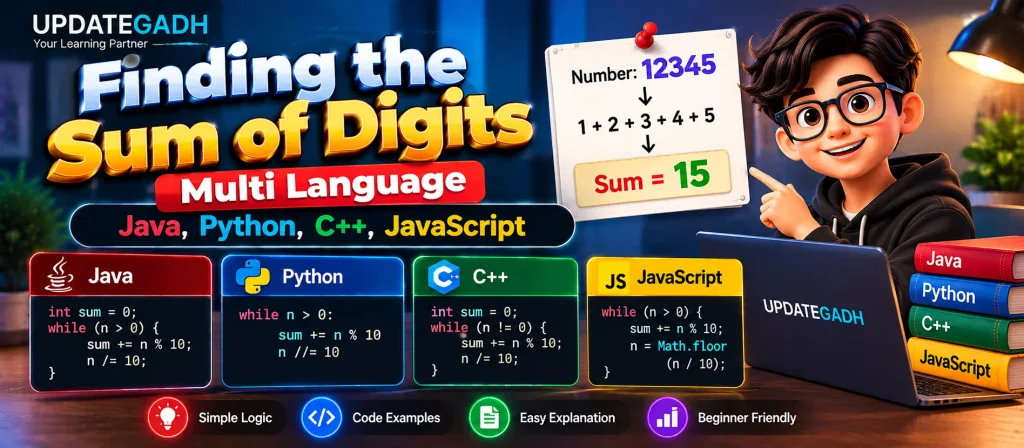
In this tutorial, we will learn how to calculate the sum of digits using four popular programming languages: Java, Python, C++, and JavaScript. The basic algorithm remains almost identical in every language, while the syntax used to implement it changes.
For example, if the input number is 12345, its digits are 1, 2, 3, 4, and 5. Therefore:
1 + 2 + 3 + 4 + 5 = 15The main idea is to repeatedly extract the last digit, add it to a total, and then remove that digit from the original number. This simple technique is useful for understanding how programming languages handle numerical operations.
How Does the Sum of Digits Algorithm Work?
The algorithm uses two important operations: the modulo operator (%) and division by 10.
The modulo operation gives the last digit of a number. For example:
12345 % 10 = 5After obtaining the last digit, we add it to the sum. We then divide the number by 10 using integer division so that the last digit is removed.
12345 → 1234 → 123 → 12 → 1 → 0The process continues until the number becomes zero.
Step-by-Step Example
Let’s understand the process using the number 12345.
| Step | Number | Last Digit | Sum |
|---|---|---|---|
| 1 | 12345 | 5 | 5 |
| 2 | 1234 | 4 | 9 |
| 3 | 123 | 3 | 12 |
| 4 | 12 | 2 | 14 |
| 5 | 1 | 1 | 15 |
After the final step, the number becomes zero and the calculated sum is 15.
1. Finding the Sum of Digits in Java
Java can solve this problem using a simple while loop. The modulo operator extracts the last digit, while integer division removes it.
public class FindSumOfDigits {

    public static int sumOfDigits(int number) {
        int sum = 0;

        while (number != 0) {
            sum += number % 10;
            number /= 10;
        }

        return sum;
    }

    public static void main(String[] args) {
        int number = 12345;

        System.out.println(
            "Sum of digits: " + sumOfDigits(number)
        );
    }
}
Output:
Sum of digits: 15How the Java Code Works
The variable sum starts at zero. During every iteration, number % 10 obtains the last digit and adds it to sum. The statement number /= 10 removes the processed digit. When the number reaches zero, the function returns the final sum.
2. Finding the Sum of Digits in Python
Python provides a concise syntax for implementing the same algorithm. Integer division can be performed using the // operator.
def sum_of_digits(number):
    total = 0

    while number > 0:
        total += number % 10
        number //= 10

    return total


number = 12345

print("Sum of digits:", sum_of_digits(number))
Output:
Sum of digits: 15Understanding the Python Code
The function receives a number as an argument and initializes total to zero. The modulo operator extracts each digit from right to left. Python’s floor-division operator // removes the last digit after it has been processed.
3. Finding the Sum of Digits in C++
The C++ implementation follows the same mathematical process. A function is created to calculate the sum, while the main() function supplies the input.
#include <iostream>
using namespace std;

int sumOfDigits(int number) {
    int sum = 0;

    while (number != 0) {
        sum += number % 10;
        number /= 10;
    }

    return sum;
}

int main() {
    int number = 12345;

    cout << "Sum of digits: "
         << sumOfDigits(number)
         << endl;

    return 0;
}
Output:
Sum of digits: 15Understanding the C++ Code
The C++ solution uses the same loop-based approach. The modulo operator retrieves the last digit, and integer division by 10 reduces the number. The accumulated value is returned after all digits have been processed.
4. Finding the Sum of Digits in JavaScript
JavaScript can also implement the algorithm using a while loop. Since JavaScript does not use the same integer-division operator as Python, Math.floor() can be used to remove the fractional portion after division.
function sumOfDigits(number) {
    let sum = 0;

    while (number > 0) {
        sum += number % 10;
        number = Math.floor(number / 10);
    }

    return sum;
}

const number = 12345;

console.log(
    "Sum of digits:", sumOfDigits(number)
);
Output:
Sum of digits: 15Understanding the JavaScript Code
The variable sum stores the accumulated value. The expression number % 10 obtains the final digit. After that, Math.floor(number / 10) reduces the number to the remaining digits. The loop ends when the number reaches zero.
Comparison of the Four Approaches
| Language | Digit Extraction | Digit Removal | Loop |
|---|---|---|---|
| Java | % 10 | /= 10 | while |
| Python | % 10 | //= 10 | while |
| C++ | % 10 | /= 10 | while |
| JavaScript | % 10 | Math.floor(/ 10) | while |
The important observation is that the algorithm does not fundamentally change between languages. Only the syntax and integer-division behavior differ.
Why Is This Problem Important?
Finding the sum of digits is more than a simple mathematical exercise. It helps beginners understand how a number can be processed one digit at a time without converting it into a string.
The same concepts can be applied to many other programming problems. Once you understand how to extract the last digit and remove it, you can solve problems involving digit reversal, counting digits, finding particular digits, checking numerical properties, and similar tasks.
Common Programming Concepts Practiced
- Loops: Repeatedly process each digit.
- Modulo operator: Extract the last digit.
- Division: Remove the processed digit.
- Variables: Store the number and running total.
- Functions: Separate the calculation from the main program.
- Conditional logic: Control when the loop should stop.
Important Point About Negative Numbers
The examples above primarily demonstrate the algorithm with positive integers. If negative numbers need to be supported, the program should first decide how the sign should be handled. A common approach is to work with the absolute value of the number before processing its digits.
This detail is important because division and modulo behavior can vary when negative values are involved, especially when comparing implementations across different languages.
Complete Advance AI Topics: Click Here
Real Time Projects:- DecodeIT
Conclusion
Finding the sum of digits is a small programming problem with significant educational value. The basic process is simple: extract the last digit using the modulo operator, add it to a running total, remove the last digit through division, and repeat until no digits remain.
We implemented the same logic using Java, Python, C++, and JavaScript. Although each language uses slightly different syntax, the underlying algorithm remains consistent. Practicing the problem in multiple languages is a useful way to understand both common programming principles and language-specific features.
Once this technique is comfortable, students can apply the same number-processing approach to many other programming exercises and improve their logical problem-solving skills.
FAQs – Finding the Sum of Digits
1. What is the sum of digits?
The sum of digits is obtained by adding all individual digits of a number. For example, the sum of 12345 is 15.
2. Which operator is used to extract the last digit?
The modulo operator % is used to obtain the last digit of a number when it is divided by 10.
3. Why is the number divided by 10?
Dividing an integer by 10 removes its last digit, allowing the program to process the next digit.
4. Can this problem be solved in Java?
Yes. Java can calculate the sum of digits using a while loop, modulo, and integer division.
5. Can Python calculate the sum of digits?
Yes. Python can use the % and // operators to process each digit.
6. Can C++ be used for this problem?
Yes. C++ supports the same loop and arithmetic approach used in the Java implementation.
7. How does JavaScript remove the last digit?
JavaScript can use Math.floor(number / 10) to reduce the number to its remaining digits.
8. What is the sum of digits of 12345?
The result is 15, because 1 + 2 + 3 + 4 + 5 equals 15.
9. Can this logic be used for other number problems?
Yes. The same digit-extraction technique can be adapted for problems such as reversing a number, counting digits, and checking numerical properties.
10. Is this problem suitable for beginners?
Yes. It is a useful beginner exercise for understanding loops, arithmetic operators, functions, and basic number manipulation.
Keywords: Finding the Sum of Digits, sum of digits in Java, sum of digits in Python, sum of digits in C++, sum of digits in JavaScript, Java sum of digits program, Python sum of digits program, C++ sum of digits program, JavaScript sum of digits, sum of digits source code, digit manipulation programs