
Product Recommendation Systems
Product Recommendation Systems have become an important part of many digital platforms. When a website suggests a product that matches a user’s interests, it is usually using a recommendation system behind the scenes. These systems analyze information about users, products, and previous interactions to generate personalized suggestions.
Recommendation technology is widely associated with platforms such as YouTube, Amazon, and Netflix, where personalized suggestions can help users discover content or products that may be relevant to them. For businesses, recommendation systems can support engagement, personalization, sales, and customer retention.
In this guide, we will understand how product recommendation systems work, explore their major types, discuss their benefits, look at commonly used algorithms, and walk through the basic steps involved in building a recommendation system.
What Is a Product Recommendation System?
A product recommendation system is an intelligent software system that analyzes available information to suggest products that may be relevant to a particular user. Instead of showing exactly the same products to every visitor, the system can use user preferences, product information, and previous interactions to generate more personalized recommendations.
For example, if a customer frequently views or purchases a particular category of products, a recommendation system can identify related patterns and suggest additional products that match those interests.
How Product Recommendation Systems Work
Recommendation systems generally examine relationships between users and items. The source content highlights three important dimensions that can be considered when generating recommendations.
1. User-to-Item Compatibility
This approach focuses on whether a particular user is likely to be interested in a particular item. The system can use available interaction information to estimate how relevant a product may be to that user.
2. User Similarities
Users with similar interests or interaction patterns can be connected. If two users show similar preferences, products associated with one user’s interests may potentially be recommended to the other.
3. Item Similarities
The system can also identify relationships between products. When a user interacts with one product, the recommendation engine can look for other items that share similar characteristics or patterns of interest.
These relationships provide the foundation for several recommendation approaches, including collaborative filtering, content-based filtering, and hybrid systems.
Types of Product Recommendation Systems
1. Collaborative Filtering
Collaborative filtering uses user-item interaction information to generate recommendations. Instead of focusing primarily on the individual characteristics of a product, it looks at patterns created by users’ interactions with items.
For example, an online store might identify that customers who purchased one product frequently purchased another product as well. Based on this interaction pattern, the second product can be recommended to users who are interested in the first one.
A familiar example is the recommendation message often expressed as “People who bought this also bought…”.
2. Content-Based Filtering
Content-based filtering focuses on the characteristics of items. The system examines information associated with products and compares those characteristics with products or interests that a user has previously interacted with.
For example, if a customer shows interest in a particular type of product, the system can identify other products with similar characteristics and recommend them.
A simple example is: “You might like Y because you liked X.”
3. Hybrid Recommendation Systems
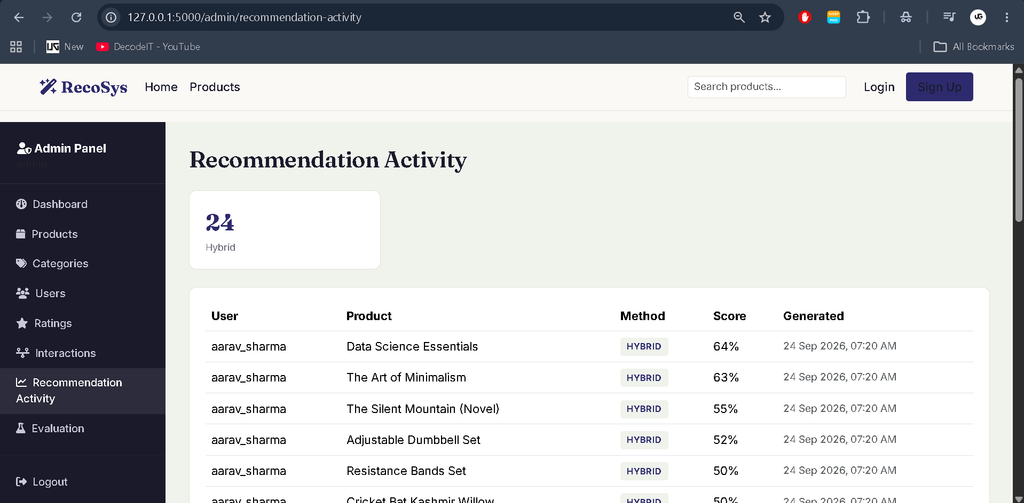
Hybrid systems combine multiple recommendation approaches. A hybrid model can use both user interaction patterns and item characteristics when generating suggestions.
This combination can provide a broader recommendation strategy because the system is not limited to only user behavior or only product information. The source identifies Netflix and Amazon as examples of platforms associated with hybrid recommendation approaches.
Key Benefits of Product Recommendation Systems
Enhanced Customer Experience
Personalized suggestions can make it easier for users to discover products that match their interests. Instead of manually searching through a large catalog, customers can receive recommendations based on available preference information.
Increased Sales
Relevant recommendations can encourage customers to explore additional products. Businesses can use recommendation systems to support product discovery, impulse purchases, and upselling opportunities.
Customer Retention
Personalized experiences can encourage users to return to a platform. When customers consistently find relevant products or content, recommendations can become an important part of their overall experience.
Operational Efficiency
A recommendation engine can automate product curation. Instead of manually selecting suggestions for every customer, businesses can use algorithms to generate recommendations from available data.
How to Build a Product Recommendation System
Building a recommendation system involves several stages. The exact implementation depends on the available data, business requirements, and selected algorithm, but the general workflow can be organized into the following steps.
Step 1: Data Collection
The first stage is gathering the information required by the recommendation model. This can include user activity, ratings, interactions, and product features.
For example, a system may work with information about products a user has viewed, rated, or purchased. Product attributes can also be collected when using content-based approaches.
Step 2: Data Preprocessing
Raw data usually needs to be cleaned and organized before it can be used by a recommendation algorithm. Preprocessing can involve preparing user-item interactions, handling the available product information, and organizing the dataset into a useful format.
The quality and organization of the input data are important because recommendation models depend on the patterns contained in that data.
Step 3: Select a Recommendation Model
The next step is choosing an approach that matches the problem. Depending on the project, you may select collaborative filtering, content-based filtering, or a hybrid model.
The selected approach should be connected to the type of data available and the kind of recommendations the application needs to generate.
Step 4: Train the System
Once the data has been prepared and the model selected, the system can be trained to identify patterns in the available information. The training process depends on the algorithm being used.
For example, a collaborative filtering system can learn from user-item interaction patterns, while a content-based approach can work with product characteristics and user preferences.
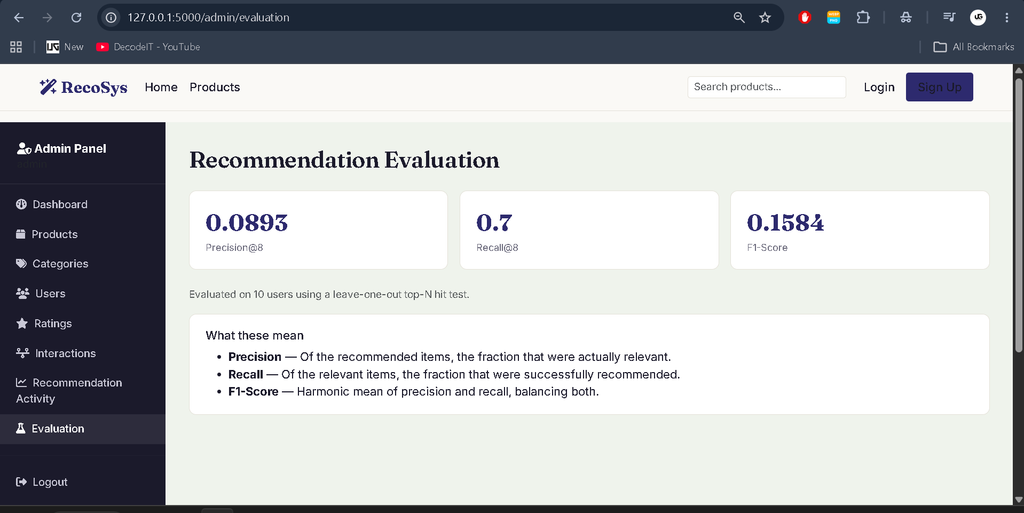
Step 5: Evaluate the Recommendations
After developing the recommendation model, its results should be evaluated. The source identifies metrics such as precision, recall, and F1-score for measuring recommendation performance.
Evaluation helps determine how effectively the system is producing relevant recommendations and provides a basis for improving the model.
How to Download
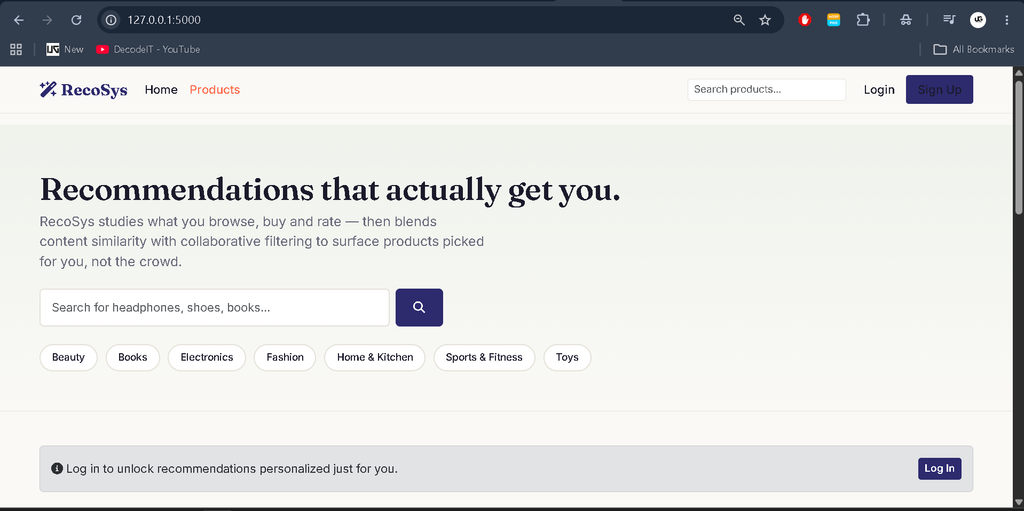
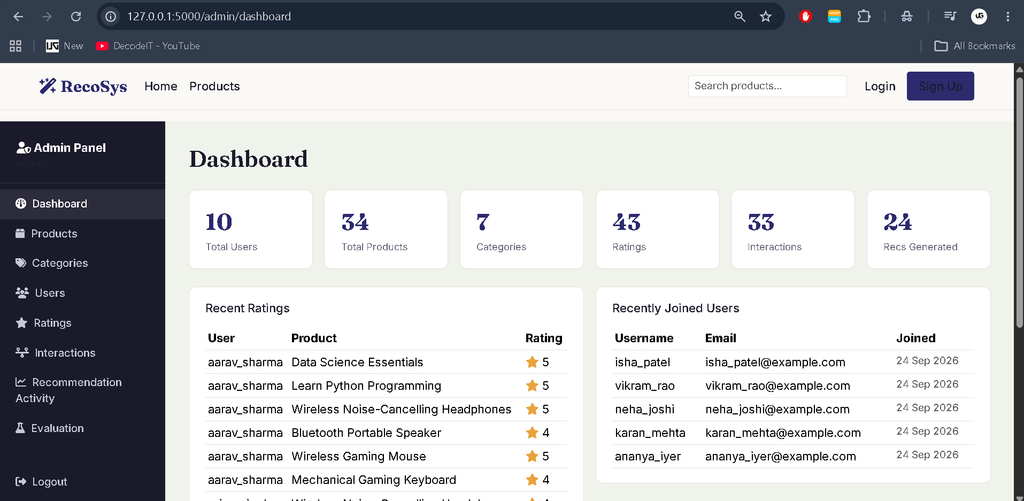
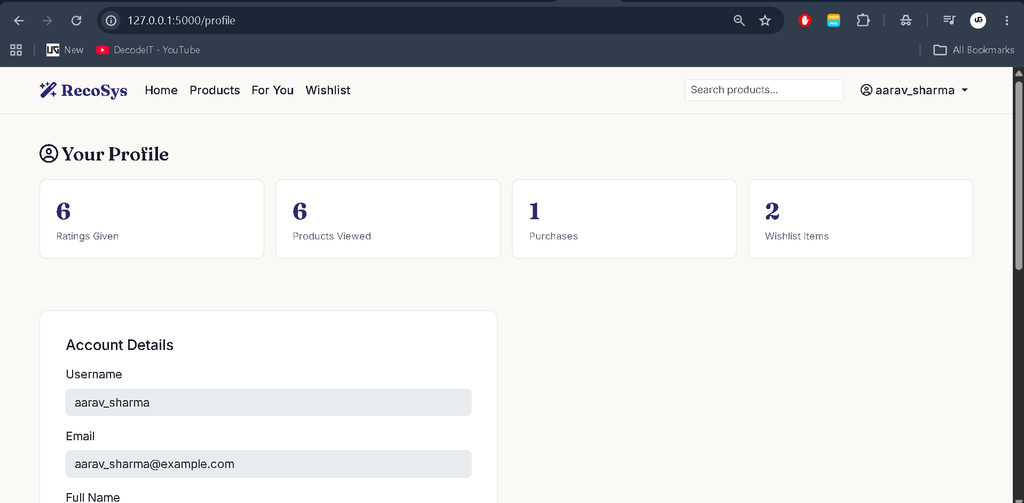
The complete package is available so you can run, study, and submit it with confidence. It includes:
- Full Source Code
Screenshot


Popular Algorithms Used in Recommendation Systems
Matrix Factorization
Matrix factorization is an important technique used in recommendation systems. SVD, or Singular Value Decomposition, is one approach associated with matrix factorization. It can be used to work with relationships represented through user-item interaction data.
K-Nearest Neighbors
K-Nearest Neighbors, commonly called KNN, can be used to identify similar users or items based on available data. The nearest or most similar examples can then contribute to recommendation generation.
Neural Collaborative Filtering
Neural Collaborative Filtering applies deep learning techniques to collaborative filtering. Neural networks can be used to learn more complex patterns from user-item interactions.
Cosine Similarity
Cosine similarity is commonly used when comparing items represented as feature vectors. In content-based recommendation systems, it can help determine how similar two products are based on their available characteristics.
Recommendation System Workflow
A simple recommendation project can be viewed as a sequence of connected stages:
- Collect user and product information.
- Clean and organize the available data.
- Select a recommendation strategy.
- Train or calculate the recommendation model.
- Generate relevant product suggestions.
- Evaluate the quality of the recommendations.
- Improve the system based on the evaluation results.
This workflow provides a practical foundation for developing a recommendation engine. More advanced systems can introduce additional data, models, and optimization techniques depending on the requirements of the application.
Collaborative vs Content-Based vs Hybrid
| Approach | Main Focus | Basic Idea |
|---|---|---|
| Collaborative Filtering | User-item interactions | Use patterns from users and their interactions with products. |
| Content-Based Filtering | Product characteristics | Recommend items similar to products the user has already liked or interacted with. |
| Hybrid Model | Multiple sources | Combine different recommendation approaches. |
Complete Advance AI Topics: Click Here
SQL Tutorial: Click Here
YT:- DecodeIT
Conclusion
Product recommendation systems provide a way to create more personalized digital experiences by connecting users with potentially relevant products. They can analyze user-item compatibility, similarities between users, and relationships between items to generate recommendations.
The three major approaches discussed in this guide are collaborative filtering, content-based filtering, and hybrid recommendation systems. Each approach works with different types of information and can be selected according to the requirements of a project.
A basic recommendation system development process includes collecting data, preprocessing it, selecting a model, training the system, and evaluating its results. Techniques such as matrix factorization, K-Nearest Neighbors, Neural Collaborative Filtering, and cosine similarity can be used in different recommendation scenarios.
Whether you are building a machine learning project for learning or developing a recommendation feature for a digital platform, understanding these fundamentals provides a useful starting point for working with recommendation engines.
FAQs – Product Recommendation Systems
1. What is a product recommendation system?
A product recommendation system is a software system that analyzes user and product information to suggest items that may be relevant to a particular user.
2. What are the main types of recommendation systems?
The main types discussed here are collaborative filtering, content-based filtering, and hybrid recommendation systems.
3. What is collaborative filtering?
Collaborative filtering uses user-item interaction patterns to generate recommendations based on similarities between users or their interactions with items.
4. What is content-based filtering?
Content-based filtering uses product characteristics and a user’s previous interests to recommend similar items.
5. What is a hybrid recommendation system?
A hybrid recommendation system combines multiple recommendation approaches, such as collaborative and content-based filtering.
6. Which algorithms are used in recommendation systems?
Common approaches include matrix factorization such as SVD, K-Nearest Neighbors, Neural Collaborative Filtering, and cosine similarity.
7. What data is required to build a recommendation system?
Depending on the approach, a system can use user activity, ratings, product features, and other user-item interaction information.
8. How can a recommendation system be evaluated?
Precision, recall, and F1-score are among the evaluation metrics identified in this guide for measuring recommendation performance.
Keywords: Product Recommendation Systems, product recommendation system tutorial, recommendation system using machine learning, collaborative filtering Python, content-based filtering, hybrid recommendation system, recommendation engine algorithm, recommendation system project, matrix factorization SVD