Heart Disease Risk Prediction in Python
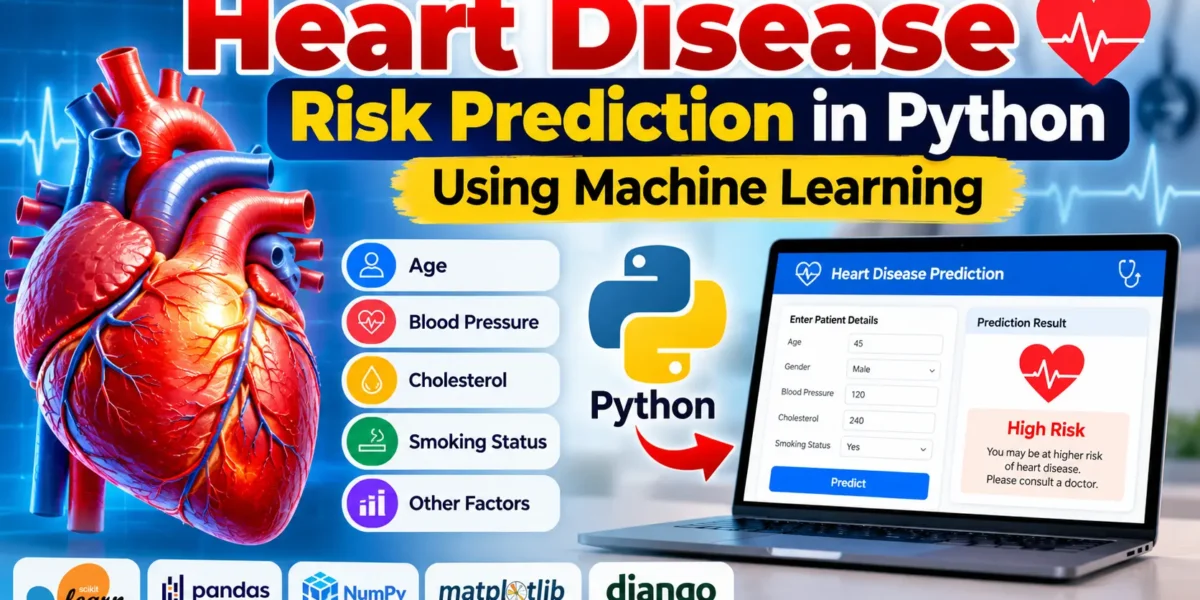
Heart Disease Risk Prediction in Python is a machine learning project designed to analyze medical data and estimate the risk of heart disease. The system uses health-related attributes such as age, gender, cholesterol levels, blood pressure, and other relevant medical indicators to generate predictions using a trained machine learning model. Early identification of potential heart disease risk can help healthcare professionals determine whether further medical evaluation is needed. This project demonstrates how Python and machine learning can be applied to healthcare data analysis and predictive modeling. For students, this project provides practical experience with data preprocessing, feature selection, model training, prediction, and evaluation. It is suitable for understanding how machine learning can be applied to real-world healthcare problems.
Complete Advance AI Topics: Click Here
Real Time Projects on YouTube:- DecodeIT
Project Overview
| Project Details | Information |
|---|---|
| Project Name | Heart Disease Risk Prediction in Python |
| Programming Language | Python |
| Machine Learning Library | Scikit-learn |
| Framework | Django or Flask, if included |
Introduction
Heart disease is a major global health concern, and identifying potential risk factors is an important part of preventive healthcare. Machine learning can analyze patterns in medical datasets and use those patterns to estimate the likelihood of a particular outcome.
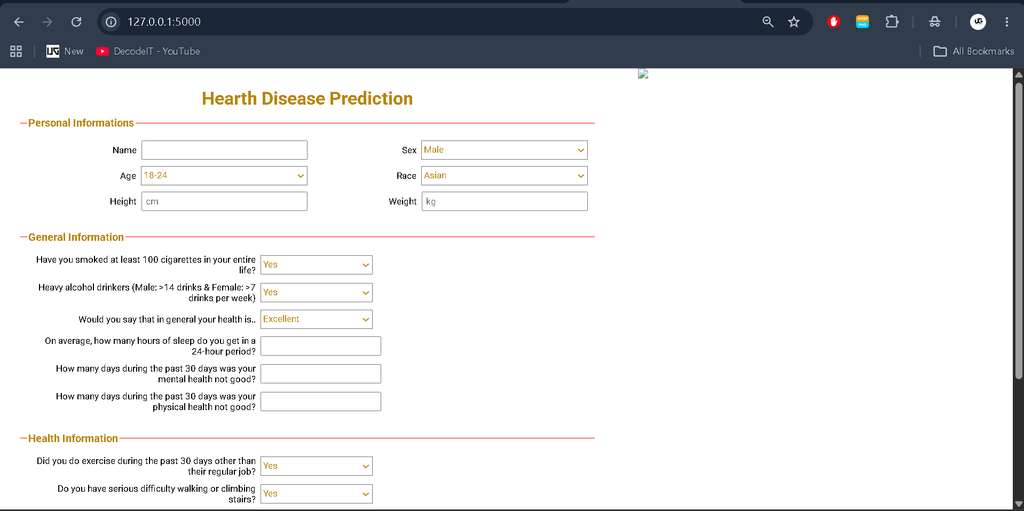
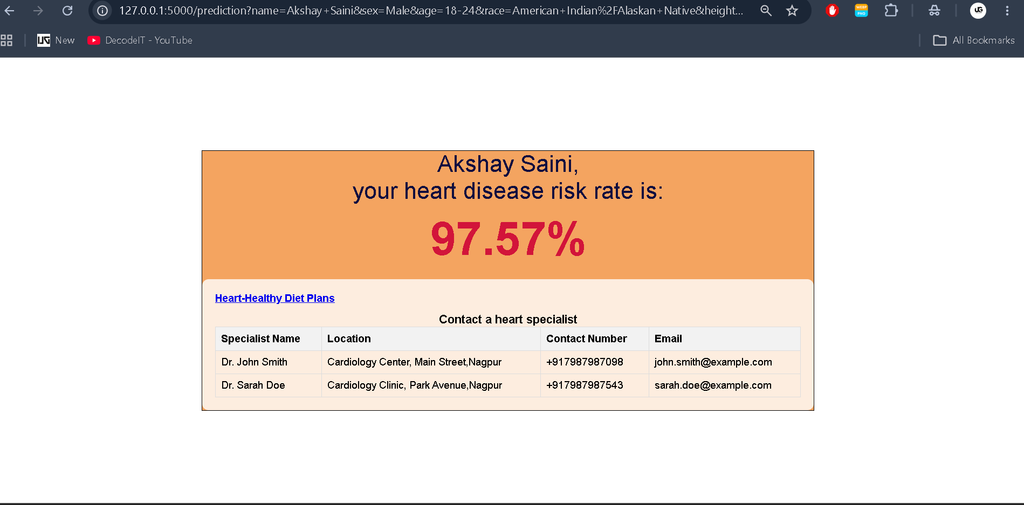
The Heart Disease Risk Prediction System uses Python libraries to prepare medical data, train a classification model, and generate predictions. Depending on the implementation, the model can be integrated into a web application where users enter health-related information and view the prediction.
Available Features
- Health Data Analysis: Examines patient information and relevant medical attributes.
- Data Preprocessing: Prepares datasets by handling missing values and transforming data when necessary.
- Feature Selection: Uses relevant input variables for model training.
- Machine Learning Prediction: Estimates risk based on patterns learned from training data.
- Model Evaluation: Measures model performance using suitable classification metrics.
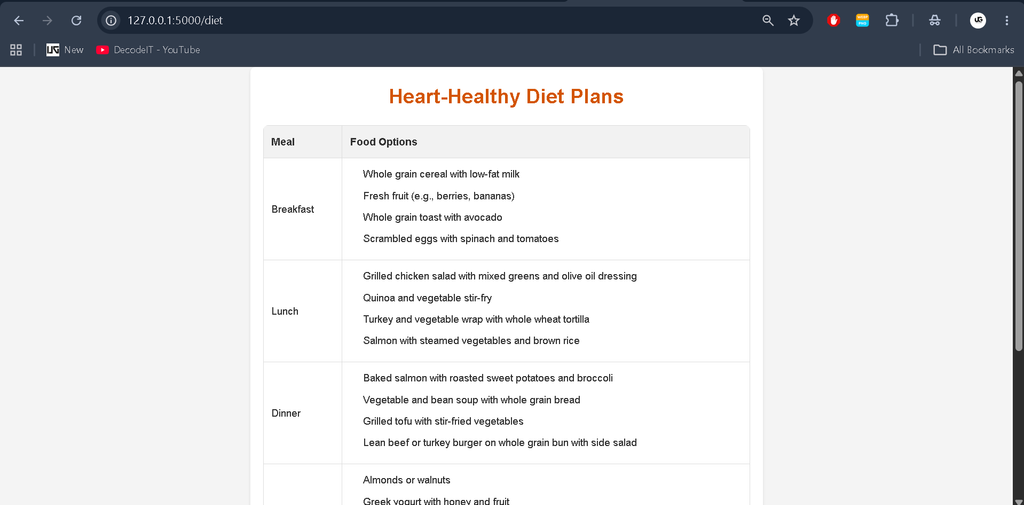
- Web Application Integration: A Django or Flask interface can accept user inputs and display predictions if included in the implementation.
Technology Stack
- Python: Main programming language.
- Pandas: Data manipulation and analysis.
- NumPy: Numerical calculations.
- Scikit-learn: Model training, preprocessing, and evaluation.
- Matplotlib: Data visualization, if required.
- Seaborn: Statistical data visualization, if required.
- Django or Flask: Web development, depending on the implementation.
- Visual Studio Code: Code editing and project management.
How to Download
The complete package is available so you can run, study, and submit it with confidence. It includes:
- Full Source Code
- Project Report
- Synopsis
- PPT Presentation
Screenshots
How the Project Works
Step 1: Dataset Collection
Collect a suitable dataset containing patient attributes and corresponding outcome labels. The UCI Heart Disease dataset is one possible resource for educational machine learning experiments.
Step 2: Data Preprocessing
Inspect the dataset, handle missing values, encode categorical variables, and scale numerical features where appropriate. Proper preprocessing helps prepare the data for machine learning algorithms.
Step 3: Model Training
Divide the dataset into training and testing sets. Train a suitable classification algorithm on the training data so that it can learn patterns associated with the available outcome labels.
Step 4: Prediction and Evaluation
Use the trained model to generate predictions for unseen records. Metrics such as accuracy, precision, recall, F1-score, and the confusion matrix can help evaluate model performance.
Step 5: Web Application
If a web interface is included, users can enter the required health information and view the model output. The interface should clearly explain that predictions are estimates and are not confirmed medical diagnoses.
Software and Tools Required
- Python
- Visual Studio Code
- Python extension for VS Code
- pip package manager
- Required Python libraries
Installation Guide for VS Code
Step 1: Open the Project in VS Code
Launch Visual Studio Code, select File → Open Folder, and choose the extracted project directory.
Step 2: Create a Virtual Environment
Open the integrated terminal and execute:
python -m venv venvActivate the environment on Windows:
venv\Scripts\activateStep 3: Install Dependencies
If the project contains a requirements.txt file, install the required packages using:
python -m pip install -r requirements.txtIf no requirements file exists, install the dependencies specified in the project documentation.
Step 4: Run the Application
python main.pyFor a Flask application, use the startup command specified by the project. Open the local URL displayed in the terminal to access the application.
Project Applications
- Educational machine learning experiments.
- Medical dataset analysis and visualization.
- Predictive modeling practice.
- Healthcare analytics research and demonstrations.
Project Limitations
Prediction quality depends on dataset quality, model selection, and validation methods. A model trained on a limited dataset may not perform reliably on different populations. Real-world medical use requires rigorous clinical validation, appropriate privacy safeguards, and professional oversight.
Note: This project is intended for educational purposes. Its predictions are not a medical diagnosis and should not replace professional medical advice.
Final Thoughts
The Heart Disease Risk Prediction in Python project is a useful learning opportunity for students interested in Python programming, machine learning, and healthcare analytics. It demonstrates how medical datasets can be processed and analyzed to generate predictive outputs.
Frequently Asked Questions
1. What is Heart Disease Risk Prediction in Python?
It is a machine learning project that analyzes health-related data to estimate the risk of heart disease.
2. Which programming language is used in this project?
Python is used for data preprocessing, model training, and prediction.
3. Which machine learning library can be used?
Scikit-learn provides tools for preprocessing data, training classification models, and evaluating their performance.
4. Can this project be developed as a web application?
Yes. A trained model can be integrated with Django or Flask if a web interface is required.
5. Can the prediction replace a doctor’s diagnosis?
No. The model is intended for educational purposes unless it has undergone appropriate clinical validation and authorization. Its output should not be treated as a medical diagnosis.
Keywords: Heart Disease Risk Prediction in Python, Heart Disease Prediction Using Machine Learning, Python Machine Learning Project, Heart Disease Prediction Project, Healthcare Data Analysis