
Schedule in DBMS
In a Database Management System (DBMS), a schedule represents the sequence in which operations such as read, write, commit, and rollback are performed by one or more transactions.
A schedule determines how transactions are executed when multiple transactions run concurrently. It preserves the relative order of operations within each transaction while allowing the DBMS to control their overall execution.
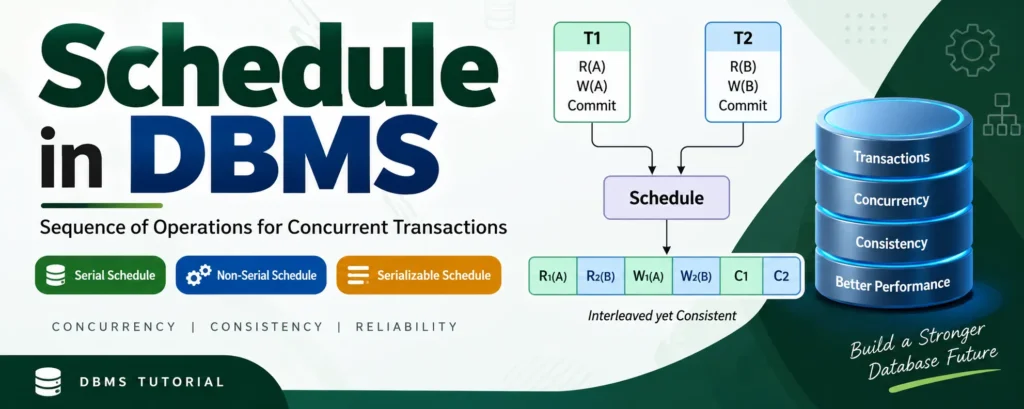
What is a Schedule in DBMS?
A schedule is the chronological arrangement of operations from multiple transactions. When transactions execute concurrently, their operations may be interleaved to improve system performance.
For example, consider two transactions T1 and T2:
T1: Read(A)
    Write(A)

T2: Read(B)
    Write(B)
A possible schedule could be:
R1(A) → R2(B) → W1(A) → W2(B)Here, operations from both transactions are interleaved while maintaining the order of operations within each transaction.
Complete Advance AI Topics: Click Here
SQL Tutorial: Click Here
Types of Schedules in DBMS
1. Serial Schedule
In a serial schedule, one transaction completes all its operations before the next transaction begins. There is no interleaving between transactions.
For example:
T1: R(A) → W(A) → Commit
T2: R(B) → W(B) → Commit
The complete schedule is:
R1(A) → W1(A) → C1 → R2(B) → W2(B) → C2Advantages:
- Easy to understand and manage.
- Provides predictable results.
- Avoids many concurrency-related problems.
Disadvantage: Transactions cannot execute concurrently, which may reduce system performance.
2. Non-Serial Schedule
In a non-serial schedule, operations from multiple transactions are interleaved. A transaction may execute some operations, followed by operations from another transaction.
For example:
R1(A) → R2(B) → W1(A) → W2(B) → C1 → C2Non-serial schedules improve concurrency, resource utilization, and overall performance. However, improper interleaving can produce inconsistent database results.
3. Serializable Schedule
A serializable schedule is a non-serial schedule that produces the same result as a corresponding serial schedule.
It provides the benefits of concurrent execution while preserving database correctness.
There are two common types of serializability:
- Conflict Serializability: Determines serializability by analyzing conflicting operations between transactions.
- View Serializability: Determines whether a schedule is view-equivalent to a serial schedule.
Serial vs Non-Serial vs Serializable Schedule
| Schedule Type | Execution | Concurrency | Correctness |
|---|---|---|---|
| Serial | One transaction at a time | Low | Guaranteed |
| Non-Serial | Transactions are interleaved | High | Not always guaranteed |
| Serializable | Transactions may be interleaved | High | Equivalent to a serial execution |
Why Are Schedules Important in DBMS?
Schedules are important because multiple transactions often execute at the same time in a database system. Proper scheduling helps the DBMS maintain data consistency, isolation, correctness, and efficient resource utilization.
Concurrency control techniques are used to ensure that concurrent schedules do not cause problems such as lost updates, dirty reads, and inconsistent data.
Summary
- Serial Schedule: Transactions execute one after another without interleaving.
- Non-Serial Schedule: Operations of multiple transactions are interleaved.
- Serializable Schedule: A concurrent schedule that produces the same result as a valid serial schedule.
Conclusion
A schedule in DBMS defines the order in which transaction operations are executed. Serial schedules provide simple and predictable execution, while non-serial schedules improve concurrency and performance. Serializable schedules combine concurrency with the correctness of serial execution, making them an important concept in database concurrency control.
YT:- DecodeIT