Degree of Relations in DBMS
Introduction
In our everyday lives, relationships are everywherebetween people, within families, among friends, and even between objects. Each individual plays multiple roles: a son or daughter, a sibling, a friend, a student, or a colleague. Despite being one person, you form various relationships with those around you. This concept of interconnectedness isn’t just a human traitits at the core of how data is structured and managed in computer systems as well.
Now imagine applying this idea to databases. In the digital world, data needs to interact and relate just like we do. Thats where the concept of relationships in a Database Management System (DBMS) comes into play. Relationships help define how different data entities connect, interact, and are managed efficiently.
Understanding DBMS Relationships
In DBMS, relationships between tables or entities define how data is logically associated. For instance, in a school system, a student might be connected to a course via enrollment data. Similarly, in an e-commerce platform, a customer links to their orders and payment details. These relationships help maintain clarity, avoid redundancy, and ensure effective data retrieval.
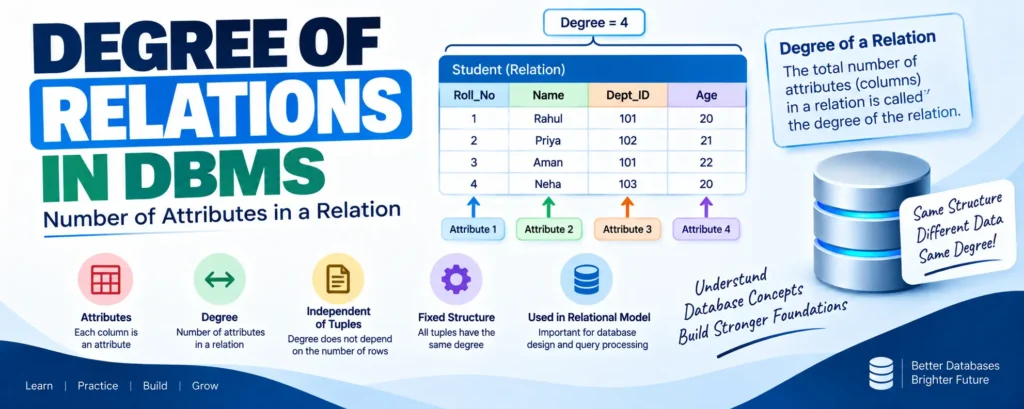
This brings us to the concept of the degree of a relationship, which refers to the number of entities involved. Based on this, relationships in DBMS can be classified as:
- One-to-One (1:1)
- One-to-Many (1:M)
- Many-to-Many (M:N)
Lets explore these in detail.
Complete Advance AI Topics: Click Here
SQL Tutorial: Click Here
1. One-to-One (1:1) Relationship
A one-to-one relationship means that one occurrence of an entity is associated with only one occurrence of another entity.
Example: If each employee is assigned a unique company car, and that car is driven only by that employee, then the relationship between employee and company car is one-to-one.
Advantages:
- Clarity in Communication: Each entity deals with a single counterpart, reducing confusion.
- Exclusive Connection: Creates a strong, dedicated link between entities.
- Trust and Accountability: Clear ownership ensures responsibility on both sides.
- Focused Interaction: Resources and attention are not divided.
2. One-to-Many (1:M) Relationship
In a one-to-many relationship, one entity occurrence is associated with multiple occurrences in another.
Example: A department may have multiple employees, but each employee belongs to only one department.
Advantages:
- Efficient Data Organization
- Enables a central entity (e.g., department) to manage multiple related records.
- Reduces data redundancy and improves readability.
- Ease of Maintenance
- Updates made in one place reflect throughout related records.
- Reduces errors and saves time during changes.
- Scalability
- Handles growing data sets efficiently.
- Ideal for scenarios like one teacher guiding many students.
3. Many-to-Many (M:N) Relationship
A many-to-many relationship exists when multiple occurrences in one entity relate to multiple occurrences in another.
Example: An employee may work on several projects, and each project can involve multiple employees.
Though less common in physical implementation (often broken down using junction tables), many-to-many relationships are powerful in design.
Advantages:
- Bidirectional Connectivity
- Allows multiple links between two entities.
- Enables flexible and rich data associations.
- Real-World Representation
- Ideal for complex scenarios like library systems, shopping carts, or collaborative projects.Flexibility and Growth
- Simplifies management of growing datasets.
- Keeps structure organized and querying efficient.
Higher-Degree Relationships
So far, weve looked at binary relationships (involving two entities). However, in some real-world scenarios, more than two entities are interconnected. These are called higher-degree relationships, such as ternary (three-entity) or even n-ary relationships.
Example: A project might involve multiple employees, departments, and tools simultaneously. Modeling such relationships as a single higher-degree relationship captures the complexity more accurately than breaking them into separate binary ones.
Why Use Higher-Degree Relationships?
- Simplifies data modeling for complex real-world scenarios.
- Reduces redundancy and improves logical clarity.
- Makes it easier to manage and interpret interconnected data.
Download New Real Time Projects :Click here
Conclusion
Just like people, data doesnt exist in isolation. Relationships in DBMS, especially higher-degree ones, mirror the complex connections found in real life. Understanding how entities interactwhether in one-to-one, one-to-many, many-to-many, or higher-degree relationshipsis key to designing scalable, logical, and effective database systems.
At we aim to make these foundational concepts simple and relatable, helping you build stronger systems with a deeper understanding.
what is degree of relationship in dbms
types of degree of relationship in dbms
degree of relationship example
ternary relationship in dbms
cardinality in dbms
quaternary relationship in dbms
unary relationship in dbms
relationship types of degree higher than two in dbms
relationship of higher degree in dbms ppt
relationship of higher degree in dbms pdf
relationship of higher degree in dbms example
relationship of higher degree in dbms geeksforgeek
cardinality of relationship in dbms
types of degree of relationship in dbms
degree of relationship in dbms example
degree of relationship example
quaternary relationship in dbms
degree in dbms
unary relationship in dbms
binary relationship in dbms