
Multivalued Dependency in DBMS
In relational database systems, Multivalued Dependency (MVD) is an important concept used to identify and reduce data redundancy. It extends the idea of functional dependency and plays a significant role in advanced database normalization, particularly Fourth Normal Form (4NF).
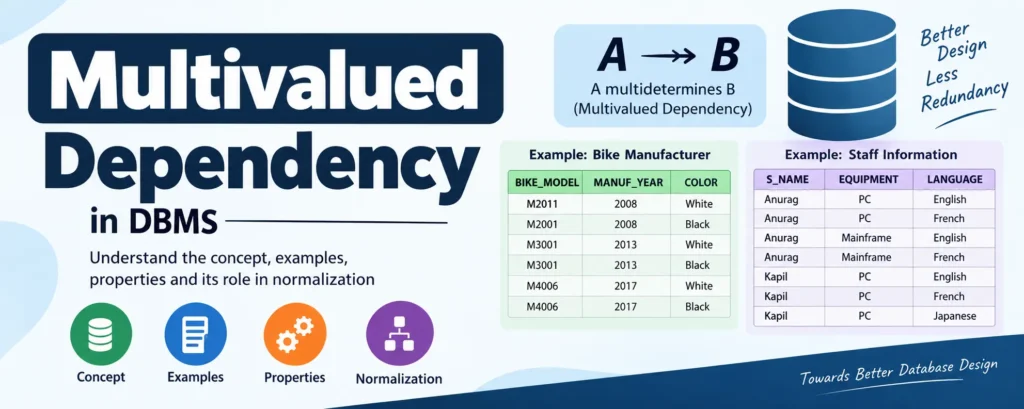
What is a Multivalued Dependency?
A Multivalued Dependency occurs when one attribute determines multiple independent values of another attribute, while those values are independent of the remaining attributes in the relation.
In simple terms, suppose an attribute A is associated with multiple values of B, and the values of B have no relationship with another attribute C. In such a situation, we say that B is multivalued dependent on A.
A multivalued dependency is represented using the symbol:
A →→ B
It is read as “A multidetermines B” or “B is multivalued dependent on A.”
An MVD generally becomes meaningful in a relation containing at least three attributes because it describes the independence between two sets of attributes.
Complete Advance AI Topics: Click Here
SQL Tutorial: Click Here
Functional Dependency vs. Multivalued Dependency
Functional dependency and multivalued dependency are related, but they describe different types of relationships.
- Functional Dependency: A value of attribute A determines exactly one value of attribute B. It is represented as A → B.
- Multivalued Dependency: A value of attribute A can determine multiple values of attribute B independently of another attribute. It is represented as A →→ B.
| Feature | Functional Dependency | Multivalued Dependency |
|---|---|---|
| Notation | A → B | A →→ B |
| Relationship | One value determines another value | One value determines a set of independent values |
| Independence | Not the main concern | Independent attribute values are central |
| Normalization | Important for several normal forms | Especially important for 4NF |
Example 1: Bike Manufacturer
Consider a company that manufactures bikes in different colors and in different manufacturing years. Suppose each bike model can have multiple valid manufacturing years and multiple colors, and the available colors are independent of the manufacturing years.
| BIKE_MODEL | MANUF_YEAR | COLOR |
|---|---|---|
| M2011 | 2008 | White |
| M2001 | 2008 | Black |
| M3001 | 2013 | White |
| M3001 | 2013 | Black |
| M4006 | 2017 | White |
| M4006 | 2017 | Black |
Here, MANUF_YEAR and COLOR are independent sets of values associated with BIKE_MODEL.
The multivalued dependencies can therefore be represented as:
- BIKE_MODEL →→ MANUF_YEAR
- BIKE_MODEL →→ COLOR
For a particular bike model, the database may need to store every valid combination of its manufacturing years and colors. This repeated combination can create redundancy.
Example 2: Staff Information
Consider a company database that stores information about staff members, the equipment assigned to them, and the languages they speak.
| S_NAME | EQUIPMENT | LANGUAGE |
|---|---|---|
| Anurag | PC | English |
| Anurag | PC | French |
| Anurag | Mainframe | English |
| Anurag | Mainframe | French |
| Kapil | PC | English |
| Kapil | PC | French |
| Kapil | PC | Japanese |
In this example:
- A staff member can be assigned multiple pieces of equipment.
- A staff member can know multiple languages.
- The equipment assigned to a staff member is independent of the languages spoken by that staff member.
Therefore, the relation contains the following multivalued dependencies:
- S_NAME →→ EQUIPMENT
- S_NAME →→ LANGUAGE
For example, if Anurag has two types of equipment and speaks two languages, the relation stores all possible combinations of those independent values.
This is exactly the type of redundancy that multivalued dependency helps database designers identify.
Properties of Multivalued Dependency
1. It Generally Involves at Least Three Attributes
A meaningful MVD normally requires a relation containing at least three attributes. This is because the concept involves one determinant and two independent sets of values.
2. Independent Values Are Involved
The values determined by the common attribute must be independent of each other. For example, a staff member’s languages can be independent of the equipment assigned to that staff member.
3. Complementary MVD
If a relation contains attributes A, B, and C, and the dependency A →→ B holds, then the complementary dependency A →→ C also holds under the standard MVD rules.
4. Functional Dependency Is a Special Case
A functional dependency can be viewed as a special case of a multivalued dependency. If an attribute determines only one possible value rather than multiple values, the multivalued relationship effectively behaves like a functional dependency.
Why Are Multivalued Dependencies Important?
Multivalued dependencies are important because they help database designers identify situations where independent multi-valued facts are being stored together in the same relation.
When such information is stored in a single table, unnecessary combinations of values may have to be repeated. This can result in:
- Data redundancy
- Increased storage requirements
- Insertion anomalies
- Update anomalies
- Deletion anomalies
Recognizing MVDs allows these problems to be addressed through better relational design.
Multivalued Dependency and Fourth Normal Form
Multivalued dependencies are particularly important when studying Fourth Normal Form (4NF).
A relation is in 4NF when, for every non-trivial multivalued dependency X →→ Y, X is a superkey of the relation.
If a relation contains a non-trivial MVD where the determinant is not a superkey, the relation may need to be decomposed into smaller relations to remove redundancy.
How MVDs Help in Database Normalization
Suppose a table stores a person’s multiple skills and multiple hobbies in the same relation. If skills and hobbies are independent, storing every possible combination can produce unnecessary rows.
Instead of storing everything in one relation, we can decompose it into separate relations:
- Person_Skill(Person, Skill)
- Person_Hobby(Person, Hobby)
This decomposition eliminates unnecessary combinations and produces a cleaner database design.
YT:- DecodeIT
Key Takeaways
- Multivalued Dependency describes a relationship where one attribute determines multiple independent values of another attribute.
- It is represented using →→.
- An MVD is generally meaningful when at least three attributes are involved.
- The dependent sets of values are independent of one another.
- MVDs can cause redundancy when multiple independent facts are stored in the same relation.
- They are especially important in Fourth Normal Form (4NF).
- Proper decomposition can remove redundancy caused by multivalued dependencies.
Conclusion
Multivalued Dependency is an important concept in relational database theory and advanced normalization. It helps identify situations where one entity has multiple independent sets of values, such as a staff member having multiple equipment assignments and speaking multiple languages.
Understanding MVDs makes it easier to recognize redundancy and design relations that satisfy higher normal forms. In particular, the concept provides the foundation for understanding Fourth Normal Form (4NF) and how decomposition can improve database consistency and maintainability.
Keywords
Multivalued Dependency, Multivalued Dependency in DBMS, MVD in DBMS, Multivalued Dependency in Database, Functional Dependency vs Multivalued Dependency, Fourth Normal Form, 4NF, Database Normalization, DBMS Normalization, MVD Examples, Multivalued Dependency Examples, Relational Database