
Transactions in Databases
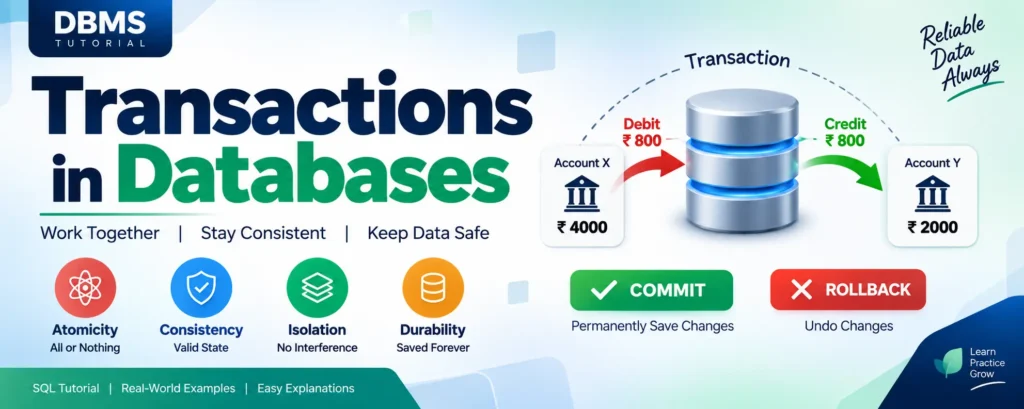
A transaction in a database is a group of logically related operations that are performed together as a single unit of work. A transaction may involve reading, modifying, and storing data while ensuring that the database remains accurate and reliable.
Transactions are especially important when multiple database operations must either succeed together or be completely undone if an error occurs.
Complete Advance AI Topics: Click Here
SQL Tutorial: Click Here
Real-World Example: Bank Transfer
Consider a bank transfer of ₹800 from Account X to Account Y. This seemingly simple operation involves multiple database actions:
- Read the balance of Account X.
- Deduct ₹800 from Account X.
- Write the updated balance of Account X.
- Read the balance of Account Y.
- Add ₹800 to Account Y.
- Write the updated balance of Account Y.
Both the debit and credit operations must be completed successfully. If the money is deducted from Account X but the credit to Account Y fails, the database would become inconsistent.
A transaction ensures that either all required operations are completed or none of them are applied.
Core Operations of a Transaction
Two fundamental operations commonly used to describe database transactions are Read and Write.
- Read(X): Retrieves the value of data item X from the database into a memory buffer.
- Write(X): Stores the updated value of X from the memory buffer back into the database.
Example of a Debit Operation
Suppose Account X has a balance of ₹4000, and we want to withdraw ₹500.
R(X)          // Read X (4000) into buffer
X = X - 500   // Update buffer value to 3500
W(X)          // Write 3500 back to the database
After the transaction completes successfully, the balance of Account X becomes ₹3500.
Commit and Rollback
Transactions use Commit and Rollback to control whether their changes should be permanently applied.
Commit
Commit permanently saves all changes made by a successful transaction to the database.
For example, after a successful bank transfer, the transaction is committed, making the updated account balances permanent.
Rollback
Rollback cancels the changes made by a transaction and restores the database to the appropriate previous state when the transaction cannot complete successfully.
For example, if money is deducted from Account X but an error occurs before Account Y is credited, the transaction can be rolled back so that the debit does not remain in the database.
ACID Properties of Transactions
Database transactions follow four important properties known as ACID. These properties help maintain data integrity and reliability.
1. Atomicity
Atomicity means that a transaction is treated as one indivisible unit. Either all of its operations are completed successfully, or none of them take effect.
Example: In a bank transfer, both the debit and credit must succeed. If one fails, the transaction is rolled back.
2. Consistency
Consistency ensures that a transaction takes the database from one valid state to another valid state while preserving all defined rules and constraints.
Example: A bank transfer should not cause an account balance or other database constraint to become invalid.
3. Isolation
Isolation ensures that concurrently executing transactions do not improperly interfere with one another. Each transaction should behave as though it is executing independently, subject to the database’s isolation level.
4. Durability
Durability means that once a transaction has been successfully committed, its changes are preserved even if the system subsequently experiences a crash or failure.
Why Are Transactions Important?
Transactions are essential for maintaining reliable database systems. They help prevent problems such as incomplete updates, inconsistent data, and loss of committed information.
They are commonly used in systems such as:
- Banking and payment applications
- Online shopping and order processing
- Ticket and seat reservation systems
- Inventory management
- Payroll and accounting systems
- Enterprise applications
YT:- DecodeIT
Conclusion
A transaction in a database groups multiple related operations into a single reliable unit of work. Operations such as Read and Write, together with Commit and Rollback, help control how changes are applied.
The ACID properties—Atomicity, Consistency, Isolation, and Durability—provide the foundation for reliable transaction processing and help databases maintain accurate and dependable data even when failures occur.
Keywords
Transactions in Databases, DBMS Transactions, Database Transaction, Transaction in DBMS, ACID Properties, Atomicity, Consistency, Isolation, Durability, Commit and Rollback, Read and Write Operations, Transaction Processing Transactions in Databases, DBMS Transactions, Transaction in DBMS, Database Transaction, ACID Properties, Atomicity, Consistency, Isolation, Durability, Commit and Rollback, Transaction Processing, Read and Write Operations, DBMS Tutorial, Database Management System, SQL Transactions