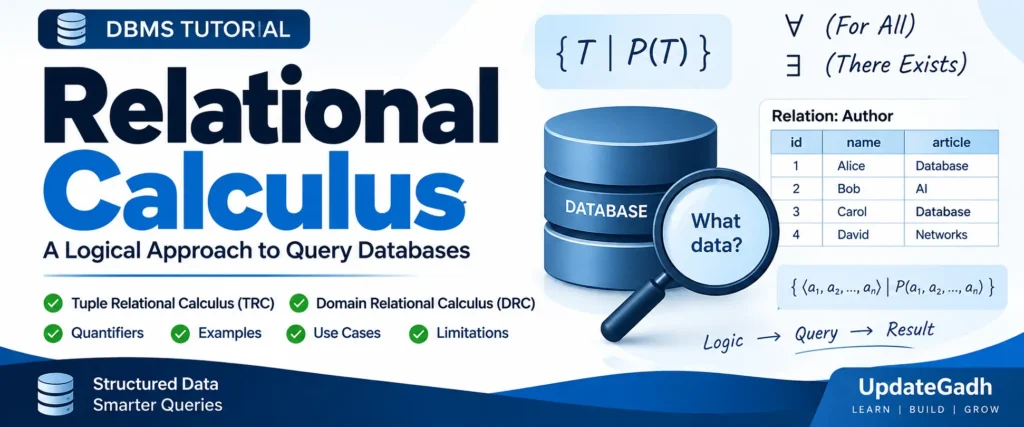
In database management systems, Relational Calculus provides a logical and declarative approach to formulating database queries. Unlike procedural query languages, where users specify how data should be retrieved, relational calculus focuses on what data is required.
Relational calculus is therefore known as a non-procedural query language. It describes the conditions that the required data must satisfy rather than defining the sequence of operations used to retrieve it.
Many modern database query concepts, including those found in SQL and other query languages, are influenced by the principles of relational calculus. Understanding relational calculus is particularly important for learning DBMS, database theory, and relational query processing.
Why Is It Called Relational Calculus?
Relational calculus is based on predicate calculus, which is a branch of mathematical logic. A predicate represents a logical condition that can evaluate to either true or false depending on the values supplied to it.
In a relational database, these logical conditions are used to describe which tuples or attribute values should be included in the query result.
For example, a condition such as Salary > 50000 can be treated as a logical predicate. A tuple is included in the result when the specified condition evaluates to true.
This logical foundation allows relational calculus to express database queries using conditions, predicates, and logical relationships instead of specifying the exact retrieval procedure.
Quantifiers in Relational Calculus
Quantifiers are important components of relatioComplete Advance AI Topics: Click Here
SQL Tutorial: Click Here
nal calculus. They specify how variables relate to a collection of values or tuples.
1. Universal Quantifier (∀)
The universal quantifier is represented by ∀ and is read as “for all”.
It indicates that a particular condition must be true for every value or tuple being considered.
2. Existential Quantifier (∃)
The existential quantifier is represented by ∃ and is read as “there exists”.
It indicates that a condition must be true for at least one value or tuple in the specified set.
Free and Bound Variables
Relational calculus also uses the concepts of free variables and bound variables.
- Bound Variable: A variable is bound when it is associated with a quantifier such as
∀or∃. - Free Variable: A variable is free when it is not controlled or restricted by a quantifier within the logical expression.
This distinction is important because the variables that remain free generally determine the values that appear in the final query result.
Types of Relational Calculus
Relational calculus is primarily divided into two types:
- Tuple Relational Calculus (TRC)
- Domain Relational Calculus (DRC)
1. Tuple Relational Calculus (TRC)
Tuple Relational Calculus uses tuple variables, also called range variables, to represent complete rows of a relation.
Instead of describing the steps required to retrieve data, TRC specifies the conditions that a tuple must satisfy to become part of the result.
TRC Syntax
{ T | P(T) }- T represents a tuple variable.
- P(T) represents the predicate or condition that the tuple must satisfy.
TRC Example
{ T | Author(T) AND T.article = 'Database' }This expression retrieves tuples from the Author relation where the article attribute contains the value “Database”.
If only the author’s name is required, the expression can conceptually be written as:
{ T.name | Author(T) AND T.article = 'Database' }The important point is that TRC describes which tuples satisfy the required condition, rather than specifying the sequence of operations needed to retrieve them.
TRC Using an Existential Quantifier
An existential quantifier can be used when a query depends on the existence of another tuple that satisfies a condition.
{ R | Author(R) AND ∃T (Author(T) AND T.article = 'Database' AND R.name = T.name) }Here, ∃T means that there must exist at least one tuple T satisfying the specified condition.
2. Domain Relational Calculus (DRC)
Domain Relational Calculus works with individual attribute values rather than complete tuples.
In DRC, variables represent values belonging to the domains of attributes. Logical operators such as AND (∧), OR (∨), and NOT (¬) can be used to construct query conditions.
DRC Syntax
{ <a1, a2, ..., an> | P(a1, a2, ..., an) }- a1, a2, …, an are domain variables.
- P(a1, a2, …, an) is the logical formula or condition applied to those variables.
DRC Example
{ <article, page, subject> | UpdateGadh(article, page, subject) AND subject = 'Database' }This expression returns the article, page, and subject values from the UpdateGadh relation where the subject is “Database”.
The key difference is that DRC focuses on individual attribute values, while TRC focuses on complete tuples.
TRC vs DRC
| Feature | Tuple Relational Calculus | Domain Relational Calculus |
|---|---|---|
| Primary Focus | Complete tuples | Individual attribute values |
| Variables | Tuple variables | Domain variables |
| Representation | Represents rows of a relation | Represents values of attributes |
| Query Style | Condition-based tuple selection | Condition-based value selection |
| Common Use | Queries involving complete records | Queries involving specific attribute values |
Use Cases of Relational Calculus in DBMS
Relational calculus provides an important theoretical foundation for relational database systems. Some of its major applications include:
- Complex Query Formulation: It provides a formal way to express queries involving multiple conditions and relationships.
- Data Validation: Logical predicates can be used to describe conditions that database records must satisfy.
- Database Design: Relational calculus concepts help in understanding relations, constraints, keys, and relationships.
- Query Language Theory: It provides the theoretical foundation for understanding declarative database query languages.
- Database Research: Relational calculus is widely used in the study of relational database theory and query processing.
Limitations of Relational Calculus
Although relational calculus is powerful and expressive, it also has some limitations:
- Less Intuitive for Beginners: Its mathematical notation can be difficult for beginners to understand.
- Mostly Theoretical: Relational calculus is primarily used as a formal foundation rather than as a practical query language for everyday database operations.
- Complex Expressions: Queries involving multiple quantifiers and predicates can become difficult to read.
- Limited Procedural Control: It describes the required result but does not specify the exact execution steps.
- Relational Model Focus: Classical relational calculus is designed around the relational model and does not directly address many features of modern non-relational data systems.
Download New Real-Time Projects: Click Here
Conclusion
Relational Calculus is a declarative and non-procedural query formalism used to describe what data is required from a relational database rather than how that data should be retrieved.
The two major forms of relational calculus are:
- Tuple Relational Calculus (TRC): Works with tuple variables that represent complete rows.
- Domain Relational Calculus (DRC): Works with domain variables that represent individual attribute values.
Understanding relational calculus helps students and database professionals build a strong foundation in DBMS, SQL, relational algebra, database theory, and query processing.
Keywords
Relational Calculus, Tuple Relational Calculus, Domain Relational Calculus, TRC, DRC, Relational Calculus in DBMS, DBMS, Database Management System, Relational Database, Database Query Language, Non Procedural Query Language, Declarative Query Language, Quantifiers in DBMS