What is a Database
Before diving into databases, let’s understand what data means.
In simple terms, data is a collection of small, distinct pieces of information such as numbers, text, images, or even videos. Data can be stored in many ways: on paper, in spreadsheets, or electronically on servers and cloud platforms.
The word “data” comes from datum, meaning a single piece of information. In computing, data is the raw material that powers everything from basic apps to advanced AI models. It must be structured, consistent, and accessible to be truly useful and thats where databases come in.
Table of Contents
Complete Advance AI Topics: Click Here
SQL Tutorial: Click Here
What is a Database?
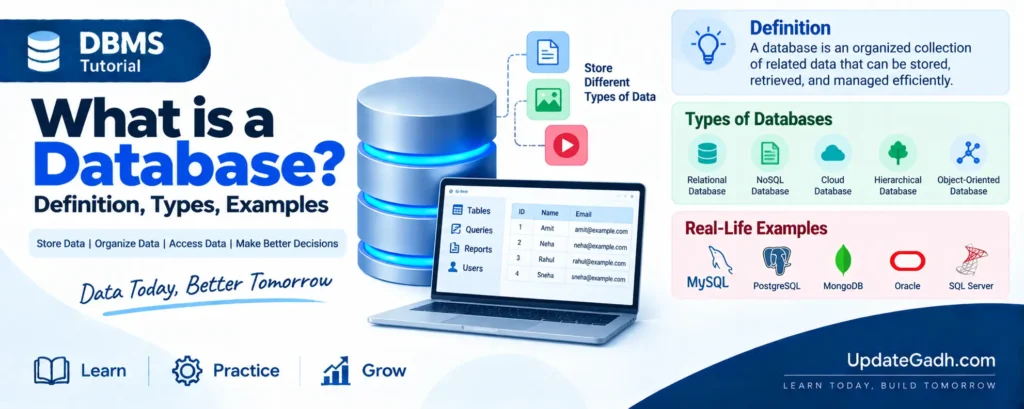
An ordered collection of data that is set up for easy access, management, and updating is called a database.
Imagine trying to find a single clients phone number in a notebook with thousands of contacts. That would take time. Now, imagine the same data in a searchable digital system, where a few keystrokes get you exactly what you need thats a database in action.
Database Management Systems (DBMSs) are specialised software programs that manage databases, which store data in tables (rows and columns). MySQL, Oracle, SQL Server, MongoDB, and PostgreSQL are a few examples.
Key Properties of Data in a Database
To ensure efficiency and reliability, the data inside a database should have the following qualities:
- Well-organized: Structured into tables or formats that make sense.
- Integrated: Related pieces of data connect seamlessly.
- Persistent: Stored permanently, not lost after use.
- Recoverable: Can be restored in case of a crash.
- Secure and resilient: Safe from unauthorized access and failures.
- Shareable: Multiple users or applications can access it.
- Accessible: Available whenever and wherever needed.
Common Database Operations
Managing data isnt just about storage. It also involves:
- Insertion: Add new records (e.g., add a new employee).
- Updation: Modify existing data (e.g., update an address).
- Deletion: Remove outdated or irrelevant records.
- Selection: Retrieve data (e.g., find sales from last month).
- Sorting: Arrange data (e.g., sort names alphabetically).
The Role of Databases in the Real World
Historically, data was stored manually in file cabinets. While this worked for small volumes, it became inefficient as organizations grew. Generating reports, avoiding duplication, and keeping data consistent was a challenge.
With computer systems and digital databases, these problems became easier to manage. Modern DBMS software made it possible to store, retrieve, and analyze large volumes of data with speed and precision.
Evolution of Databases
Databases have come a long way since the 1960s:
1. File-Based Systems (1968)
Data stored in flat files with limited structure and no relationships. Difficult to scale.
2. Hierarchical Model (19681980)
Data stored in a tree-like structure. Fast but limited in flexibility.
Merits: Simple, fast, good data integrity
Demerits: Only supports one-to-many relationships, lacks standards
3. Network Model
Developed by Charles Bachman. Uses a graph-like structure with many-to-many relationships.
Merits: High performance, handles complex relationships
Demerits: Complex design, requires pointer management
4. Relational Model (1970Present)
Proposed by E.F. Codd. Data organized into tables. This model powers most modern applications.
Merits: Simple queries with SQL, strong data integrity
Demerits: Not ideal for handling unstructured or highly dynamic data
5. Object-Oriented Databases
Combines database features with object-oriented programming. Supports inheritance, encapsulation, and polymorphism.
6. NoSQL Databases
Designed for unstructured or semi-structured data. Useful in big data and real-time web apps.
Types:
- Document-based (MongoDB)
- Key-value stores (Redis)
- Wide-column (Cassandra)
- Graph databases (Neo4j)
Merits: High scalability, handles massive data volumes
Demerits: No standard query language, weak backup systems
7. Cloud Databases
Stored on cloud platforms like AWS, Azure, and Google Cloud.
Merits: Cost-effective, scalable, globally accessible
Demerits: Security and compliance challenges
DBMS vs. RDBMS
| Feature | DBMS | RDBMS |
|---|---|---|
| Structure | Can be any form | Strictly tabular |
| Relationships | Not supported | Supports table relationships |
| Examples | XML DB, File System | MySQL, Oracle, PostgreSQL |
| Data Redundancy | High | Reduced due to normalization |
| Security | Basic | Advanced features like access control |
Common Types of Users in a Database System
- Database Administrator (DBA) Oversees setup and security
- Database Designers Plans structure
- Application Developers Writes code to interact with data
- End Users Uses the application interface
Download New Real Time Projects :-Click here
Final Thoughts
From flat files to intelligent cloud-based systems, databases have revolutionized how we manage and use information. Whether you’re running a blog, a bank, or a billion-dollar e-commerce store a database is the engine behind the scenes making everything run smoothly.
Understanding the types, operations, and importance of databases equips you to make smarter, data-driven decisions no matter your industry.
For more database tutorials, keep following your trusted guide for tech insights.
what is a database management system
database examples
types of database
what is a database table?
what is database in computer
what are databases used for
what is a database in sql
advantages of database
what is a primary key
who created the first dbms
what is a database in computer
what is a database in dbms
what is a database management