
Fifth Normal Form (5NF)
Normalization is an important part of relational database design because it helps reduce data redundancy and maintain data integrity. Fifth Normal Form (5NF), also known as Project-Join Normal Form (PJ/NF), is an advanced stage of database normalization.
5NF extends the principles of Fourth Normal Form (4NF) by focusing on join dependencies. Its primary goal is to ensure that a relation cannot be further decomposed into smaller relations without losing important information or introducing unwanted tuples.
What is Fifth Normal Form (5NF)?
A relation is considered to be in 5NF when:
- It is already in 4NF.
- It has no non-trivial join dependencies that are not implied by candidate keys.
- Any decomposition of the relation is lossless.
In simple terms, 5NF ensures that a relation has been decomposed as much as necessary to remove redundancy caused by join dependencies, while still allowing the original information to be reconstructed correctly.
Why is 5NF Important?
Most database normalization techniques focus on functional dependencies and multivalued dependencies. However, some forms of redundancy can exist because of relationships among three or more attributes.
5NF addresses these situations by identifying join dependencies and decomposing relations when necessary.
Although 5NF is relatively uncommon in everyday database design, it can be useful for complex databases where several independent relationships must be represented without creating unnecessary combinations of data.
Complete Advance AI Topics: Click Here
SQL Tutorial: Click Here
Key Concepts of 5NF
1. Join Dependency (JD)
A join dependency exists when a relation can be reconstructed by joining two or more projections of that relation.
Suppose a relation R can be decomposed into R1, R2, and R3. If:
R = R1 ⋈ R2 ⋈ R3and joining the decomposed relations always produces the original relation without adding incorrect tuples, then a join dependency exists.
A join dependency is trivial when one of the projections is the complete relation itself. 5NF is concerned with removing meaningful, non-trivial join dependencies that are not already implied by candidate keys.
2. Lossless Decomposition
A decomposition is called lossless when splitting a relation into smaller relations does not cause information to be lost.
When the smaller relations are joined again, they should reproduce the original relation exactly, without missing tuples or generating incorrect additional tuples.
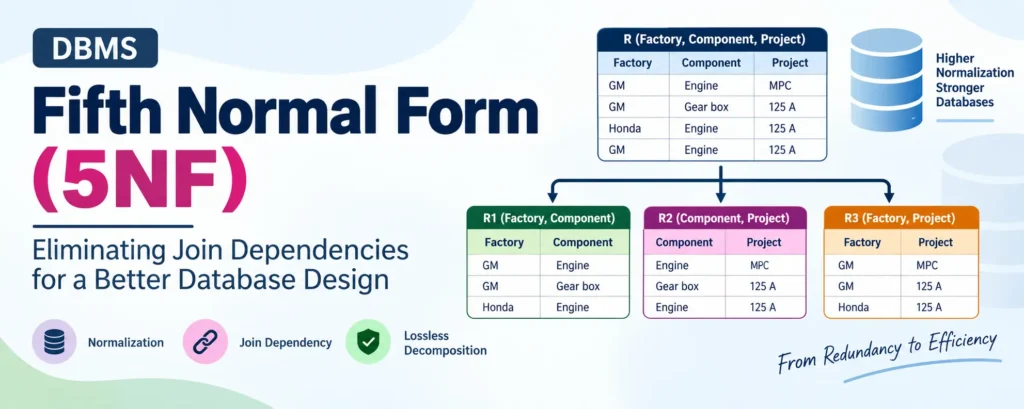
Example 1: Factory-Component-Project Relation
Consider the following relation:
| Factory | Component | Project |
|---|---|---|
| GM | Engine | MPC |
| GM | Gear box | 125 A |
| Honda | Engine | 125 A |
| GM | Engine | 125 A |
Assume this relation satisfies the conditions for 4NF. We can decompose it into three smaller relations.
R1: Factory-Component
| Factory | Component |
|---|---|
| GM | Engine |
| GM | Gear box |
| Honda | Engine |
R2: Component-Project
| Component | Project |
|---|---|
| Engine | MPC |
| Gear box | 125 A |
| Engine | 125 A |
R3: Factory-Project
| Factory | Project |
|---|---|
| GM | MPC |
| GM | 125 A |
| Honda | 125 A |
These relations represent three different pairwise relationships. If the original relation can always be reconstructed from these projections without generating spurious combinations, a join dependency exists.
This illustrates why 5NF is concerned with relationships involving multiple projections rather than only dependencies between individual attributes.
If an additional tuple such as (Honda, Gear box, MPC) is introduced, the relationship among the three attributes changes. Whether the relation satisfies 5NF must then be determined by the actual join dependencies and candidate keys rather than simply by the number of rows.
Example 2: RANKING Relation
Consider a relation containing information about factories:
| Factory# | Fact_name | Position | City |
|---|---|---|---|
| F01 | Volvo | 17 | Mumbai |
| F11 | Honda | 22 | Chennai |
| F15 | Maruti | 26 | Gurgaon |
| F25 | GM | 37 | Chandigarh |
Suppose Factory# and Fact_name are candidate keys.
The relation may have join dependencies involving combinations such as:
- (Factory#, Fact_name, Position) and (Factory#, City)
- (Factory#, Fact_name, Position), (Factory#, Position), and (Fact_name, City)
If these dependencies are properly implied by candidate keys and their decompositions are lossless, the relation can satisfy the requirements of 5NF.
Example 3: Subject-Lecturer-Semester Relation
Consider the following relation:
| Subject | Lecturer | Semester |
|---|---|---|
| Computer | Anshika | Semester 1 |
| Computer | John | Semester 1 |
| Math | John | Semester 1 |
| Math | Akash | Semester 2 |
| Chemistry | Praveen | Semester 1 |
Here, the combination of Subject, Lecturer, and Semester represents a relationship among three different entities.
If these relationships are independent, storing everything in one table can lead to unnecessary combinations and make it difficult to represent new information independently.
One possible decomposition is:
P1: Semester-Subject
| Semester | Subject |
|---|---|
| Semester 1 | Computer |
| Semester 1 | Math |
| Semester 1 | Chemistry |
| Semester 2 | Math |
P2: Subject-Lecturer
| Subject | Lecturer |
|---|---|
| Computer | Anshika |
| Computer | John |
| Math | John |
| Math | Akash |
| Chemistry | Praveen |
P3: Semester-Lecturer
| Semester | Lecturer |
|---|---|
| Semester 1 | Anshika |
| Semester 1 | John |
| Semester 2 | Akash |
| Semester 1 | Praveen |
This type of decomposition separates the three pairwise relationships. If the original three-way relationship can be losslessly reconstructed from these relations, the decomposition is an example of the type of decomposition studied by 5NF.
5NF vs 4NF
| 4NF | 5NF |
|---|---|
| Deals primarily with multivalued dependencies. | Deals primarily with join dependencies. |
| Removes redundancy caused by independent multivalued facts. | Removes redundancy caused by complex join relationships. |
| Every 5NF relation is also in 4NF. | 5NF is a stronger normal form than 4NF. |
| Usually easier to identify. | Can require analysis of three or more relations. |
Important Properties of 5NF
- 5NF is also called Project-Join Normal Form (PJ/NF).
- Every relation in 5NF must already satisfy the requirements of 4NF.
- 5NF focuses on eliminating non-trivial join dependencies.
- Decompositions should be lossless so that the original information can be reconstructed.
- 5NF is particularly relevant when relationships involve three or more independent entities.
- 5NF is stronger than 4NF, so every 5NF relation is also in 4NF.
- 5NF is relatively rare in ordinary database designs because many practical schemas do not contain complex join dependencies.
Advantages of 5NF
- Reduces redundancy: Complex relationships can be separated into smaller relations.
- Improves data integrity: Each fact can be stored in the appropriate relation.
- Minimizes update anomalies: Changes can be made without unnecessarily modifying multiple records.
- Provides a highly normalized design: Unnecessary join dependencies are removed.
- Supports complex relationships: It is useful when several entities participate in interconnected relationships.
Disadvantages of 5NF
- More tables: Decomposition can significantly increase the number of relations.
- Complex queries: Retrieving information may require multiple joins.
- Potential performance overhead: Join-heavy queries can become expensive on large datasets.
- More maintenance: Highly normalized schemas can be harder to understand and maintain.
- Complex implementation: Identifying join dependencies can be considerably more difficult than identifying simple functional dependencies.
When Should You Use 5NF?
5NF is most useful when a database contains complex relationships where information about three or more entities can be represented independently.
For small or straightforward applications, normalization up to 3NF or BCNF may be sufficient. 4NF and 5NF become more relevant when multivalued and join dependencies create meaningful redundancy.
How to Identify 5NF
- First verify that the relation satisfies the lower normal forms.
- Confirm that the relation is already in 4NF.
- Look for non-trivial join dependencies.
- Determine whether those dependencies are implied by candidate keys.
- If an unnecessary join dependency exists, decompose the relation into smaller relations.
- Verify that the decomposition is lossless.
- If no non-trivial join dependency remains, the relation satisfies 5NF.
YT:- DecodeIT
Conclusion
Fifth Normal Form (5NF) is an advanced level of relational database normalization that focuses on join dependencies. It ensures that a relation cannot be further meaningfully decomposed without introducing redundancy or losing the ability to reconstruct the original information.
While 5NF can produce highly normalized and logically clean database designs, it is not required for every application. Excessive decomposition can increase the number of joins and make queries more complicated. Therefore, 5NF should be applied when the underlying data model genuinely contains complex join dependencies.
Keywords
Fifth Normal Form (5NF), 5NF in DBMS, Fifth Normal Form in DBMS, Project-Join Normal Form, PJ/NF, join dependency, lossless decomposition, database normalization, 4NF vs 5NF, normalization in DBMS, 5NF examples, relational database normalization