Introduction
Database design gets complex as systems grow. You need a smart way to organize data without repeating yourself.
That’s where generalization comes in.
Generalization combines multiple entities that share common features into one higher-level entity. The result is less redundancy, a cleaner structure, and a database that scales easily.
What is Generalization in DBMS?
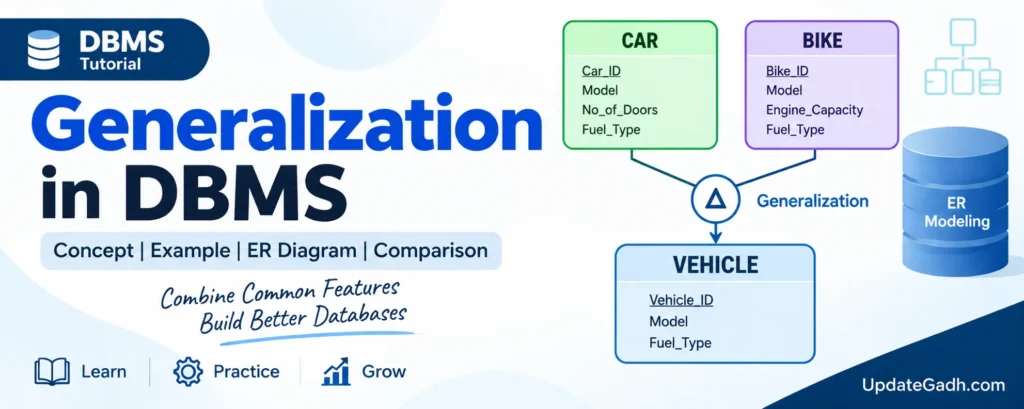
Generalization is a bottom-up approach to database design.
You start with specific, lower-level entities. You find what they have in common. Then you move those shared features into one higher-level entity.
Example: Car and Bike both share engine_number, manufacturer, and model_year. Instead of storing these twice, you create a parent entity called Vehicle. Car and Bike become sub-entities that inherit from Vehicle.
This creates a clean parent-child relationship with zero data duplication.
Complete Advance AI Topics: Click Here
SQL Tutorial: Click Here
How Generalization Works in DBMS
Generalization works like the relationship between a subclass and a superclass in programming.
- Subclass = specific entity (e.g., Student, Faculty)
- Superclass = generalized entity (e.g., Person)
If Student and Faculty both have name, age, and email those attributes move up to the Person entity. Each sub-entity keeps its own unique fields.
Step-by-Step Process
- Identify lower-level entities List all specific entities in your system
- Find shared attributes Look for common fields across entities
- Create a generalized entity Move shared attributes into a new parent entity
- Link sub-entities Connect original entities to the generalized entity
- Retain unique attributes Keep specific fields in their original sub-entities
- Repeat if needed Apply again if new entities share features
Why Use Generalization in Database Design?
- Reduces redundancy Common attributes are stored once, not many times
- Simplifies ER diagrams Fewer entities make diagrams easier to read
- Easier maintenance Update one place instead of five
- Better performance Cleaner structure means faster queries
- Future-ready New entities can be added without major redesign
- Fewer inconsistencies Central data reduces mismatched records
Example: A company has full-time and part-time employees. Both have employee_id, name, and department. You generalize these into one Employee entity. Each type keeps its own unique fields like salary_type or hours_per_week.
Real-World Example: Media Content
Before Generalization
Television Programmes has: genre, target_audience, air_time, artists, awards, type, ratings
Internet Programmes has: platform, genre, target_audience, upload_time, host, views, likes, ratings
Shared Attributes
Both share: genre, target_audience, ratings, artists/host, awards
After Generalization
Create a parent entity called Entertainment with all shared attributes.
- Television Programmes sub-entity (keeps
air_time,type) - Internet Programmes sub-entity (keeps
platform,views,likes)
Now adding Podcasts or Live Streams in the future requires no major restructuring.
Significance of Generalization in DBMS
1. Simplifies Complex Structures Combining overlapping entities streamlines the schema. It’s easier to navigate and design.
2. Reduces Data Duplication Shared attributes are stored once. No repetitive data storage.
3. Clarifies Relationships Generalized tables improve relational clarity, especially with foreign keys.
4. Bottom-Up Design Start with detailed entities and abstract upward. Build more efficient models step by step.
5. Supports Future Expansion New entity types with shared features integrate easily into existing generalized structures.
6. Encourages Reusability Generalized entities can be reused across modules, saving development time.
7. Enhances Query Performance Efficient data organization means faster retrieval, simpler joins, and better performance.
YT:- DecodeIT
Generalization vs. Specialization in DBMS
| Aspect | Generalization | Specialization |
|---|---|---|
| Approach | Bottom-up | Top-down |
| Direction | Specific General | General Specific |
| Purpose | Merge similar entities | Divide a broad entity |
| Schema Effect | Reduces entity count | Increases entity count |
| Example | Car + Bike Vehicle | Vehicle Car, Bike |
Also Read: |
Frequently Asked Questions
Q: What is generalization in DBMS with example? Generalization combines entities with shared attributes into one parent entity. Example: Car and Bike Vehicle.
Q: What is the difference between generalization and specialization in DBMS? Generalization is bottom-up it moves from specific to general. Specialization is top-down it moves from general to specific.
Q: What are the constraints on generalization in DBMS? The two main constraints are disjoint (an entity belongs to only one sub-entity) and overlapping (an entity can belong to multiple sub-entities).
Q: How is generalization shown in an ER diagram? Using a triangle labeled “ISA” that connects the parent entity to its sub-entities.
Conclusion
Generalization keeps your database schema clean, flexible, and easy to maintain.
The core idea is simple find what entities have in common and move it up. This bottom-up approach reduces duplication, speeds up queries, and prepares your database for future growth.
Whether you’re building a small app or a large enterprise system, generalization helps you design smarter.
Tags: generalization in dbms, what is generalization in dbms with example, generalization and specialization in dbms, difference between specialization and generalization in dbms, generalization in dbms diagram, constraints on specialization and generalization in dbms, generalization in dbms with example, specialization in dbms, aggregation in