
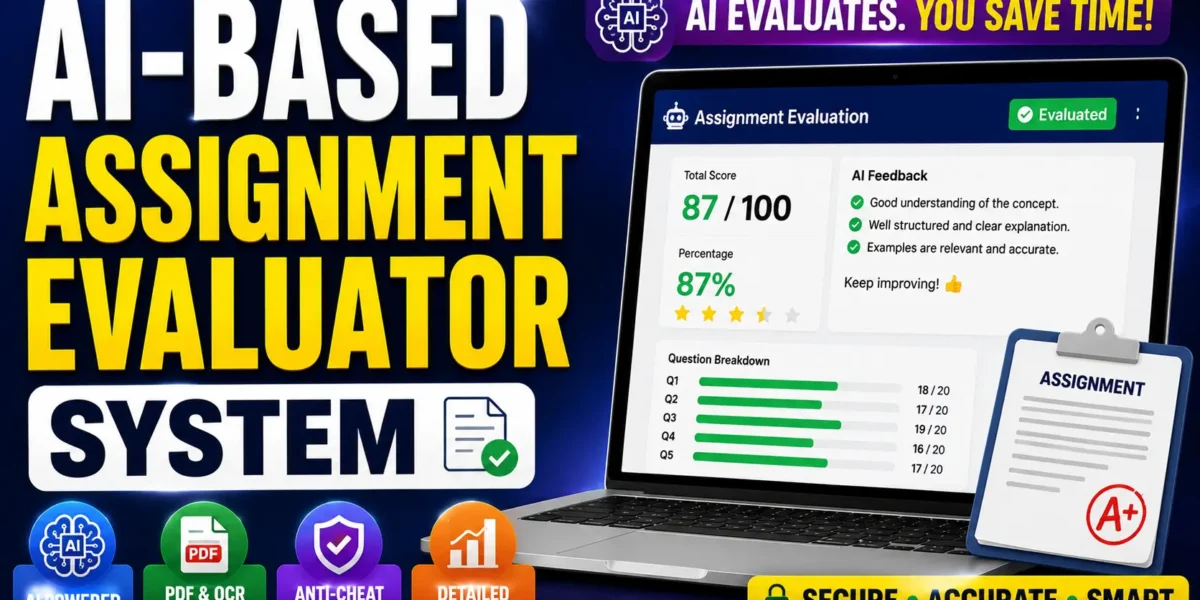
The AI-Based Assignment Evaluator System is a cutting-edge final year project that brings artificial intelligence directly into the classroom — automatically grading student assignments, generating detailed feedback, and tracking results in real time. Built with Python FastAPI on the backend and powered by OpenAI GPT-4o-mini combined with Sentence Transformers, this project is one of the most impressive and practical final year project ideas available for BCA, MCA, and B.Tech CS/IT students in 2026. In this post you will learn exactly what this system does, how it works, and how to download the complete package including source code, project report, synopsis, and presentation.
About the AI-Based Assignment Evaluator System
Manual assignment checking is one of the most time-consuming tasks teachers face. With large class sizes, evaluating each submission individually — applying consistent marks, writing constructive feedback, and recording results — takes hours and is often subject to inconsistency. There is a clear need for an intelligent, automated solution that can evaluate student work fairly, quickly, and at scale without compromising on the quality of feedback.
| Field | Details |
|---|---|
| Project Name | AI-Based Assignment Evaluator System |
| Language | Python 3.13, HTML5, CSS3, JavaScript |
| Framework | FastAPI |
| AI Engine | OpenAI GPT-4o-mini + Sentence Transformers |
| Database | SQLite (via SQLAlchemy ORM) |
| OCR / PDF Support | PyMuPDF + Pytesseract |
| Authentication | JWT (python-jose + passlib bcrypt) |
| Project Type | Web Application |
| Difficulty Level | Advanced |
| Best For | BCA, MCA, B.Tech CS/IT, M.Tech Final Year |
| Year | 2026 |
| Developer | Updategadh |
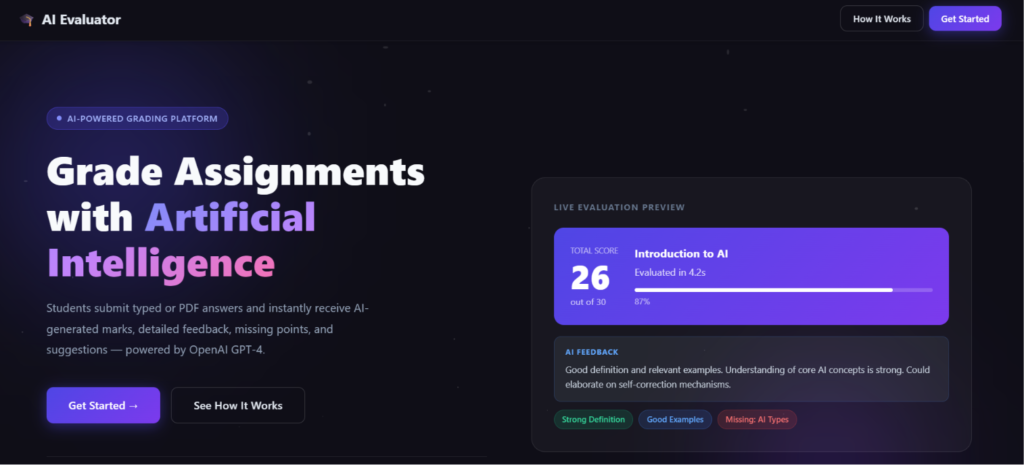
This AI-Based Assignment Evaluator System solves that problem directly. Teachers create assignments with model answers and assigned marks through a clean dashboard. Students then submit their responses either by typing directly in the browser or by uploading a PDF — including handwritten scans. The AI evaluation engine blends OpenAI GPT-4o-mini’s reasoning with semantic similarity scoring from Sentence Transformers, generating a final blended score along with per-question feedback, missing points, and improvement suggestions. Results are stored in SQLite and presented instantly on both teacher and student dashboards.
Key Features
Teacher Module
- Assignment Creation: Create assignments with any number of questions, model answers, and per-question marks that must sum to the total.
- Targeted Sharing: Share assignments with specific students or broadcast to all registered students in one click.
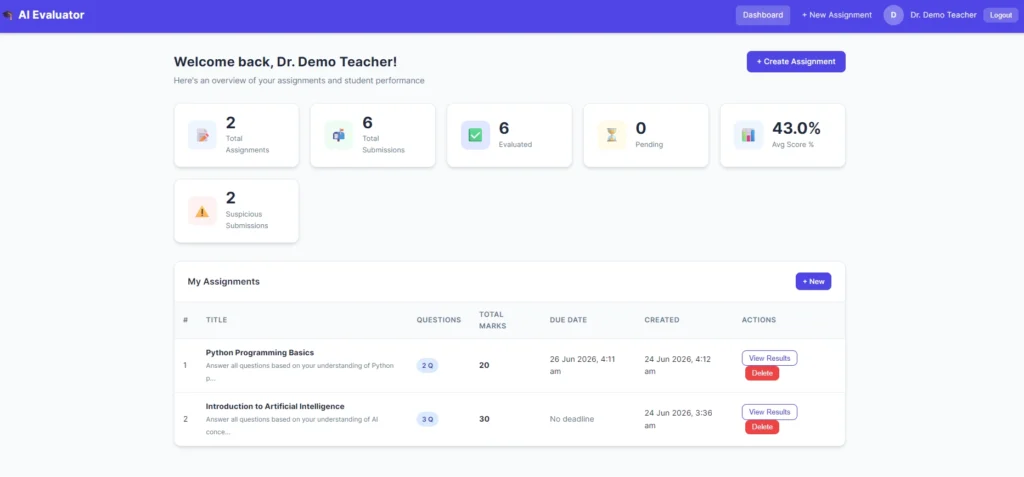
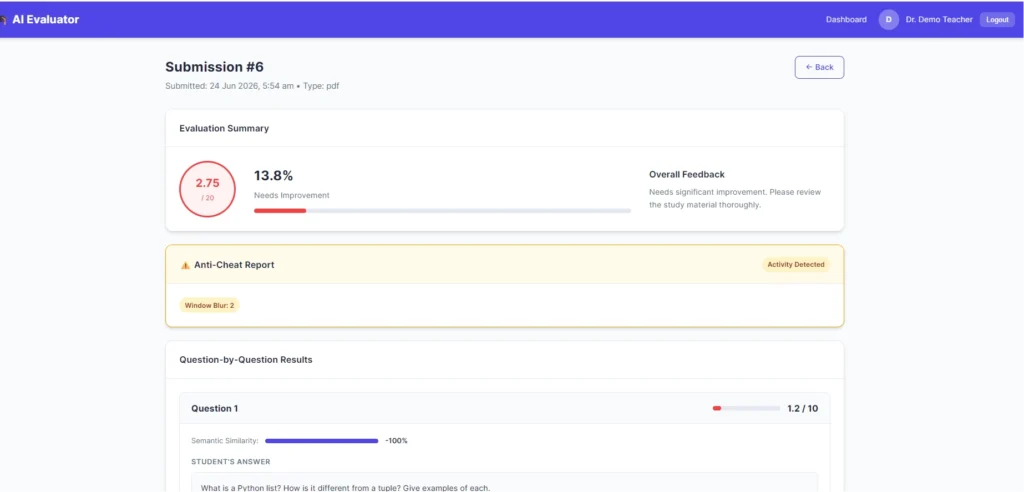
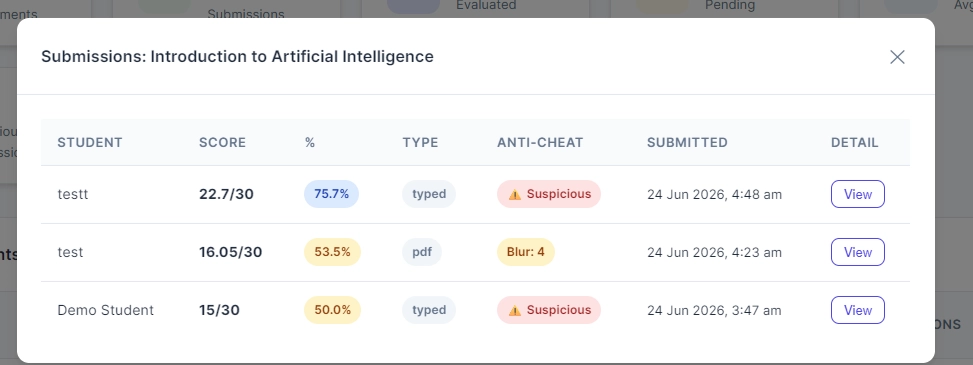
- Submission Overview: View all student submissions for any assignment in a modal, including scores, percentages, submission type, and anti-cheat flags.
- Detailed Drill-Down: Open any individual submission to see the complete per-question AI feedback alongside the student’s answers.
- Aggregate Dashboard: View overall class statistics and assignment performance at a glance.
Student Module
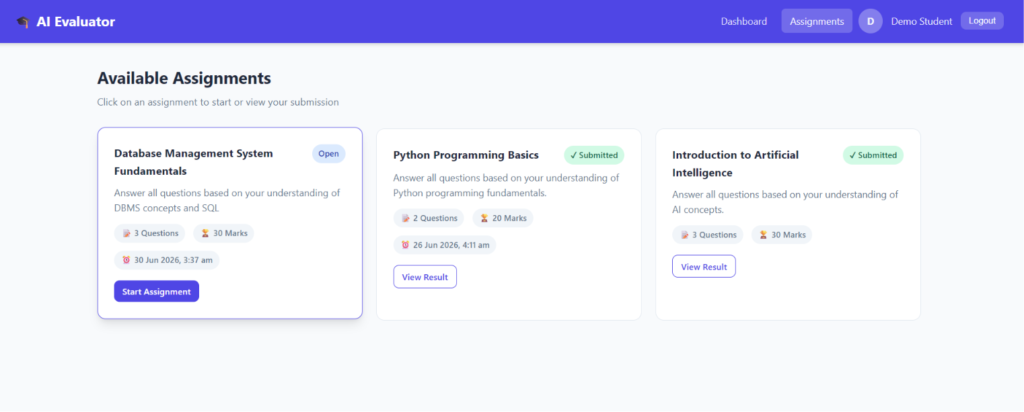
- Personalised Assignment List: Students only see assignments explicitly shared with them or marked as open to all.
- Typing Mode: Write answers directly in the browser with real-time anti-cheat monitoring that flags excessive tab switches, copy-paste attempts, and window blur events.
- PDF Upload Mode: Upload a typed or handwritten PDF; the system extracts text using PyMuPDF with a Tesseract OCR fallback for scanned pages.
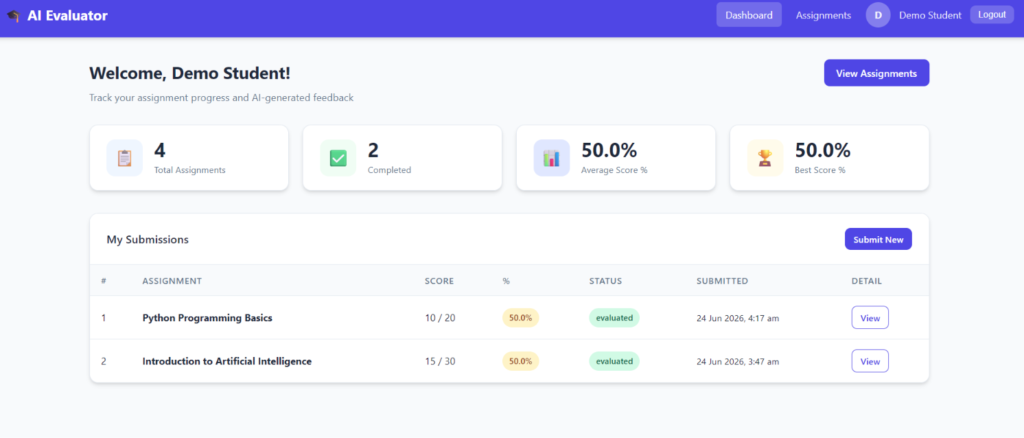
- Instant AI Results: Receive the final score, percentage, per-question breakdown, AI-generated feedback, missing points, and suggestions immediately after submission.
- Submission History: Track all past submissions and results from a personal dashboard.
AI Evaluation Engine
- OpenAI GPT-4o-mini Integration: Uses a strict academic evaluator prompt to return structured JSON containing marks, feedback, missing points, and suggestions for each question.
- Sentence Transformers Similarity: Computes cosine similarity between student answer embeddings and model answer embeddings using the
all-MiniLM-L6-v2model. - Blended Scoring Formula: Final score is calculated as 70% OpenAI marks plus 30% similarity-based marks for a balanced, fair result.
- Graceful Fallback: If the OpenAI key is unavailable, scoring relies on semantic similarity alone. If Sentence Transformers is not installed, similarity defaults to 50%.
Technologies Used
| Layer | Technology | Purpose |
|---|---|---|
| Backend | Python 3.13 + FastAPI | REST API server, routing, business logic |
| AI Engine | OpenAI GPT-4o-mini | Intelligent answer evaluation and feedback generation |
| NLP / Similarity | Sentence Transformers (all-MiniLM-L6-v2) | Semantic similarity scoring via cosine distance |
| Database | SQLite via SQLAlchemy ORM | Persistent storage of users, assignments, and results |
| PDF / OCR | PyMuPDF + Pytesseract | Text extraction from typed and handwritten PDFs |
| Authentication | JWT (python-jose + passlib bcrypt) | Secure login, role-based access control |
| Frontend | HTML5, CSS3, Vanilla JavaScript | Teacher and student dashboards, submission forms |
| Server | Uvicorn | ASGI server with hot-reload for development |
How It Works
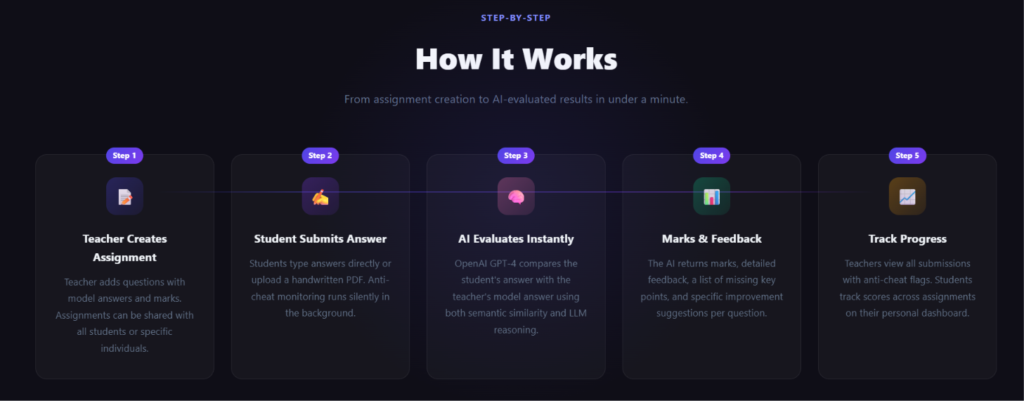
- Teacher Setup: The teacher registers, logs in, and creates an assignment by entering questions, model answers, and marks per question. They then share the assignment with selected students or all students.
- Student Access: The student logs in and views their personalised list of available assignments. They choose an assignment to attempt.
- Answer Submission: The student either types answers directly in the browser (with anti-cheat monitoring active) or uploads a PDF file containing their responses.
- PDF Processing: For PDF submissions, PyMuPDF extracts the text. If the PDF is a scanned image, Pytesseract OCR takes over. Answers are then parsed per question using a Q1/Q2/Q3 pattern — with equal text-splitting as a fallback.
- AI Evaluation: Each student’s answer is evaluated by OpenAI GPT-4o-mini against the model answer. Simultaneously, Sentence Transformers computes the cosine similarity between the two answer embeddings.
- Score Calculation: The final mark per question is a blend of 70% from the GPT-4o-mini score and 30% from the similarity score, producing a fair and robust result.
- Result Storage and Display: Marks, percentage, per-question feedback, missing points, and suggestions are stored in SQLite and shown instantly to the student on the result page. The teacher can view all submissions from their dashboard at any time.
How to Run This Project
Step 1 — Prerequisites
Make sure you have Python 3.13 installed on your system. You will also need pip and access to a terminal or command prompt.
Step 2 — Install Dependencies
pip install -r requirements.txt
pip install email-validator bcrypt==4.0.1
Note: Use bcrypt==4.0.1 Specifically, newer versions are incompatible with passlib 1.7.4.
Step 3 — Configure Environment Variables
Open the .env file and fill in your details:
OPENAI_API_KEY=sk-...your_key_here...
SECRET_KEY=your_secret_key
DATABASE_URL=sqlite:///./assignment_evaluator.db
UPLOAD_FOLDER=uploads
ACCESS_TOKEN_EXPIRE_MINUTES=1440
If you do not have an OpenAI API key, the system will still run using semantic similarity scoring only.
Step 4 — Start the Server
python run.pyStep 5 — Create Demo Accounts and Sample Data
python setup_demo.pyThis creates a demo teacher account (teacher@demo.com) and a demo student account (student@demo.com), both with the password demo1234, along with a sample assignment ready to test.
Demo Video
Screenshots
Student
How to Download
Get This Project
The complete package is available so you can run, study, and submit it with confidence. It includes:
- Full Source Code
- Project Report
- Synopsis
- PPT Presentation
For any queries or a quick response, reach out on WhatsApp: +91 79834 34684
Why This Is a Great Final Year Project
- Real-World Relevance: Automated assessment tools are actively being adopted by ed-tech companies and educational institutions — building one demonstrates commercial awareness to examiners and recruiters alike.
- Advanced AI Integration: Combining OpenAI GPT-4o-mini with Sentence Transformers and blended scoring shows a mature understanding of modern NLP and generative AI pipelines — far beyond a typical CRUD application.
- Full-Stack Architecture: The project covers backend API design with FastAPI, database modelling with SQLAlchemy, JWT authentication, OCR processing, and a multi-page frontend — giving strong coverage for viva and placement interviews.
- PDF and OCR Skills: Working with PyMuPDF and Pytesseract for both digital and handwritten document extraction is a practical, in-demand skill that stands out on a resume.
- Role-Based Access Control: Separate teacher and student portals with JWT-protected endpoints that demonstrate solid software engineering principles and security awareness.
- Anti-Cheat Monitoring: The real-time detection of tab switches, copy-paste events, and window blur adds an integrity layer that shows thoughtful product thinking beyond basic requirements.
- Resume-Worthy Tech Stack: Python, FastAPI, OpenAI API, Sentence Transformers, SQLAlchemy, and JWT authentication are all keywords actively searched by hiring teams in 2026.
How to Download This Project
The complete AI-Based Assignment Evaluator System project package from Updategadh includes everything you need to submit and present with confidence:
- Full Source Code — Python FastAPI backend, frontend HTML/CSS/JS, and all configuration files
- Project Report — Academic-format documentation ready for college submission
- Synopsis — Concise project summary for your department
- PowerPoint Presentation — Ready-to-present slides for your viva
For direct support or custom project queries, reach us on WhatsApp: +91 79834 34684
Possible Extensions and Future Enhancements
- Add support for multiple choice questions (MCQs) and true/false question types alongside descriptive answers.
- Integrate a plagiarism detection module that cross-checks submissions within the same class batch.
- Build a mobile-responsive Progressive Web App (PWA) so students can submit assignments from any device.
- Add email or SMS notifications to alert students when their results are ready.
- Implement a bulk CSV import feature so teachers can register many students at once.
- Add analytics charts on the teacher dashboard showing class-wide performance trends over time.
- Support additional document formats such as DOCX and images submitted directly via mobile camera.
- Introduce a timed assignment mode where the submission form automatically closes after a set duration.
Watch More Project Demos on YouTube
Subscribe to the DecodeIT2 YouTube channel for full video walkthroughs of this project and many more final year project demos, tutorials, and coding guides.
Subscribe to DecodeIT2 on YouTube
Frequently Asked Questions
Which students is the AI-Based Assignment Evaluator System suitable for?
This project is well-suited for BCA, MCA, B.Tech CS/IT, and M.Tech final year students who want a project that demonstrates practical AI, full-stack web development, and modern API design skills. MBA students in information systems programmes can also use it.
Do I need an OpenAI API key to run this project?
No. The system includes a graceful fallback — if no valid OpenAI key is configured, assignments are still evaluated using Sentence Transformers semantic similarity scoring. This means the project runs fully offline without any paid API usage if needed for testing or demonstration.
Is this project difficult to set up and explain in a viva?
Setup requires only a few pip install commands and editing a single
.envfile. The architecture is modular and well-structured, making it straightforward to walk through in a viva. The blended AI scoring formula, JWT authentication, and OCR pipeline are particularly strong discussion points that examiners appreciate.Does the package from Updategadh include a project report and presentation?
Yes. The complete package includes full source code, an academic-format project report, a synopsis for your department, and a PowerPoint presentation — everything required for final year submission and viva at most Indian universities.


I do believe all the ideas youve presented for your post They are really convincing and will certainly work Nonetheless the posts are too short for novices May just you please lengthen them a little from subsequent time Thanks for the post