Specialization in DBMS
Specialization in DBMS is an important concept in database design and ER (Entity-Relationship) modeling. It follows a top-down approach, where a general entity is divided into multiple smaller and more specific sub-entities.
Specialization is useful when different groups of entities share common attributes but also have their own unique properties. It is the opposite of generalization in DBMS, which follows a bottom-up approach.
Complete Advance AI Topics: Click Here
SQL Tutorial: Click Here
What is Specialization in DBMS?
Specialization is the process of dividing a higher-level entity into one or more lower-level entities called subtypes.
The higher-level entity contains common attributes that are shared by all subtypes, while each subtype can have additional attributes specific to it.
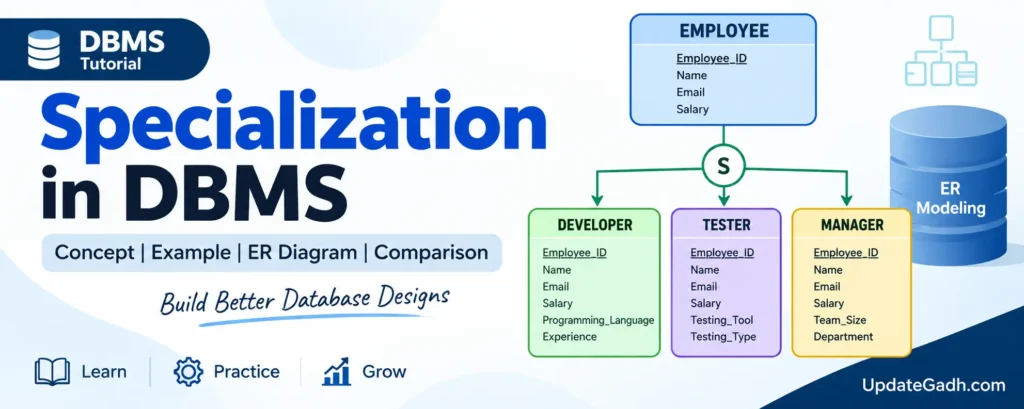
For example, consider an EMPLOYEE entity with common attributes such as:
- Employee_ID
- Name
- Salary
The EMPLOYEE entity can be specialized into:
DEVELOPER– Programming_Language, ExperienceTESTER– Testing_Tool, Testing_TypeMANAGER– Team_Size, Department
All three subtypes inherit the common properties of EMPLOYEE while maintaining their own specific attributes.
Why is Specialization Necessary?
Specialization helps create a well-organized and flexible database structure. Some major benefits include:
1. Reduces Data Redundancy
Common attributes are stored in the parent entity instead of being repeated in every subtype.
2. Improves Data Organization
Different types of entities can be represented separately according to their specific characteristics.
3. Improves Data Integrity
Common information is maintained in one parent entity, reducing the possibility of inconsistent data.
4. Simplifies Database Maintenance
Changes to common attributes can be handled at the parent level, while subtype-specific changes remain isolated.
5. Supports Scalability
New subtypes can be introduced when business requirements change without redesigning the entire database.
Real-World Example of Specialization
Consider an e-commerce database with a general PRODUCT entity.
The PRODUCT entity may contain:
- Product_ID
- Product_Name
- Price
- Quantity
This entity can be specialized into different product categories.
Electronics
Additional attributes may include:
- Brand
- Warranty
- Model_Number
Books
Additional attributes may include:
- Author
- ISBN
- Genre
Clothing
Additional attributes may include:
- Size
- Material
- Color
The common product information remains in the PRODUCT entity, while category-specific information is stored in the corresponding subtype.
Specialization in ER Model
A simple specialization hierarchy can be represented as:
                 PRODUCT
                    |
          -----------------------
          |          |          |
     ELECTRONICS    BOOKS     CLOTHING
          |          |          |
       Brand       Author      Size
       Warranty    ISBN        Material
       Model       Genre       Color
Here, PRODUCT is the superclass (higher-level entity), while ELECTRONICS, BOOKS, and CLOTHING are subclasses (lower-level entities).
Specialization vs Generalization in DBMS
Specialization and generalization are both used to represent hierarchies in an ER model, but they work in opposite directions.
| Aspect | Generalization | Specialization |
|---|---|---|
| Approach | Bottom-up | Top-down |
| Process | Combines multiple entities | Divides one entity |
| Direction | Specific to general | General to specific |
| Starting Point | Multiple lower-level entities | One higher-level entity |
| Result | One superclass | Multiple subclasses |
| Example | Car + Bike → Vehicle | Employee → Developer + Tester |
Example of Specialization and Generalization
Suppose a database contains CAR and BIKE entities.
If we combine their common attributes into a single VEHICLE entity, it is called generalization.
YT:- DecodeIT
        VEHICLE
        /     \
      CAR     BIKE
On the other hand, if we start with an EMPLOYEE entity and divide it into DEVELOPER, TESTER, and MANAGER, it is called specialization.
              EMPLOYEE
             /    |     \
     DEVELOPER   TESTER   MANAGER
Conclusion
Specialization in DBMS provides a structured way to divide a general entity into more specific subtypes. It improves database organization, reduces redundancy, supports data integrity, and makes the database easier to maintain and extend.
Understanding specialization is also important for learning related ER model concepts such as generalization, aggregation, inheritance, and ER diagrams.
Keywords
Specialization in DBMS, generalization in DBMS, specialization in DBMS with example, specialization and generalization in DBMS, difference between specialization and generalization, specialization in DBMS diagram, DBMS specialization ER diagram, DBMS specialization examples