Difference Between DBMS and RDBMS
Knowing the distinction between DBMS (Database Management System) and RDBMS (Relational Database Management System) is crucial when working with data systems. Both store and manage data, but they differ in structure, design principles, and functionality.
Table of Contents
Complete Advance AI Topics: Click Here
SQL Tutorial: Click Here
What is DBMS?
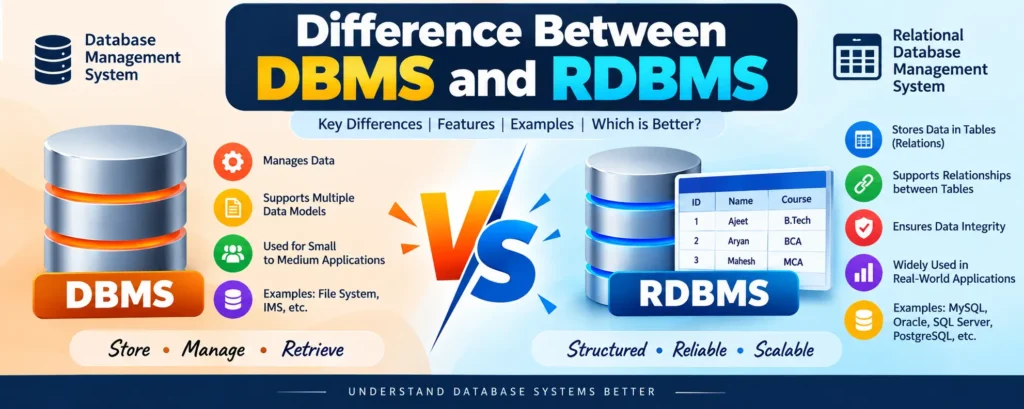
A DBMS lets users define, create, maintain, and control access to a database. It simplifies inserting, updating, and retrieving data. Traditional DBMS systems store data in files and follow a hierarchical or navigational model.
What is RDBMS?
An RDBMS stores data in tabular form (rows and columns). Each table has a primary key to uniquely identify records and supports relationships across tables. It follows the relational model proposed by E. F. Codd, providing greater structure, consistency, and flexibility.
Key Differences
| DBMS | RDBMS |
|---|---|
| Stores data as files | Stores data in tables |
| Hierarchical/navigational model | Relational table model |
| No normalization | Supports normalization |
| No relations between entities | Relations via foreign keys |
| Single user typically | Multiple concurrent users |
| Does not support ACID | Fully supports ACID |
| Examples: XML, file systems | Examples: MySQL, Oracle, SQL Server |
Download New Real Time Projects:- Click here
Conclusion
RDBMS is an enhanced version of DBMS, designed to handle complex data structures while ensuring integrity, security, and consistency. DBMS suits small, simple applications; RDBMS is preferred for modern enterprise systems. For more database tutorials, stay connected with .
difference between dbms and rdbms with example
difference between dbms and rdbms in sql
difference between dbms and rdbms pdf
difference between dbms and file system
dbms and rdbms examples
normalization in dbms
what is rdbms
difference between dbms and rdbms tabular