
Model Planning for Data Analytics
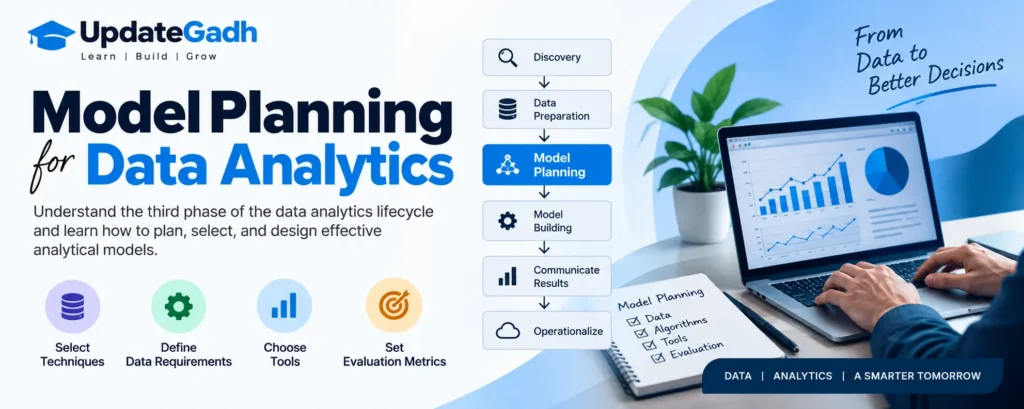
In the world of data analytics, model planning is an important stage in the data analytics lifecycle. It is the third phase of the lifecycle and helps determine how data-driven solutions will be designed, evaluated, and implemented.
In this tutorial, we will explore the Model Planning phase, its importance, commonly used tools, key steps, and how it connects the planning process with model building.
Table of Contents
Complete Advance AI Topics: Click Here
SQL Tutorial: Click Here
What Is Model Planning?
Model planning is the stage where a data science team decides how to solve the business problem identified during the discovery phase. It involves selecting appropriate statistical techniques, data modeling methods, algorithms, and analytical tools for the model-building stage.
At this stage, the focus moves from exploring the data to creating a clear strategy for turning insights into useful analytical solutions.
The Role of Hypotheses in Model Planning
During the discovery phase, the team develops initial hypotheses based on business requirements and preliminary data exploration. These hypotheses help guide important decisions during model planning.
- Data selection and transformation
- Feature engineering
- Algorithm selection
- Evaluation strategy
The main goal is to create a clear path for the modeling process, reduce guesswork, and improve efficiency.
Tools Commonly Used in the Model Planning Phase
Selecting suitable tools can streamline the analytics workflow, support model development, and improve decision-making. Some commonly used tools include:
| Tool | Key Highlights |
|---|---|
| Python (Pandas, Scikit-learn) | Widely used for data cleaning, analysis, and model prototyping. It also supports machine learning pipelines. |
| SQL Workbench | Supports structured queries and backend analysis and is useful for relational data preparation. |
| Power BI | Provides interactive dashboards and integration with Excel and other services. |
| SPSS | Provides a statistical interface for users who prefer a non-programming environment and is useful for hypothesis testing. |
| Orange | A visual programming tool for data mining that provides drag-and-drop components. |
| Google Data Studio | Supports quick dashboard creation and live data connections from Google sources. |
Why Is Model Planning Important?
Model planning provides a structured approach to the modeling process. Skipping or rushing this phase can result in several problems, including:
- Poor model performance
- Wasted resources
- Inaccurate business insights
A well-planned modeling process helps ensure:
- Efficient use of resources
- Proper alignment with business goals
- Selection of a suitable modeling technique
- Higher chances of predictive success
Key Steps in Model Planning
The model planning phase can be divided into several important steps.
1. Select Modeling Techniques
Choose appropriate methods such as regression, clustering, and decision trees based on the type of problem being solved, such as classification or prediction.
2. Define Data Requirements
Identify the datasets, features, and data formats required for building the model.
3. Define a Data Partitioning Strategy
Plan how the available data will be divided into training, validation, and test sets. Proper data partitioning helps reduce the risk of overfitting and supports reliable model evaluation.
4. Select Tools and Technologies
Choose platforms and technologies that match the technical requirements of the project and the skills of the data science team.
5. Establish Evaluation Metrics
Define the appropriate performance metrics for evaluating the model. Depending on the objective, these may include accuracy, precision, recall, F1-score, and AUC-ROC.
Bridging Model Planning to Model Building
Once the model planning blueprint is complete, the next stage, Model Building, can begin with a clear direction.
The team should have a defined understanding of what data to use, how to use it, and which modeling approach to follow. This helps prevent blind experimentation and provides a structured path toward developing the analytics solution.
Life Cycle Phases of Data Analytics
Data analytics plays an important role in helping businesses, researchers, and organizations discover useful insights from large volumes of data. These results are achieved through a structured Data Analytics Life Cycle.
What Is the Data Analytics Life Cycle?
The Data Analytics Life Cycle is a step-by-step methodology used to solve Big Data problems and manage data science projects effectively.
It provides a roadmap for activities such as data acquisition, data processing, analysis, and data reuse, guiding teams from an initial business problem toward a data-driven solution.
Phase 1: Discovery
Every successful data analytics project begins with understanding the right questions and defining the problem.
During the discovery phase:
- The data science team becomes familiar with the business domain and the problem being addressed.
- Potential data sources, including internal and external sources, are identified.
- Initial assumptions and hypotheses are developed for later testing.
- The team defines project goals, success criteria, and deliverables.
This phase focuses on exploration, understanding the project scope, and establishing a strong foundation.
Phase 2: Data Preparation
Data preparation, often known as data wrangling, involves preparing raw data for analysis and modeling.
Key activities include:
- Cleaning, transforming, and integrating data from different sources
- Creating an analytic sandbox for experimentation
- Handling missing values, duplicates, and inconsistent formats
Common tools used during this phase include Hadoop, Alpine Miner, and OpenRefine.
Data preparation is usually an iterative process and may require several rounds of processing before the data is ready for modeling.
Phase 3: Model Planning
After the data has been prepared, the team begins planning the analytics model.
- Relationships between variables are explored to determine suitable data modeling techniques.
- Algorithms are selected and workflows are designed.
- Datasets are structured for training and testing.
- A clear analytical approach is established.
Tools such as MATLAB and STATISTICA can be used during this phase for data visualization and modeling.
Phase 4: Model Building
Once the planning stage is complete, the team moves to constructing the actual model.
During model building:
- The model is trained, validated, and tested using prepared data.
- The team evaluates whether the available infrastructure can support the computational requirements.
- Parameters are fine-tuned to improve model performance.
Tools used during this stage can include:
- Free/Open Source: R, PL/R, Octave, WEKA
- Commercial: MATLAB, STATISTICA
Model building is a technical process that combines data, algorithms, experimentation, and intelligent design.
Phase 5: Communicate Results
After the model has been developed and tested, the results need to be communicated effectively. This is where data storytelling becomes important.
The team needs to:
- Analyze outcomes and compare performance with the original objectives.
- Identify important findings and translate them into business value.
- Create presentations, dashboards, and visualizations to communicate insights.
Effective communication is not simply about creating attractive graphs. Stakeholders should be able to understand and act on the results. Important assumptions, limitations, and next steps should also be clearly presented.
Phase 6: Operationalize
The final phase of the Data Analytics Life Cycle focuses on deploying the solution and making its benefits available across the organization.
Important activities include:
- Launching a pilot to test the model in a controlled real-world environment.
- Evaluating the model’s performance, scalability, and impact.
- Making required adjustments before a full-scale rollout.
- Preparing final documentation, presentations, and deployment scripts.
Tools such as WEKA, SQL, Octave, and MADlib can be used to support implementation and monitoring.
YT:- DecodeIT
Final Thoughts
Model planning may not receive as much attention as machine learning algorithms or AI predictions, but it is where much of the strategic thinking takes place. It connects the understanding of a business problem with the process of solving it through data.
A well-defined model planning phase helps teams select suitable data, techniques, tools, and evaluation methods before moving into model building.
When starting a data analytics project, do not overlook the Model Planning phase. It provides the structured foundation needed for effective and actionable analytics.
Stay Connected with UpdateGadh
We bring you simplified and professional tutorials covering programming, analytics, and technology. Keep following UpdateGadh for more useful content designed for learners and future data professionals.
Keywords
model planning for data analytics, model planning for data analytics life cycle, model planning for data analytics example, model planning for data analytics with example, what are model planning for data analytics phase in data science, model planning for data analytics life cycle pdf, model planning for data analytics diagram, model fit statistics in model planning for data analytics, model planning for data analytics machine learning, model data analytics, model planning for data analytics example, a model planning for data analytics, a model planning for data analytics that finds the production schedule that minimizes overtime