
Failure Classification in DBMS
Failure classification in DBMS is the process of identifying and grouping different types of database failures based on their causes and effects. Understanding these failures is important for maintaining data consistency, protecting information, and selecting the appropriate recovery technique.
A database system may fail because of hardware problems, software errors, transaction issues, or storage failures. Proper failure classification helps database administrators understand the root cause of a failure and restore the database efficiently.
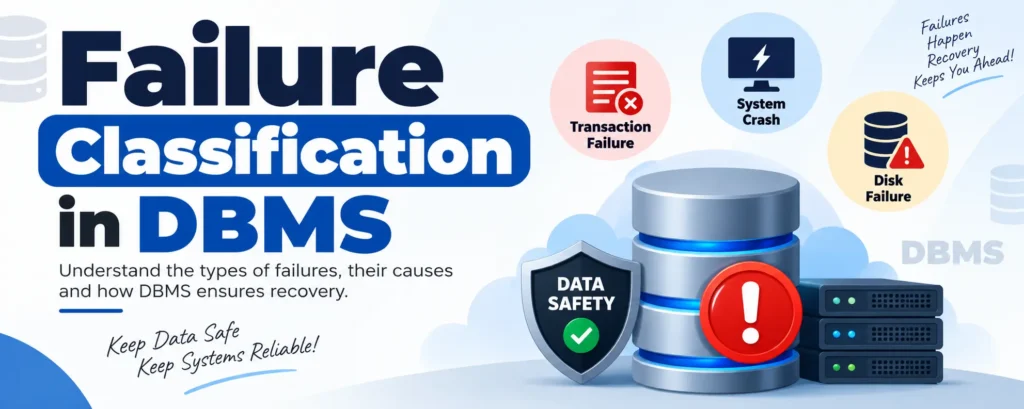
Failure Classification
Failures in a Database Management System can be classified in different ways depending on their cause and impact on the system.
Hardware Failure
Hardware failures occur when physical components of the computer system stop working correctly. Common examples include hard disk crashes, power failures, memory problems, overheating, and faulty hardware components.
Hardware failures can cause partial or complete data loss. Therefore, regular backups, RAID configurations, and disaster recovery mechanisms are important for protecting database information.
Complete Advance AI Topics: Click Here
SQL Tutorial: Click Here
Software Failure
Software failures occur because of problems in the database software, operating system, or applications connected to the database. Bugs, programming errors, incompatible software versions, and unexpected exceptions can cause software failures.
Proper testing, error handling, software updates, and monitoring can help reduce the possibility of software-related failures.
Transient Failure
Transient failures are temporary failures that usually disappear after a short period. Examples include temporary network disconnections, brief system overloads, or temporary unavailability of a required resource.
These failures can often be handled using retry mechanisms, timeout handling, and temporary fallback strategies.
Failure Categorization in DBMS
From the database recovery perspective, failures are commonly categorized into the following three major types:
- Transaction Failure
- System Crash
- Disk Failure
1. Transaction Failure
Transaction failure occurs when an individual transaction cannot complete successfully. It generally affects one transaction or a small number of transactions rather than the entire database system.
A transaction may fail because of logical errors, invalid operations, deadlocks, insufficient resources, constraint violations, or other execution problems.
Causes of Transaction Failure
- Logical Errors: Incorrect transaction logic or invalid conditions may prevent successful execution.
- System Errors: Deadlocks, resource limitations, or other DBMS-level problems may cause a transaction to terminate.
- Constraint Violations: An operation may fail when it violates database constraints.
- Invalid Operations: Incorrect or unsupported operations can cause the transaction to fail.
Advantages
- Improved Reliability: Detecting transaction failures helps prevent incomplete or inconsistent data from being stored.
- Efficient Recovery: Failed transactions can usually be rolled back without affecting successfully completed transactions.
- Easier Troubleshooting: Identifying the cause of a transaction failure helps developers resolve problems efficiently.
Disadvantages
- Increased Complexity: The DBMS requires additional mechanisms to detect and handle transaction failures.
- Performance Overhead: Failure detection, logging, and rollback operations may introduce additional processing overhead.
2. System Crash
A system crash occurs when the database system unexpectedly stops functioning because of problems such as power failure, operating system errors, hardware problems, or software crashes.
During a system crash, data stored in volatile memory such as RAM may be lost. Data that has already been safely written to non-volatile storage is generally expected to remain available. This assumption is commonly used when designing database recovery mechanisms.
After the system restarts, recovery techniques use transaction logs and other recovery information to restore the database to a consistent state.
Advantages
- Simplified Recovery: Recovery mechanisms can focus on transactions whose changes were not safely preserved.
- Data Integrity: Logging and recovery procedures help maintain database consistency after a crash.
- Automatic Recovery: Modern DBMSs can often perform recovery automatically after restarting.
Disadvantages
- Volatile Data Loss: Unsaved changes stored in RAM may be lost during a crash.
- Downtime: The database may remain unavailable while the system is restarted and recovery is performed.
- Recovery Overhead: Processing logs and restoring transactions requires additional system resources.
3. Disk Failure
Disk failure occurs when a storage device containing database files becomes damaged, corrupted, or inaccessible. Bad sectors, physical damage, storage controller problems, and disk hardware failures are common causes.
Unlike a simple transaction failure or system crash, disk failure can result in the permanent loss of database files if reliable backups or redundant storage are not available.
Advantages
- Better Storage Protection: The risk of disk failure encourages organizations to use RAID, replication, and backup systems.
- Stronger Recovery Planning: Organizations often implement disaster recovery strategies to protect against storage failures.
- Improved Reliability: Redundant storage systems can reduce the impact of individual disk failures.
Disadvantages
- Permanent Data Loss: Important data may be permanently lost when no valid backup is available.
- High Recovery Cost: Replacing storage hardware and restoring large databases can be expensive.
- Extended Downtime: Recovery from major storage failures may take considerable time.
Difference Between Types of Failures
| Failure Type | Main Cause | Impact | Typical Recovery |
|---|---|---|---|
| Transaction Failure | Logical errors, deadlocks, constraint violations | Usually affects individual transactions | Rollback or restart transaction |
| System Crash | Power failure, OS error, software crash | May affect active transactions and volatile data | Log-based recovery and restart |
| Disk Failure | Storage hardware failure or corruption | Can cause partial or complete data loss | Backup restoration, RAID, or replication |
YT:- DecodeIT
Why Failure Classification Is Important
Failure classification helps database administrators and developers select an appropriate recovery strategy. Different failures require different recovery mechanisms. For example, a transaction failure may require a rollback, while a disk failure may require restoring data from a backup.
Proper classification also helps organizations improve database reliability, reduce downtime, protect critical information, and design effective disaster recovery plans.
Frequently Asked Questions (FAQ)
Q1. What is failure classification in DBMS?
Answer: Failure classification in DBMS is the process of grouping database failures according to their causes and effects. Common categories include transaction failure, system crash, and disk failure.
Q2. What are the major types of failures in DBMS?
Answer: The major types are transaction failure, system crash, and disk failure. Hardware, software, and transient failures may also be used to describe failures based on their causes or characteristics.
Q3. What happens during a transaction failure?
Answer: A transaction fails to complete successfully because of problems such as logical errors, deadlocks, constraint violations, or resource-related issues. The DBMS can usually roll back the failed transaction.
Q4. What is a system crash in DBMS?
Answer: A system crash occurs when the database environment unexpectedly stops working. Data in volatile memory may be lost, while recovery mechanisms use logs to restore the database to a consistent state.
Q5. What is disk failure?
Answer: Disk failure occurs when the storage device containing database files becomes damaged or inaccessible. Recovery may require backups, RAID, replication, or other redundant storage mechanisms.
Keywords
Failure Classification, Failure Classification in DBMS, DBMS Failure, Types of Failures in DBMS, Transaction Failure, System Crash, Disk Failure, Hardware Failure, Software Failure, Transient Failure, Database Recovery, Database Failure Recovery, DBMS Recovery Techniques, Log Based Recovery, Database Backup, Database Management System