
Join Dependency in DBMS
Join Dependency (JD) is a concept in database management systems that describes a condition where a relation can be decomposed into multiple smaller relations and then reconstructed exactly by performing a natural join on those relations.
In simple words, suppose a large relation R is divided into smaller relations R1, R2, R3, … Rn. If joining all the decomposed relations produces exactly the original relation R, then a Join Dependency exists.
Join Dependency is particularly important in database normalization, especially in Fifth Normal Form (5NF), where complex relationships may need to be decomposed to remove redundancy while preserving all the original information.
What is Join Dependency?
A Join Dependency specifies that a relation can be reconstructed from a collection of its projections. The decomposition is considered valid when joining those projections produces exactly the original relation, without losing tuples or generating unwanted tuples.
The general representation of a Join Dependency is:
R = R1 ⨝ R2 ⨝ R3 ⨝ ... ⨝ RnHere:
- R represents the original relation.
- R1, R2, R3, … Rn represent the decomposed relations.
- ⨝ represents the natural join operation.
Therefore, if the natural join of all the decomposed relations gives exactly R, the decomposition satisfies the corresponding Join Dependency.
Complete Advance AI Topics: Click Here
SQL Tutorial: Click Here
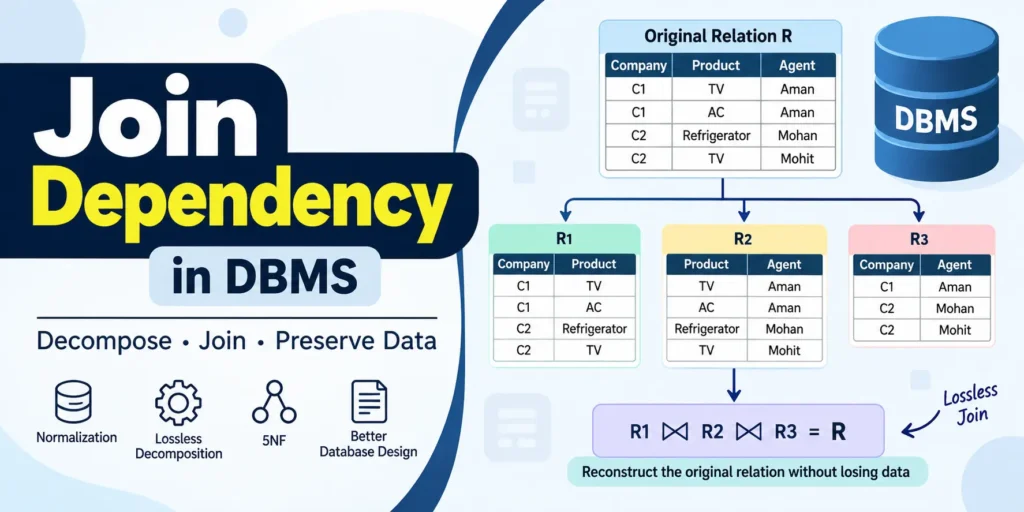
Understanding Join Dependency with an Example
Consider a relation:
Company_Stats(Company, Product, Agent)Suppose it contains the following data:
| Company | Product | Agent |
|---|---|---|
| C1 | TV | Aman |
| C1 | AC | Aman |
| C2 | Refrigerator | Mohan |
| C2 | TV | Mohit |
We can decompose this relation into three smaller relations.
R1: Company and Product
| Company | Product |
|---|---|
| C1 | TV |
| C1 | AC |
| C2 | Refrigerator |
| C2 | TV |
R2: Product and Agent
| Product | Agent |
|---|---|
| TV | Aman |
| AC | Aman |
| Refrigerator | Mohan |
| TV | Mohit |
Joining R1 and R2
If we perform a natural join between R1 and R2 using the common attribute Product, we get:
| Company | Product | Agent |
|---|---|---|
| C1 | TV | Aman |
| C1 | TV | Mohit |
| C1 | AC | Aman |
| C2 | Refrigerator | Mohan |
| C2 | TV | Aman |
| C2 | TV | Mohit |
Notice that this result contains additional combinations such as:
- (C1, TV, Mohit)
- (C2, TV, Aman)
These rows were not present in the original relation. They are called spurious tuples.
This shows that decomposing a relation into only R1 and R2 does not guarantee that the original relation can be reconstructed exactly.
R3: Company and Agent
To preserve the complete relationship between companies and agents, we can introduce another relation:
| Company | Agent |
|---|---|
| C1 | Aman |
| C2 | Mohan |
| C2 | Mohit |
Now we have:
R1(Company, Product)
R2(Product, Agent)
R3(Company, Agent)
When all three relations are joined together:
R1 ⨝ R2 ⨝ R3the result is:
| Company | Product | Agent |
|---|---|---|
| C1 | TV | Aman |
| C1 | AC | Aman |
| C2 | Refrigerator | Mohan |
| C2 | TV | Mohit |
This is exactly the same as the original Company_Stats relation. Therefore, the decomposition satisfies the corresponding Join Dependency.
Join Dependency and Lossless Decomposition
A Join Dependency is closely related to the idea of a lossless decomposition. A decomposition is lossless when joining the decomposed relations produces exactly the original relation.
In other words:
Join(Decomposed Relations) = Original RelationA lossless decomposition must satisfy two important conditions:
- No original tuples should be lost.
- No spurious tuples should be generated.
Lossless Join
A lossless join occurs when a relation is decomposed into smaller relations and joining those relations reconstructs the original relation exactly.
For example, suppose an Employee relation contains:
| ID | Name | Salary |
|---|---|---|
| 101 | Amit | 50000 |
| 102 | Ravi | 60000 |
It can be decomposed into:
R1(ID, Name)
R2(ID, Salary)
If joining R1 and R2 using ID produces exactly the original Employee relation, the decomposition is lossless.
Lossy Decomposition
A lossy decomposition occurs when joining the decomposed relations does not reproduce the original relation correctly.
The result may contain:
- Missing tuples
- Additional tuples
- Spurious tuples
For example, in the Company_Stats example, joining only R1 and R2 produces combinations such as (C1, TV, Mohit) that were not present in the original table. This makes the decomposition lossy.
Join Dependency and Multivalued Dependency
Join Dependency is a generalization of Multivalued Dependency (MVD).
A multivalued dependency describes a specific type of relationship where one attribute determines a set of independent values. A Join Dependency is more general because it can involve the decomposition of a relation into more than two projections.
This makes Join Dependency especially useful for representing complex relationships that cannot always be adequately handled using functional dependencies or multivalued dependencies alone.
YT:- DecodeIT
Join Dependency in 5NF
Join Dependency plays an important role in Fifth Normal Form (5NF), also called Project-Join Normal Form (PJ/NF).
A relation is generally considered to be in 5NF when every non-trivial Join Dependency is implied by the candidate keys of the relation.
The main goal of 5NF is to eliminate redundancy caused by complex join relationships while ensuring that the original information can still be reconstructed from the decomposed relations.
Trivial Join Dependency
A trivial Join Dependency is a Join Dependency that does not impose a meaningful additional constraint on the relation.
For example, if one of the decomposed relations is the complete original relation itself, the corresponding join dependency does not provide a useful decomposition.
Non-trivial Join Dependencies are more important in normalization because they can reveal relationships that require further decomposition.
Join Dependency vs Lossless Decomposition
| Join Dependency | Lossless Decomposition |
|---|---|
| Describes a condition involving multiple projections of a relation. | Describes whether a decomposition can reconstruct the original relation exactly. |
| It is formally represented using a collection of relation projections. | It focuses on preserving all original information after decomposition. |
| It is especially important in 5NF. | It is an important property of a good database decomposition. |
Advantages of Join Dependency
- Helps identify complex relationships between attributes.
- Supports advanced database normalization.
- Helps reduce redundancy in complex relational structures.
- Plays an important role in achieving Fifth Normal Form.
- Helps ensure that decomposed relations can be joined without generating incorrect combinations when the required JD is satisfied.
Key Points to Remember
- Join Dependency (JD) specifies that a relation can be reconstructed by joining multiple projections of that relation.
- The general form is R = R1 ⨝ R2 ⨝ … ⨝ Rn.
- Join Dependency is a generalization of Multivalued Dependency.
- JD is particularly important in Fifth Normal Form (5NF).
- A lossless decomposition reconstructs the original relation exactly.
- A lossy decomposition can produce missing or spurious tuples.
- Spurious tuples are unwanted rows created when decomposed relations are joined incorrectly.
- A Join Dependency can involve more than two decomposed relations.
FAQs on Join Dependency
Q1. What is Join Dependency in DBMS?
Join Dependency is a constraint that specifies that a relation can be reconstructed exactly by joining multiple decomposed relations or projections of the original relation.
Q2. What is the notation for Join Dependency?
A Join Dependency can be represented as:
R = R1 ⨝ R2 ⨝ R3 ⨝ ... ⨝ Rnwhere the natural join of the decomposed relations produces the original relation.
Q3. Is Join Dependency related to 5NF?
Yes. Join Dependency is closely associated with Fifth Normal Form (5NF). 5NF deals with eliminating redundancy caused by non-trivial join dependencies.
Q4. What is lossless decomposition?
Lossless decomposition is a decomposition in which joining the resulting relations reconstructs exactly the original relation without losing information or creating spurious tuples.
Q5. What is lossy decomposition?
Lossy decomposition is a decomposition in which joining the decomposed relations does not reproduce the original relation correctly. It may generate spurious tuples or fail to preserve the original information.
Q6. What are spurious tuples?
Spurious tuples are unwanted rows generated after joining decomposed relations. They represent combinations that were not present in the original relation.
Q7. What is decomposition in DBMS?
Decomposition is the process of dividing a relation into smaller relations to reduce redundancy, improve database structure, and eliminate update, insertion, and deletion anomalies while preserving the required information.
Conclusion
Join Dependency is an important concept in relational database theory and normalization. It describes situations where a relation can be decomposed into several smaller relations and reconstructed through a natural join.
The concept becomes particularly important in 5NF, where complex relationships may require decomposition based on non-trivial Join Dependencies. Understanding the difference between Join Dependency, lossless decomposition, lossy decomposition, and spurious tuples is essential for designing well-structured relational databases.
Keywords
Join Dependency, Join Dependency in DBMS, Join Dependency in Database, JD in DBMS, Join Dependency 5NF, Fifth Normal Form, Lossless Decomposition, Lossy Decomposition, Spurious Tuples, Database Normalization, Multivalued Dependency, DBMS Normalization, Relational Database, 5NF in DBMS Join Dependency, Join Dependency in DBMS, Join Dependency in Database, JD in DBMS, Join Dependency 5NF, Fifth Normal Form, 5NF in DBMS, Lossless Join Dependency, Lossless Decomposition, Lossy Decomposition, Spurious Tuples, Database Normalization, Multivalued Dependency, DBMS Normalization, Relational Database