
Recoverability of Schedule in DBMS
Recoverability of Schedule in DBMS is an important concept in database transaction management. It ensures that transactions are executed in a way that allows the database to recover correctly when a transaction fails.
In a multi-user database system, several transactions may execute concurrently. One transaction may read data written by another transaction before the first transaction commits. If the first transaction fails, the second transaction may also need to be rolled back. Therefore, recoverable schedules are essential for maintaining database consistency and reliability.
Introduction
Recoverability ensures that a database can return to a consistent state after failures such as system crashes, power outages, hardware problems, or software errors.
When transactions execute concurrently, one transaction may depend on the result of another. A proper transaction schedule must ensure that a dependent transaction does not commit before the transaction whose data it has read commits successfully.
Transaction logs, undo operations, redo operations, checkpoints, and other recovery mechanisms help DBMSs restore the database to a correct state after failures.
Complete Advance AI Topics: Click Here
SQL Tutorial: Click Here
What is Recoverability in DBMS?
Recoverability in DBMS refers to the ability of a database system to recover from transaction failures while maintaining data consistency.
A schedule is called recoverable when a transaction that has read data written by another transaction is allowed to commit only after the transaction that produced that data has committed.
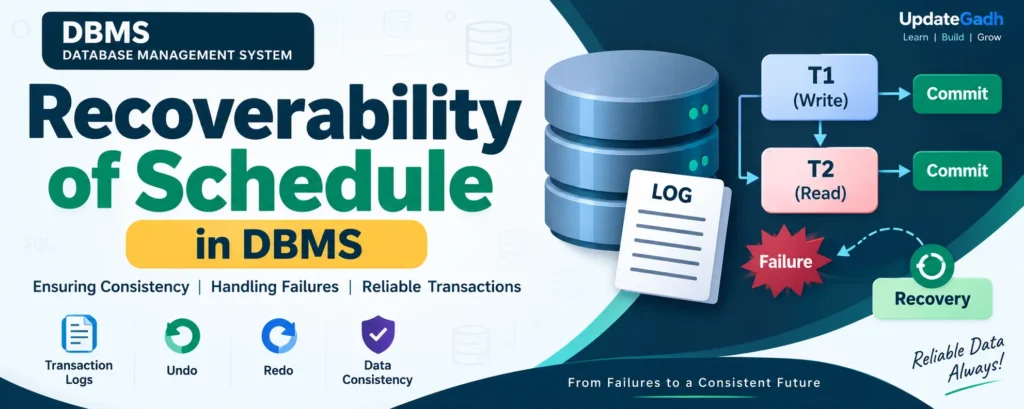
For example, suppose transaction T1 writes data item A and transaction T2 reads that value. If T2 commits before T1 commits, the schedule may become irrecoverable because T1 could fail after T2 has already committed.
Recoverability of Schedule
A schedule containing multiple transactions is recoverable if the commit order of dependent transactions follows the commit order of the transactions they depend upon.
Consider the following schedule:
T1: Write(A)
T2: Read(A)
T1: Commit
T2: Commit
Here, T2 reads the value written by T1. Since T2 commits only after T1 commits, the schedule is recoverable.
However, consider:
T1: Write(A)
T2: Read(A)
T2: Commit
T1: Abort
This schedule is irrecoverable because T2 has already committed after reading a value produced by T1, while T1 later aborts.
Types of Recoverable Schedules
Recoverability is commonly discussed through three important types of schedules:
- Irrecoverable Schedule
- Recoverable Schedule with Cascading Rollback
- Cascadeless Schedule
1. Irrecoverable Schedule
An irrecoverable schedule is a schedule in which a transaction commits after reading data written by another transaction that has not yet committed.
If the first transaction subsequently fails or aborts, the committed transaction cannot be rolled back safely. This can leave the database in an inconsistent state.
Example of Irrecoverable Schedule
T1: Write(A)
T2: Read(A)
T2: Commit
T1: Abort
Here, T2 reads the value written by T1 and commits before T1 commits. Later, T1 aborts. Since T2 has already committed, its result cannot simply be rolled back.
Therefore, this is an irrecoverable schedule.
2. Recoverable Schedule with Cascading Rollback
A recoverable schedule with cascading rollback allows a transaction to read data written by another transaction, but the dependent transaction does not commit until the transaction it depends on commits.
If the first transaction fails, the dependent transaction can also be rolled back.
Example
T1: Write(A)
T2: Read(A)
T1: Commit
T2: Commit
Here, T2 reads the value written by T1, but T2 commits only after T1 commits. Therefore, the schedule is recoverable.
If T1 had aborted before committing, T2 would also need to be rolled back because it had read an uncommitted value from T1. This dependency can cause a cascading rollback.
3. Cascadeless Schedule
A cascadeless schedule is a stronger form of recoverable schedule in which a transaction is allowed to read a data item only after the transaction that wrote that data item has committed.
This prevents transactions from reading uncommitted data and therefore eliminates cascading rollbacks.
Example
T1: Write(A)
T1: Commit
T2: Read(A)
T2: Commit
T2 reads A only after T1 has committed. Therefore, if T1 had failed before committing, T2 would never have read its uncommitted value.
Hence, this is a cascadeless schedule.
Recoverable vs Cascadeless vs Irrecoverable Schedule
| Schedule Type | Can Read Uncommitted Data? | Cascading Rollback | Recoverable? |
|---|---|---|---|
| Irrecoverable | Yes | Problematic | No |
| Recoverable | Yes | Possible | Yes |
| Cascadeless | No | No | Yes |
Importance of Recoverability in DBMS
Recoverability is important because it protects the database from inconsistent results caused by transaction failures.
- Maintains database consistency.
- Prevents committed transactions from depending incorrectly on failed transactions.
- Supports safe concurrent transaction execution.
- Helps the DBMS recover from transaction and system failures.
- Reduces the possibility of data corruption.
- Provides a reliable foundation for transaction recovery.
Role of Transaction Logs in Recovery
DBMSs maintain transaction logs to record important operations performed by transactions. These logs help the recovery manager determine which transactions need to be undone or redone after a failure.
Depending on the recovery technique, the DBMS may use:
- Undo: Reverses the changes made by incomplete or aborted transactions.
- Redo: Reapplies changes made by committed transactions when necessary.
- Undo-Redo: Supports both undo and redo operations during recovery.
Recoverability and Cascading Rollback
Suppose T1 writes a value and T2 reads that value before T1 commits. If T1 later fails, T2 has read an invalid or uncommitted value.
To maintain consistency, T2 must also be rolled back. If another transaction T3 has already read data from T2, T3 may also need to be rolled back.
This chain of rollbacks is known as a cascading rollback.
T1 → T2 → T3

T1 fails
↓
T2 must rollback
↓
T3 may also rollback
Cascadeless schedules avoid this problem by preventing transactions from reading uncommitted data.
Relationship Between Recoverable and Cascadeless Schedules
YT:- DecodeIT
There is a hierarchy between these schedules:
Strict Schedule
      ↓
Cascadeless Schedule
      ↓
Recoverable Schedule
      ↓
Irrecoverable Schedule
A cascadeless schedule is always recoverable, but every recoverable schedule is not necessarily cascadeless.
Frequently Asked Questions
Q1. What is a recoverable schedule in DBMS?
A recoverable schedule is a schedule in which a transaction commits only after the transaction whose data it has read has committed.
Q2. What is an irrecoverable schedule?
An irrecoverable schedule occurs when a transaction commits after reading data from another transaction that later aborts or fails.
Q3. What is a cascading rollback?
A cascading rollback occurs when the failure of one transaction causes other dependent transactions to roll back because they had read its uncommitted data.
Q4. What is a cascadeless schedule?
A cascadeless schedule ensures that transactions read only committed data. As a result, cascading rollbacks are avoided.
Q5. Is every cascadeless schedule recoverable?
Yes. Every cascadeless schedule is recoverable because a transaction reads data only after the transaction that produced the data has committed.
Conclusion
Recoverability of Schedule in DBMS is essential for maintaining database consistency during concurrent transaction execution. A recoverable schedule ensures that dependent transactions commit in a safe order and prevents committed transactions from depending on transactions that later fail.
Recoverable schedules may still allow cascading rollbacks, while cascadeless schedules prevent transactions from reading uncommitted data and therefore provide better recovery behavior. Understanding recoverable, irrecoverable, and cascadeless schedules is important for designing reliable and consistent database transaction systems.
Keywords
Recoverability of Schedule in DBMS, recoverable schedule in DBMS, DBMS recoverability, recoverable schedule, irrecoverable schedule, cascadeless schedule, cascading rollback, transaction recovery, transaction schedule in DBMS, concurrency control in DBMS, database recovery, transaction management in DBMS