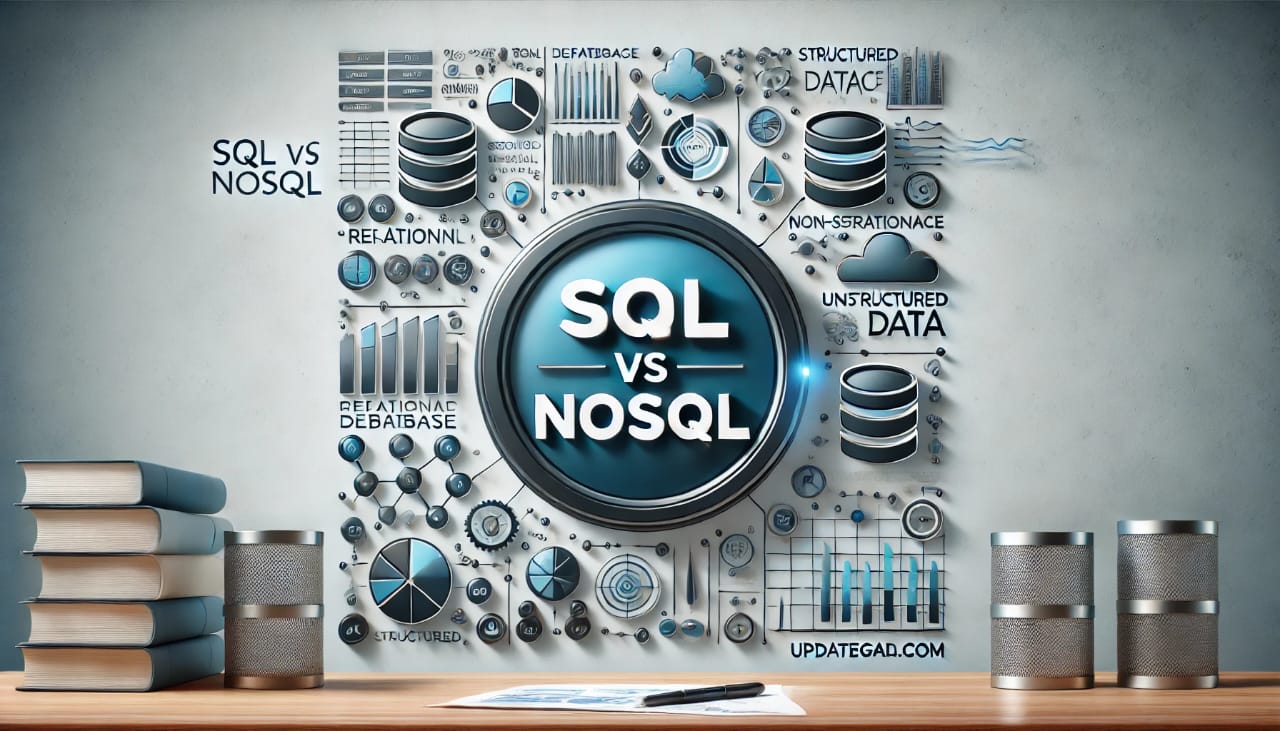
SQL vs NoSQL
Databases come in two main categories: SQL (Structured Query Language) databases and NoSQL (Not Only SQL) databases. SQL databases follow a structured, tabular relational model. NoSQL databases use a non-tabular structure, offering flexibility. Knowing the differences helps you pick the right tool for the job.
Complete Advance AI Topics: Click Here
SQL Tutorial: Click Here
Key Differences at a Glance
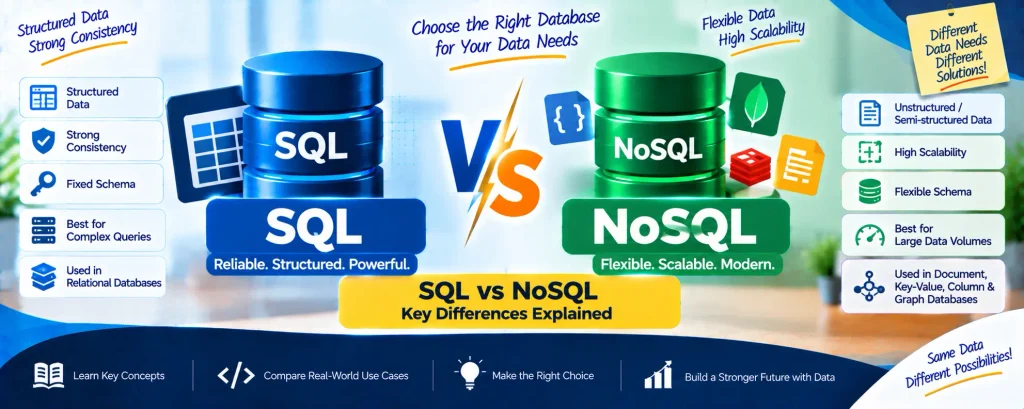
- Type: SQL is relational (RDBMS); NoSQL is non-relational/distributed.
- Schema: SQL = fixed predefined schema; NoSQL = dynamic schema.
- Storage: SQL stores in tables; NoSQL uses key-value, document, graph, or wide-column stores.
- Scaling: SQL scales vertically (bigger server); NoSQL scales horizontally (more servers).
- Query Language: SQL uses standardized SQL; NoSQL uses database-specific APIs.
- Complex Joins: SQL excels; NoSQL struggles with complex queries.
- Examples: SQL ÔÇö MySQL, PostgreSQL, Oracle, SQL Server. NoSQL ÔÇö MongoDB, Cassandra, Redis, Neo4j.
When to Use SQL
- Structured data with complex relationships.
- Strong consistency and integrity required.
- Frequent complex queries (joins, aggregates).
- Examples: banking, ERP, traditional web apps.
When to Use NoSQL
- Large volumes of unstructured or semi-structured data.
- Scalability and flexibility are priorities.
- Real-time analytics, caching, or big data.
- Examples: social feeds, IoT data, real-time chat.
Download New Real Time Projects:- Click here
Final Thoughts
SQL provides reliability and structure; NoSQL offers flexibility and scalability. Both have valid roles in modern systems ÔÇö choose based on your data model, scale, and consistency needs. For more database insights, visit .
sql vs nosql examples
sql vs nosql when to use
sql vs nosql pros and cons
sql vs nosql interview questions