SQL Injection
Introduction
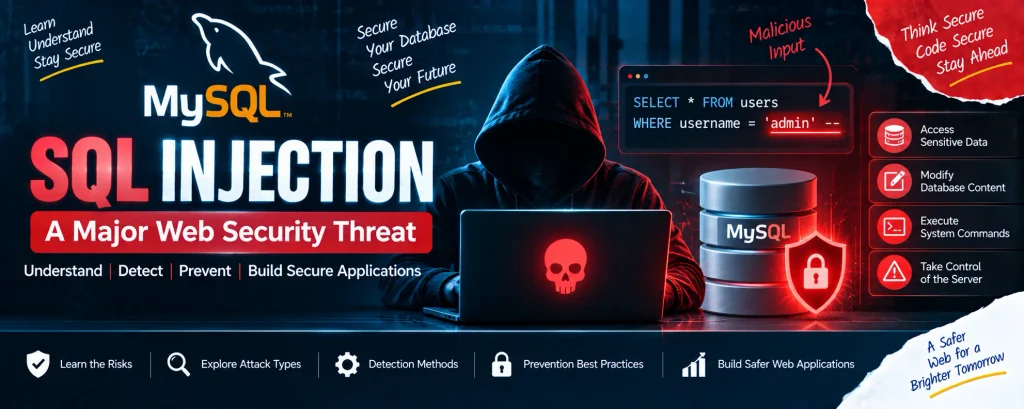
SQL Injection is a serious security vulnerability that can result in data breaches, unauthorized access, and potentially complete control over a web application’s database. It is one of the commonly exploited web hacking techniques in which attackers insert malicious SQL statements into application input fields to manipulate database operations.
In this article, we will understand what SQL Injection is, how it works, its different types, possible impact, detection methods, and important practices for preventing these attacks.
Complete Advance AI Topics: Click Here
SQL Tutorial: Click Here
What is SQL Injection?
SQL Injection (SQLi) is a code injection technique in which an attacker manipulates an application’s SQL query by inserting malicious SQL code. The vulnerability generally occurs when user input is not properly validated or sanitized.
As a result, attackers may gain unauthorized access to sensitive information or potentially modify the structure and contents of a database.
How SQL Injection Works
When a web application accepts information from a user, such as a username or ID, that input may be directly added to an SQL query. If the input is not properly validated, an attacker can provide SQL code instead of the expected value.
Example:
userInput = getRequestString("UserInput");
query = "SELECT * FROM customers WHERE customer_id = " + userInput;
For example, if an attacker enters 100 OR 1=1, the resulting query becomes:
SELECT * FROM customers WHERE customer_id = 100 OR 1=1;Because 1=1 is always true, the query can return all records instead of only the expected customer record, potentially exposing sensitive database information.
Types of SQL Injection Attacks
1. Retrieving Unauthorized Data
Attackers can use SQL Injection to retrieve sensitive information, including user credentials, payment details, and personal information.
2. Modifying Database Content
Malicious SQL statements can be used to update, insert, or delete records, which may affect the functionality and data of an application.
3. Executing System Commands
Advanced SQL Injection techniques may allow attackers to execute system-level commands, install malicious software, or gain remote control over a server.
4. Batch SQL Injection
When a database supports multiple SQL statements, an attacker may attempt to execute several queries within a single request.
Example:
SELECT * FROM orders; DROP TABLE order_history;This query first retrieves order information and then attempts to delete the order_history table.
Real-World Example of SQL Injection
Consider an employee database where users can retrieve their records by entering an Employee ID.
If an attacker enters:
12345 OR 1=1The resulting query could become:
SELECT * FROM employees WHERE employee_id = 12345 OR 1=1;Since 1=1 is always true, the query can return all employee records, potentially exposing information that should not be accessible to the user.
Detecting SQL Injection Attacks
1. Web Application Firewall (WAF)
A Web Application Firewall (WAF) can analyze incoming requests and detect or block basic SQL Injection attempts.
2. Intrusion Detection System (IDS)
An Intrusion Detection System (IDS) can help identify suspicious activity through different monitoring methods:
- Network-based IDS: Monitors network traffic going to the database and identifies suspicious activity.
- Host-based IDS: Examines server logs and looks for unusual or suspicious behavior.
Impact of SQL Injection Attacks
- Data Theft: Attackers may gain access to sensitive information such as usernames, passwords, and financial details.
- Loss of Integrity: Attackers may modify, delete, or corrupt important business data.
- Unauthorized Access: SQL Injection can potentially bypass authentication mechanisms and provide administrative access.
- System Compromise: In certain situations, attackers may execute system commands and potentially gain control over the server.
How to Prevent SQL Injection Attacks
1. Use Prepared Statements and Parameterized Queries
Parameterized queries separate SQL logic from user-provided input, helping prevent malicious input from being interpreted as SQL code.
query = "SELECT * FROM users WHERE username = ?";
statement.setString(1, userInput);
2. Input Validation
Validate user input by clearly defining the expected format, length, and data type. This helps prevent unexpected input from reaching database queries.
3. Use the Least Privilege Principle
Database permissions should be restricted according to user roles. Avoid using administrative privileges for normal application queries.
4. Avoid Displaying Detailed Errors
Using generic error messages can prevent attackers from obtaining useful information about the application’s database structure.
5. Perform Regular Security Audits
Regular vulnerability assessments and penetration testing can help identify security weaknesses before they can be exploited.
Download New Real Time Projects :- Click here
Conclusion
SQL Injection continues to be a serious cybersecurity threat that can put sensitive application and database information at risk. Understanding how SQL Injection works, its potential impact, and the available prevention techniques is important for developing more secure web applications.
Using proper input validation, implementing prepared statements and parameterized queries, and following the least privilege principle are important steps for protecting applications against SQL Injection vulnerabilities.
Stay vigilant, follow security best practices, and make application security a priority to reduce the risk of SQL Injection attacks.
SEO Keywords
sql injection, how to prevent sql injection, types of sql injection, error based sql injection, owasp sql injection, sql injection definition, sql injection test, sql injection vs xss, sql injection meme, sql injection cyber security, sql injection cheat sheet owasp, sql injection attack definition, sql injection attack in cyber security