GROUP BY vs ORDER BY in SQL
Introduction
When working with SQL queries, GROUP BY and ORDER BY are two important clauses used for organizing and presenting data. Beginners often confuse these clauses because both affect how query results are handled, but their purposes are different.
The main difference is:
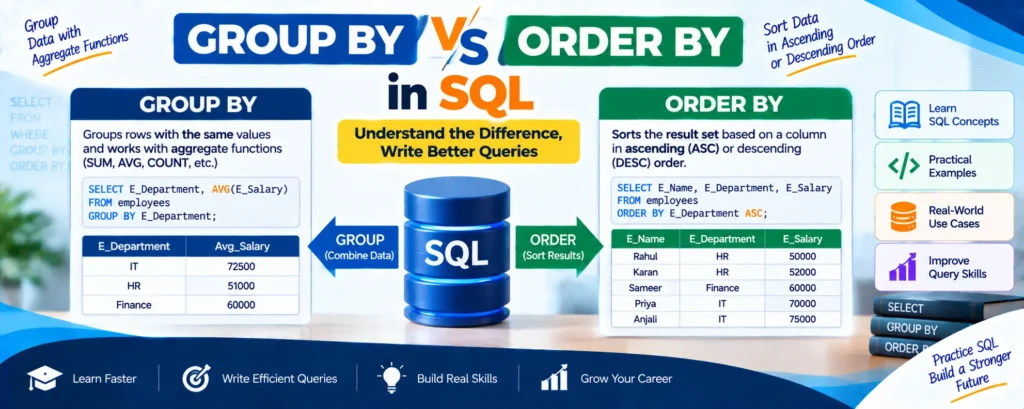
- GROUP BY: Used to group multiple rows together, especially when working with aggregate functions.
- ORDER BY: Used to arrange query results according to selected columns in ascending or descending order.
Before comparing them, let’s understand how each clause works.
Complete Advance AI Topics: Click Here
SQL Tutorial: Click Here
ORDER BY Clause
The ORDER BY clause is used to sort the results returned by an SQL query. By default, the results are arranged in ascending order.
You can also specify the sorting direction explicitly:
- ASC: Arranges values in ascending order.
- DESC: Arranges values in descending order.
Syntax
SELECT expressions
FROM tables
[WHERE conditions]
ORDER BY column_name [ ASC | DESC ];
Example
Consider an employees table containing the following data:
| E_ID | E_Name | E_Department | E_Salary |
|---|---|---|---|
| 101 | Rahul | HR | 50000 |
| 102 | Priya | IT | 70000 |
| 103 | Sameer | Finance | 60000 |
| 104 | Anjali | IT | 75000 |
| 105 | Karan | HR | 52000 |
To arrange employees according to E_Department in ascending order, use:
SELECT E_Name, E_Department, E_Salary
FROM employees
ORDER BY E_Department ASC;
Output
| E_Name | E_Department | E_Salary |
|---|---|---|
| Rahul | HR | 50000 |
| Karan | HR | 52000 |
| Sameer | Finance | 60000 |
| Priya | IT | 70000 |
| Anjali | IT | 75000 |
Here, the query sorts the results according to the E_Department column in ascending order.
GROUP BY Clause
The GROUP BY clause combines records that have the same values in the specified columns. It is commonly used together with aggregate functions such as:
- SUM()
- AVG()
- MIN()
- MAX()
- COUNT()
Syntax
SELECT column_name, function(column_name)
FROM table_name
WHERE condition
GROUP BY column_name;
Example
Suppose we want to calculate the average salary for each department. We can use the following query:
SELECT E_Department, AVG(E_Salary) AS Avg_Salary
FROM employees
GROUP BY E_Department
ORDER BY E_Department DESC;
Output
| E_Department | Avg_Salary |
|---|---|
| IT | 72500 |
| HR | 51000 |
| Finance | 60000 |
In this example, employees are grouped according to E_Department, the average salary is calculated for each department, and the final result is sorted in descending order.
Important Differences Between GROUP BY and ORDER BY
| No. | GROUP BY | ORDER BY |
|---|---|---|
| 1 | Groups rows that contain the same values. | Sorts the result in ascending or descending order. |
| 2 | A CREATE VIEW statement may use it. | It cannot be utilized in a CREATE VIEW statement. |
| 3 | Organizes rows according to their similarity. | Controls the order in which the results are displayed. |
| 4 | Attributes under GROUP BY cannot be in an aggregate function. | An aggregate function may contain attributes used under ORDER BY. |
| 5 | In a SELECT query, it comes before ORDER BY. | In a SELECT query, it comes after GROUP BY. |
| 6 | Requires aggregate functions. | Aggregate functions are optional. |
| 7 | Used for grouping similar data. | Used for sorting query results. |
Download New Real Time Projects :- Click here
Conclusion
In SQL, GROUP BY and ORDER BY serve different purposes.
- GROUP BY groups rows and is commonly used with aggregate functions.
- ORDER BY sorts the final query results according to selected column values.
Both clauses are important SQL features and can also be used together when creating useful database reports. Understanding when to use GROUP BY and ORDER BY helps you write more effective queries and work with database information more efficiently.
For more SQL-related tutorials, stay connected!
SEO Keywords
group by with order by in sql, group by and order by in same query, group by in sql, difference between group by vs order by in sql with example, difference between group by vs order by in sql w3schools, group by and order by in mysql, group by vs order by in sql, difference between group by vs order by in sql, sql group by and order by count, group by having and order by clause in sql, group by vs having, group by vs order by in sql w3schools, group by vs order by in sql server, group by vs order by in sql example, group by vs order by in sql oracle