Skip to content
  • SiteMap
  • Our Services
  • Frequently Asked Questions (FAQ)
  • Support
  • About Us

UpdateGadh

Update Your Skills.

  • Home
  • Projects
    •  Blockchain projects
    • Python Project
    • Data Science
    •  Ai projects
    • Machine Learning
    • PHP Project
    • React Projects
    • Java Project
    • SpringBoot
    • JSP Projects
    • Java Script Projects
    • Code Snippet
    • Free Projects
  • Tutorials
    • Ai
    • Machine Learning
    • Advance Python
    • Advance SQL
    • DBMS Tutorial
    • Data Analyst
    • Deep Learning Tutorial
    • Data Science
    • Nodejs Tutorial
  • Blog
  • Contact us
  • Toggle search form
SQL WITH Clause

SQL WITH Clause

Posted on February 5, 2025February 5, 2025 By Rishabh saini No Comments on SQL WITH Clause

SQL WITH Clause

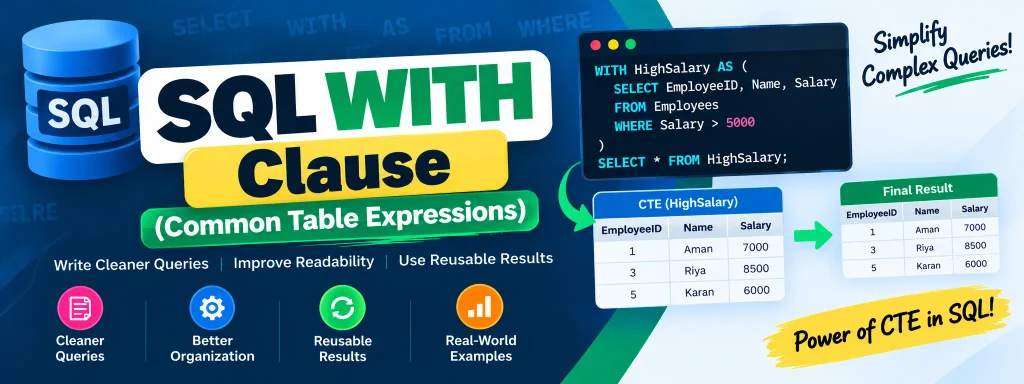
The SQL WITH clause is used to create a sub-query block that can be referenced multiple times within the main SQL query. This helps improve query readability and efficiency. The WITH clause was introduced by Oracle in Oracle 9i Release 2 and is widely supported in various SQL databases today.

Complete Python Course with Advance topics:-Click Here
SQL Tutorial :-Click Here

Why Use the WITH Clause?

  • Enhances code readability.
  • Improves query performance by reducing redundant sub-query execution.
  • Allows modular query writing.
  • Helps in complex query optimization.

Syntax for the SQL WITH Clause

Using a Single Sub-query Alias

WITH <alias_name> AS (sql_sub-query_statement)  
SELECT column_list FROM <alias_name> [table_name]  
[WHERE <join_condition>];  

Using Multiple Sub-query Aliases

WITH <alias_name_A> AS (sql_sub-query_statement),  
<alias_name_B> AS (sql_sub-query_statement_from_alias_name_A OR sql_sub-query_statement)  
SELECT <column_list>  
FROM <alias_name_A>, <alias_name_B>, [table_names]  
[WHERE <join_condition>];

Example: Employee Table

Consider the following Employee table:

Emp_IDEmp_NameDepartmentSalary
101AryanIT70000
102SnehaHR60000
103RohanFinance75000
104MeeraIT72000

Now, let’s use the WITH clause to calculate the average salary per department.

Query Using WITH Clause

WITH Dept_Salary AS (
    SELECT Department, AVG(Salary) AS Avg_Salary 
    FROM Employee 
    GROUP BY Department
)
SELECT e.Emp_Name, e.Department, ds.Avg_Salary 
FROM Employee e 
JOIN Dept_Salary ds 
ON e.Department = ds.Department;

Explanation:

  • The Dept_Salary sub-query calculates the average salary for each department.
  • The main SELECT query retrieves the employee name, their department, and the calculated average salary.
  • The JOIN condition ensures that each employee is matched with their department’s average salary.

Download New Real Time Projects :-Click here
Complete Advance AI topics:- CLICK HERE

Conclusion

The SQL WITH clause is an essential feature for writing cleaner, optimized, and modular SQL queries. It simplifies complex queries by breaking them into smaller, reusable blocks. If you frequently work with sub-queries, using the WITH clause will make your SQL code more readable and efficient.

For more SQL tutorials and database optimization tips, stay connected with UpdateGadh!


with clause in sql w3schools
sql multiple with clause
sql server with clause
with clause in oracle sql
mysql with clause
with clause in postgresql
sql with as ( select)
sql with cte
with clause in sql
sql
sql with clause example

Post Views: 515
SQL Tutorial Tags:clause, dow clause, group by clause, group by clause in sql, having clause in sql, how to use with clause in sql, how to write sql queries using with clause, oracle sql with clause, oracle with clause, sql clause, sql cte with clause, sql group by clause, sql having clause, sql in clause, sql queries using with clause, sql where clause, sql with clause, where clause, where clause in sql, with clause, with clause in oracle, with clause in sql, with clause tutorial

Post navigation

Previous Post: How to Print Patterns in Python
Next Post: Learning Management System Using Django Web Framework

More Related Articles

HAVING Clause in SQL HAVING Clause in SQL SQL Tutorial
SQL SELECT RANDOM SQL SELECT RANDOM: Fetching Random Rows from a Database SQL Tutorial
GROUP BY vs. ORDER BY in SQL GROUP BY vs ORDER BY in SQL SQL Tutorial

Leave a Reply Cancel reply

Your email address will not be published. Required fields are marked *

You may also like

  1. Understanding the SQL DELETE Statement and Its Variants
  2. SQL Temporary Tables: A Handy Tool for Developers
  3. SQL SELECT TOP Clause: A Comprehensive Guide
  4. SQL UPDATE with JOIN
  5. Understanding SQL CROSS JOIN with Examples
  6. IN vs EXISTS in SQL: A Complete Guide

Most Viewed Posts

  1. Top Large Language Models in 2025
  2. Online Shopping System using PHP, MySQL with Free Source Code
  3. login form in php and mysql , Step-by-Step with Free Source Code
  4. Flipkart Clone using PHP And MYSQL Free Source Code
  5. News Portal Project in PHP and MySql Free Source Code
  6. User Login & Registration System Using PHP and MySQL Free Code
  7. Top 10 Final Year Project Ideas in Python
  8. Online Bike Rental Management System Using PHP and MySQL
  9. E learning Website in php with Free source code
  10. E-Commerce Website Project in Java Servlets (JSP)
  • AI
  • ASP.NET
  • Blockchain
  • ChatCPT
  • code Snippets
  • Collage Projects
  • Data Science Project
  • Data Science Tutorial
  • DBMS Tutorial
  • Deep Learning Tutorial
  • Final Year Projects
  • Free Projects
  • How to
  • html
  • Interview Question
  • Java Notes
  • Java Project
  • Java Script Notes
  • JAVASCRIPT
  • Javascript Project
  • JSP JAVA(J2EE)
  • Machine Learning Project
  • Machine Learning Tutorial
  • MySQL Tutorial
  • Node.js Tutorial
  • PHP Project
  • Portfolio
  • Python
  • Python Interview Question
  • Python Projects
  • PythonFreeProject
  • React Free Project
  • React Projects
  • Spring boot
  • SQL Tutorial
  • TOP 10
  • Uncategorized
  • Online Examination System in PHP with Source Code
  • AI Chatbot for College and Hospital
  • Job Portal Web Application in PHP MySQL
  • Online Tutorial Portal Site in PHP MySQL — Full Project with Source Code
  • Online Job Portal System in JSP Servlet MySQL

Most Viewed Posts

  • Top Large Language Models in 2025 (8,612)
  • Online Shopping System using PHP, MySQL with Free Source Code (5,210)
  • login form in php and mysql , Step-by-Step with Free Source Code (4,862)

Copyright © 2026 UpdateGadh.

Powered by PressBook Green WordPress theme