Node.js vs Java
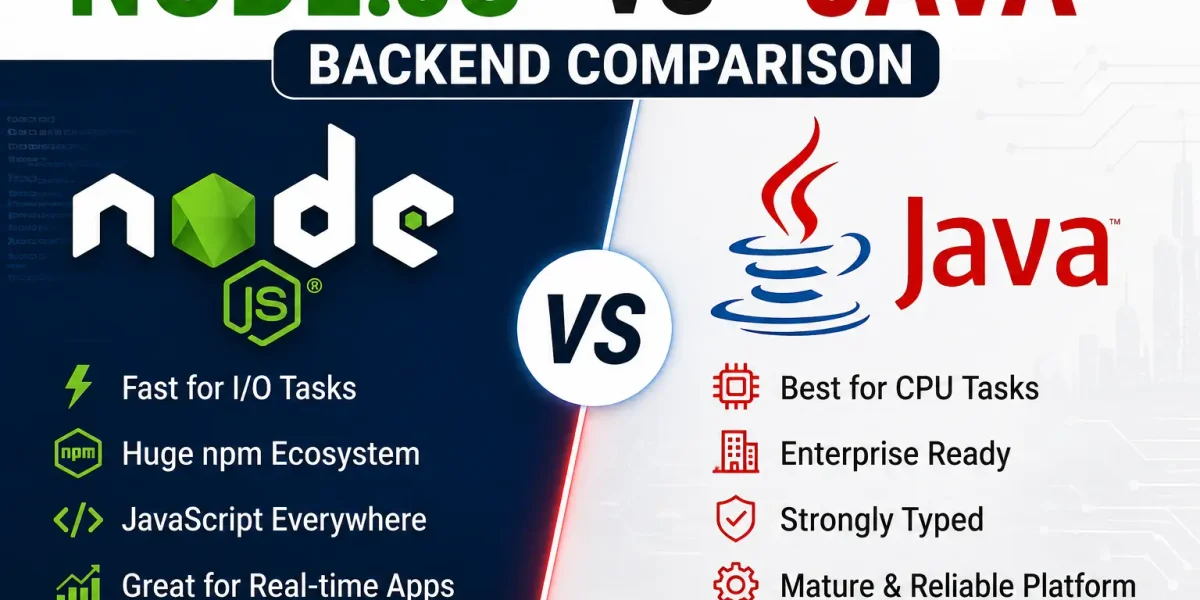
Node.js and Java are two powerful backend technologies that are widely used for developing modern applications. Both technologies provide strong performance and scalability, but they follow different approaches when it comes to threading, I/O operations, memory usage, and application architecture.
Choosing between Node.js and Java depends on the requirements of your project. While Node.js is well suited for real-time applications, APIs, microservices, and streaming, Java is a strong choice for enterprise systems, CPU-intensive workloads, and large multi-threaded applications.
Below is a clear comparison of Node.js and Java to help you understand their major differences and choose the right backend technology for your project.
Key Differences Between Node.js and Java
| Feature | Node.js | Java |
|---|---|---|
| Threading | Single-threaded with an event loop | Multi-threaded |
| I/O Model | Asynchronous and non-blocking | Historically synchronous; modern frameworks like Spring WebFlux support asynchronous programming |
| Performance | Faster for I/O-heavy workloads | Faster for CPU-bound tasks |
| Memory Usage | Lighter memory footprint | JVM generally uses more memory but performs well for long-running processes |
Node.js Advantages
Node.js provides several advantages for backend development, especially when applications require fast I/O operations and real-time communication.
1. High Performance for Real-Time Applications
Node.js is well suited for real-time applications because of its event-driven and non-blocking architecture. It can handle multiple I/O operations efficiently without blocking the main execution flow.
2. Massive npm Ecosystem
Node.js has access to the npm ecosystem, which contains hundreds of thousands of packages. Developers can use these packages to add functionality to applications without building every component from scratch.
3. Easy Scalability
The event-driven architecture of Node.js makes it suitable for applications that need to handle a large number of concurrent requests. This makes Node.js a popular option for scalable backend applications.
4. Same Language for Frontend and Backend
One of the major advantages of Node.js is that developers can use JavaScript for both frontend and backend development. This can simplify development for full-stack JavaScript teams.
5. Streaming Uploads
Node.js supports streaming uploads without requiring the entire file to be buffered into memory. This makes it useful for applications that work with streaming data and file uploads.
Java Advantages
Java has been widely used for enterprise software development for many years and provides a mature ecosystem with powerful development and monitoring tools.
1. Mature Enterprise Platform
Java is a mature platform with more than 25 years of enterprise use. It is widely used for building large-scale and long-running applications.
2. Powerful IDEs
Java developers have access to several powerful Integrated Development Environments, including:
- IntelliJ IDEA
- Eclipse
- NetBeans
These development environments provide extensive features for writing, testing, debugging, and maintaining Java applications.
YT:- DecodeIT
3. Excellent Development and Monitoring Tools
Java provides strong tooling for monitoring, profiling, and debugging. These tools are useful when developing and maintaining large applications.
4. Strongly Typed Language
Java is a strongly typed language. Its type system can help identify certain programming errors during compilation, before the application is executed.
5. Suitable for CPU-Intensive Applications
Java is well suited for CPU-intensive workloads and large multi-threaded systems. Its multi-threading capabilities make it useful for applications requiring significant computational processing.
Node.js vs Java Performance
Performance depends heavily on the type of workload being handled by the application.
Node.js performs particularly well for I/O-heavy workloads because it uses an asynchronous, non-blocking event-driven architecture. This makes it suitable for applications handling many concurrent I/O operations.
Java is well suited for CPU-bound workloads and applications that require extensive multi-threaded processing. Its JVM and mature runtime environment are designed to support long-running applications.
Therefore, there is no universal performance winner. The better choice depends on whether the application’s workload is primarily I/O-heavy or CPU-intensive.
Node.js vs Java for Backend Development
Both Node.js and Java can be used to build backend applications, APIs, and large-scale systems. However, their strengths are different.
Node.js is a strong option when the backend requires real-time communication, asynchronous operations, streaming, APIs, or microservices. Java is particularly useful when building large enterprise systems, multi-threaded applications, and CPU-intensive backend logic.
The project requirements should therefore be considered before selecting a backend technology.
When to Use Node.js
Node.js is a suitable choice for several types of applications and development environments.
- Real-Time Applications: Applications that require real-time communication and updates.
- APIs: Backend APIs that handle many I/O operations.
- Microservices: Applications built using an event-driven architecture.
- Streaming: Applications that process streaming data or uploads.
- Startups: Projects where fast development and a large package ecosystem are valuable.
- Full-Stack JavaScript Teams: Teams that want to use JavaScript across frontend and backend development.
When to Use Java
Java is a strong choice for applications that require enterprise-level architecture, multi-threading, or significant CPU processing.
- Large Enterprise Systems: Large and long-running business applications.
- Banking: Enterprise and banking applications.
- Android: Android application development.
- Big Data: Applications and systems working with large-scale data.
- CPU-Heavy Backend Logic: Applications requiring intensive computational processing.
Node.js vs Java: Which One Should You Choose?
There is no single technology that is best for every project. Node.js and Java have different strengths, and the right choice depends on the application’s requirements.
Choose Node.js when you need real-time functionality, APIs, microservices, streaming, rapid development, or a JavaScript-based full-stack environment.
Choose Java when you need large enterprise systems, banking applications, big data solutions, Android development, or CPU-intensive and multi-threaded backend processing.
Node.js vs Java vs Python
Node.js, Java, and Python are all widely used technologies, but each can be suitable for different development requirements. Node.js focuses on JavaScript-based event-driven backend development, Java provides a mature enterprise and multi-threaded platform, while Python is widely used across different areas of software development.
The choice between these technologies should be based on the project’s requirements, workload, architecture, and development environment rather than popularity alone.
Node.js vs Java Jobs and Salary
Both Node.js and Java provide career opportunities for backend developers. Job availability and salary can vary depending on experience, location, company, skills, and market demand.
Instead of choosing a technology only based on salary or job popularity, developers should consider the type of applications they want to build and the development ecosystem they prefer.
Node.js vs Java vs Spring Boot
Node.js is a JavaScript runtime environment used for backend development, while Spring Boot is a Java-based framework commonly used for building backend and enterprise applications.
Node.js provides an event-driven and asynchronous approach, whereas Java with Spring Boot provides the features and ecosystem of the Java platform for developing enterprise backend applications.
The appropriate choice depends on the project’s architecture, performance requirements, team skills, and application type.
More:- UPDATEGADH
Conclusion
Node.js and Java are both powerful backend technologies, but neither is universally better than the other. They are designed around different approaches and perform well in different scenarios.
Node.js is particularly strong for real-time applications, APIs, microservices, streaming, and fast development. Java is a strong choice for enterprise systems, large multi-threaded applications, banking, big data, and CPU-intensive backend logic.
The best approach is to select the technology according to the requirements of your project rather than choosing it based only on popularity.
Keywords: node js vs java performance, node js vs java salary, node js vs javascript, node js vs java jobs, java vs node js vs python, node js vs java for backend, node js vs spring boot, nodejs vs javascript