
Transaction Properties in DBMS
In a database, a transaction is not necessarily a single operation. It can contain multiple operations that together perform one logical task. A transaction must either complete successfully or be rolled back if an error occurs.
When multiple users execute transactions concurrently, their operations may overlap. Without proper control, this can lead to incorrect or inconsistent data. To maintain data integrity and reliability, database transactions follow four fundamental properties known as ACID properties.
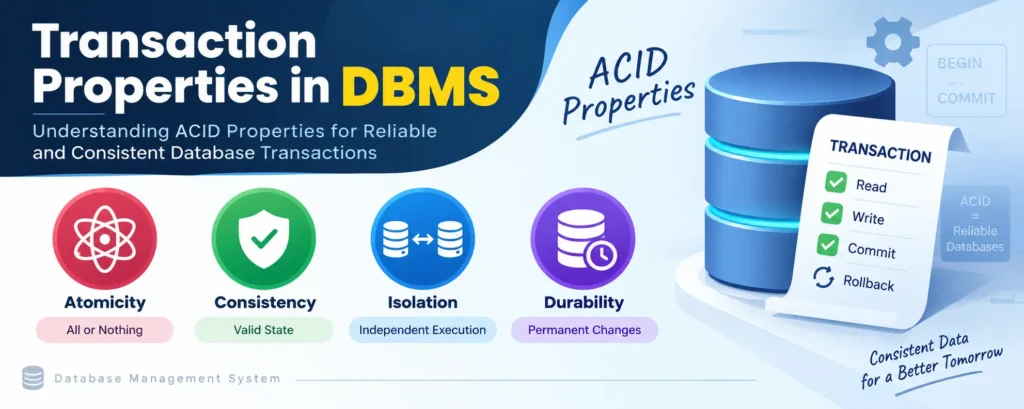
The four ACID properties are:
- Atomicity
- Consistency
- Isolation
- Durability
Let us understand each transaction property in detail.
Table of Contents
What is a Transaction in DBMS?
A transaction is a sequence of one or more database operations that together form a single logical unit of work.
Transactions can perform operations such as:
- Inserting new records
- Updating existing records
- Deleting records
- Reading data
- Performing multiple operations together
For a transaction to maintain database reliability, it should satisfy the four ACID properties:
- Atomicity – All operations succeed or none are applied.
- Consistency – The database remains valid before and after the transaction.
- Isolation – Concurrent transactions do not improperly interfere with each other.
- Durability – Committed changes remain permanent even after a failure.
What are ACID Properties in DBMS?
ACID stands for Atomicity, Consistency, Isolation, and Durability. These properties define how reliable database transactions should behave.
1. Atomicity
Atomicity follows the principle of “all or nothing.” It ensures that all operations within a transaction are completed successfully, or none of them are applied to the database.
If any operation fails, the entire transaction is rolled back. This prevents a transaction from leaving the database in a partially updated state.
Complete Advance AI Topics: Click Here
SQL Tutorial: Click Here
Key Features of Atomicity
- All operations of a transaction must be completed, or none should take effect.
- Partial execution of a transaction is not allowed.
- If a failure occurs, the DBMS can roll back the transaction.
- The DBMS uses recovery mechanisms to help maintain atomicity.
Commit and Rollback
Two important concepts associated with atomicity are:
- Commit: Permanently saves the changes made by a successful transaction.
- Rollback: Undoes the changes made by a failed transaction.
Example of Atomicity
Suppose Account A has ₹600 and Account B has ₹300. A transaction transfers ₹100 from A to B.
The transaction contains two major operations:
- Subtract ₹100 from Account A.
- Add ₹100 to Account B.
After a successful transaction:
- Account A = ₹500
- Account B = ₹400
Now suppose the system fails after deducting ₹100 from A but before adding it to B. Atomicity ensures that the incomplete transaction is rolled back so that the database does not remain in a partially updated state.
2. Consistency
Consistency ensures that a transaction moves the database from one valid state to another valid state.
In other words, all database rules, constraints, and integrity conditions must remain satisfied before and after the transaction.
Key Features of Consistency
- The database must satisfy all defined integrity constraints.
- A transaction must not leave the database in an invalid state.
- Invalid transactions are rejected or rolled back.
- Database constraints such as primary keys, foreign keys, and unique constraints help maintain consistency.
Example of Consistency
Consider the same account transfer example:
Before the transaction:
₹600 + ₹300 = ₹900
After transferring ₹100:
₹500 + ₹400 = ₹900
The total amount remains ₹900, so the transaction preserves the required business rule.
If the transaction were partially completed and only ₹100 were deducted from Account A, the total would become ₹800. This would violate the expected rule and result in an inconsistent state.
Consistency is supported by both the DBMS and the application logic. Developers must design transactions correctly and enforce appropriate business rules and constraints.
3. Isolation
Isolation ensures that concurrent transactions do not improperly interfere with one another.
When multiple transactions execute at the same time, each transaction should behave as though it is executing independently, according to the isolation level selected by the database system.
Isolation is primarily handled by the DBMS’s concurrency control mechanisms.
Why is Isolation Important?
Multiple users may access and modify the same data simultaneously. Without isolation, one transaction might read intermediate or incorrect results produced by another transaction.
This can cause problems such as:
- Dirty reads
- Non-repeatable reads
- Phantom reads
- Lost updates
- Incorrect results caused by conflicting operations
Example of Isolation
Consider two transactions:
- T1: Transfers ₹750 from Account A to Account B.
- T2: Transfers 20% of Account A’s current balance to Account B.
If both transactions access and modify Account A at the same time without appropriate concurrency control, T2 may read a value that does not represent the correct state it should use.
Isolation ensures that conflicting operations are properly controlled so that the final result is equivalent to a valid execution of the transactions.
4. Durability
Durability guarantees that once a transaction has been successfully committed, its changes are preserved permanently, even if the system crashes immediately afterward.
In simple terms, committed data should not be lost because of a system failure.
Key Features of Durability
- Committed changes survive system crashes.
- Data remains available after the database restarts.
- Recovery mechanisms help restore committed changes when necessary.
- Logs and persistent storage are important for implementing durability.
Example of Durability
Suppose a transaction transfers ₹100 from Account A to Account B and the DBMS successfully commits the transaction.
Immediately afterward, the database server crashes.
When the system restarts, the committed transfer should still be reflected in the database:
- Account A = ₹500
- Account B = ₹400
Database recovery mechanisms, including transaction logs and persistent storage, help ensure that committed changes are not lost after failures.
ACID Properties in DBMS
| Property | Meaning | Purpose |
|---|---|---|
| Atomicity | All or nothing | Prevents partial transaction execution |
| Consistency | Valid state to valid state | Maintains database rules and integrity |
| Isolation | Transactions execute without improper interference | Controls problems caused by concurrent execution |
| Durability | Committed changes are permanent | Protects data from system failures |
Difference Between Atomicity, Consistency, Isolation, and Durability
| Property | Focus | Simple Explanation |
|---|---|---|
| Atomicity | Transaction completion | Either the entire transaction succeeds or it is rolled back. |
| Consistency | Data validity | The transaction must preserve database rules and constraints. |
| Isolation | Concurrent execution | Transactions should not improperly affect each other’s intermediate work. |
| Durability | Permanent storage | Committed changes remain saved even after failures. |
Real-Life Example of ACID Properties
Consider an online banking transaction where ₹1,000 is transferred from one account to another.
Atomicity: The money must be deducted from the sender and credited to the receiver as one logical operation. If the transaction fails, the incomplete changes are rolled back.
Consistency: The transfer must follow banking rules and maintain correct account balances.
Isolation: Other transactions should not interfere with the transfer while it is being processed in a way that produces an incorrect result.
Durability: Once the transfer is committed, the updated balances must remain available even if the banking server crashes afterward.
YT:- DecodeIT
Why are ACID Properties Important?
ACID properties are essential for building reliable and trustworthy database systems. They help databases handle concurrent users, transaction failures, and system crashes without compromising data integrity.
The major benefits include:
- Improved data reliability
- Protection against partial transactions
- Maintenance of database integrity
- Safe concurrent transaction processing
- Recovery from system failures
- Reliable permanent storage of committed data
Conclusion
The ACID properties form the foundation of reliable transactions in DBMS. They ensure that database operations remain accurate and dependable even when multiple transactions execute concurrently or failures occur.
In short:
- Atomicity = All or nothing
- Consistency = Database rules are preserved
- Isolation = Concurrent transactions are properly controlled
- Durability = Committed changes are permanent
Together, these four properties make database transactions reliable, maintainable, and resistant to errors and system failures.
Keywords
Transaction Properties in DBMS, ACID Properties in DBMS, Atomicity in DBMS, Consistency in DBMS, Isolation in DBMS, Durability in DBMS, Transaction in DBMS, DBMS Transactions, ACID Transaction, Database Transaction Properties