
Normalization in DBMS
In the world of Database Management Systems (DBMS), organizing data efficiently is essential for maintaining consistency, reducing redundancy, and improving overall database performance. When a large amount of data is stored in a single table, the same information may be repeated across multiple records. This can create several problems, including:
- Large and difficult-to-manage tables
- Difficulty in updating and maintaining data
- Unnecessary use of storage space
- Increased chances of data inconsistency and errors
- Insertion, deletion, and update anomalies
To overcome these problems, database designers use Normalization. It is a systematic process of organizing and decomposing large tables into smaller, logically related tables while maintaining data integrity.
In this tutorial from Updategadh, we will learn what normalization is, why it is important, the different types of normal forms, database anomalies, and the advantages and disadvantages of normalization.
Table of Contents
What is Normalization?
Normalization is the process of organizing data in a relational database to reduce data redundancy and prevent data anomalies. It involves dividing large tables into smaller tables and establishing relationships between them.
The primary objective of normalization is not simply to remove duplicate data. It also ensures that data is stored logically and consistently so that database operations such as insertion, deletion, and updating can be performed safely.
A properly normalized database improves data integrity and makes the database easier to maintain and scale.
Complete Advance AI Topics: Click Here
SQL Tutorial: Click Here
Why Do We Need Normalization?
Normalization is an important part of relational database design because it helps create a structured and reliable database.
The major reasons for using normalization include:
- Reducing unnecessary data duplication
- Preventing insertion, deletion, and update anomalies
- Improving data consistency
- Maintaining data integrity
- Creating logical relationships between tables
- Making databases easier to maintain
- Providing a scalable database structure
Without proper normalization, a database can contain repeated information and become increasingly difficult to manage as the amount of data grows.
Types of Data Anomalies
One of the primary purposes of normalization is to eliminate or reduce data anomalies. There are three major types of anomalies in database systems.
1. Insertion Anomaly
An Insertion Anomaly occurs when new information cannot be inserted into a table without also providing unrelated or unnecessary information.
Example: Suppose a table stores both student and course information. If a new course is created but no student has enrolled in it yet, it may be difficult to add the course information without also entering student-related data.
2. Deletion Anomaly
A Deletion Anomaly occurs when deleting one record unintentionally removes other important information from the database.
Example: If student and course information are stored in the same table and the only student enrolled in a particular course is deleted, information about that course may also be lost.
3. Update Anomaly
An Update Anomaly occurs when the same information is stored in multiple rows and must be updated in several places.
Example: If a student’s phone number appears in multiple records, changing the phone number requires updating every occurrence. Missing even one record can result in inconsistent data.
Types of Normal Forms
Normalization is performed through a series of stages known as Normal Forms. Each normal form introduces additional rules to reduce redundancy and improve database structure.
| Normal Form | Description |
|---|---|
| 1NF | Ensures that every attribute contains atomic and indivisible values and that repeating groups are eliminated. |
| 2NF | A table must be in 1NF and every non-key attribute must depend on the entire primary key. |
| 3NF | A table must be in 2NF and should not contain transitive dependencies between non-key attributes. |
| BCNF | A stronger version of 3NF in which every determinant must be a candidate key. |
| 4NF | A table must be in BCNF and should not contain problematic multivalued dependencies. |
| 5NF | Deals with join dependencies and ensures that a relation cannot be further decomposed without losing information. |
Steps to Normalize a Database
Database normalization generally follows a sequence of steps. Each stage addresses a particular type of dependency or redundancy.
- Identify the unnormalized data: Examine the existing table and identify repeating groups, duplicate information, and relationships between attributes.
- Apply 1NF: Remove repeating groups and ensure that every field contains a single atomic value.
- Apply 2NF: Remove partial dependencies so that non-key attributes depend on the complete primary key.
- Apply 3NF: Remove transitive dependencies so that non-key attributes depend only on the key.
- Apply BCNF, 4NF, or 5NF when required: More advanced normal forms can be applied when the database contains complex dependencies or specific business requirements.
The goal is to create a database structure that minimizes redundancy while maintaining relationships and data integrity.
Advantages of Normalization
Normalization provides several important benefits for relational database systems.
- Reduces Data Redundancy: Duplicate information is minimized by separating data into related tables.
- Improves Data Consistency: Since data is stored in appropriate locations, updates are less likely to produce inconsistent records.
- Prevents Data Anomalies: Proper normalization reduces insertion, deletion, and update anomalies.
- Improves Data Integrity: Well-defined relationships help maintain accurate and reliable data.
- Provides a Logical Structure: Data is organized into meaningful entities and relationships.
- Improves Maintainability: Smaller, well-structured tables are generally easier to manage and modify.
- Supports Scalability: A properly designed schema can make it easier to expand the database as requirements grow.
Disadvantages of Normalization
Although normalization offers significant benefits, excessive normalization can also introduce challenges.
- More Tables: Normalization can increase the number of tables in a database.
- More Joins: Queries may require multiple joins to retrieve related information.
- Potential Performance Impact: Highly normalized databases may require more complex queries and joins, which can affect performance in some workloads.
- Complex Design: Understanding functional dependencies and relationships can make database design more challenging.
- Time-Consuming: Proper normalization requires careful analysis of business requirements and data relationships.
Normalization vs Denormalization
Normalization focuses on reducing redundancy and improving data integrity by dividing information into related tables. On the other hand, Denormalization intentionally introduces some redundancy to reduce joins and potentially improve read performance.
| Normalization | Denormalization |
|---|---|
| Reduces data redundancy | May intentionally introduce redundancy |
| Improves data consistency | Can improve read performance |
| Usually requires more joins | Can reduce the number of joins |
| Common in transactional systems | Often useful in reporting and analytical workloads |
Example of Normalization
Consider a table containing student, course, and instructor information:
| Student ID | Student Name | Course | Instructor | Instructor Phone |
|---|---|---|---|---|
| 101 | Rahul | DBMS | Mr. Sharma | 9876543210 |
| 102 | Priya | DBMS | Mr. Sharma | 9876543210 |
Here, the instructor’s phone number is repeated for every student enrolled in the course. If the phone number changes, multiple records may need to be updated.
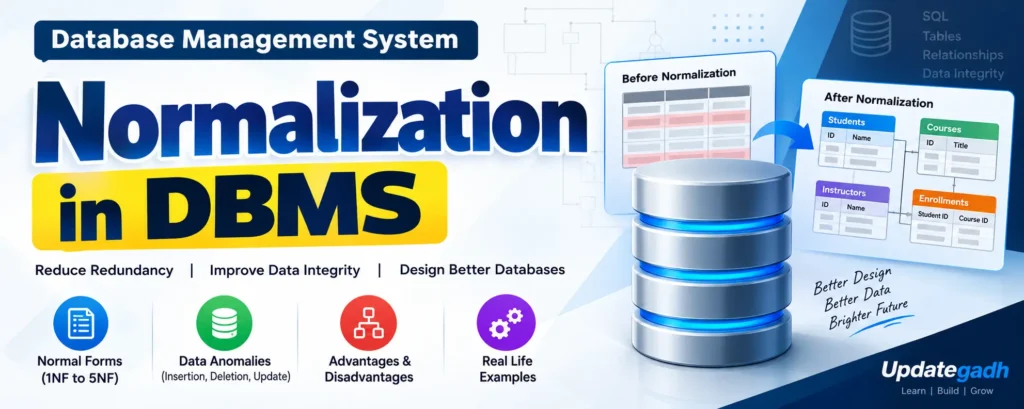
A normalized design can separate the information into related tables such as:
- Students: Student ID, Student Name
- Courses: Course ID, Course Name, Instructor ID
- Instructors: Instructor ID, Instructor Name, Instructor Phone
- Enrollments: Student ID, Course ID
This structure reduces unnecessary duplication and makes it easier to maintain consistent information.
YT:- DecodeIT
Conclusion
Normalization in DBMS is a fundamental concept in relational database design. It provides a systematic approach to organizing data, reducing redundancy, preventing anomalies, and maintaining data integrity.
Normal forms such as 1NF, 2NF, 3NF, BCNF, 4NF, and 5NF provide progressively stronger rules for designing well-structured relational databases.
However, normalization should be applied thoughtfully. Over-normalization can result in excessive joins and potentially affect query performance, while insufficient normalization can lead to redundancy and data anomalies.
The best database design depends on the application’s requirements, workload, and performance goals. A balanced approach to normalization can help create databases that are reliable, maintainable, scalable, and efficient.
Keywords
Normalization in DBMS, Database Normalization, Normalization, Normal Forms in DBMS, 1NF, 2NF, 3NF, BCNF, 4NF, 5NF, Database Anomalies, Insertion Anomaly, Deletion Anomaly, Update Anomaly, DBMS Tutorial, Database Design, SQL Database, Relational Database