R vs Python vs SAS for Data Science
Choosing the right programming language is an important decision when starting or advancing your career in Data Science. Among the most popular options, R, Python, and SAS each have their own strengths, advantages, and use cases.
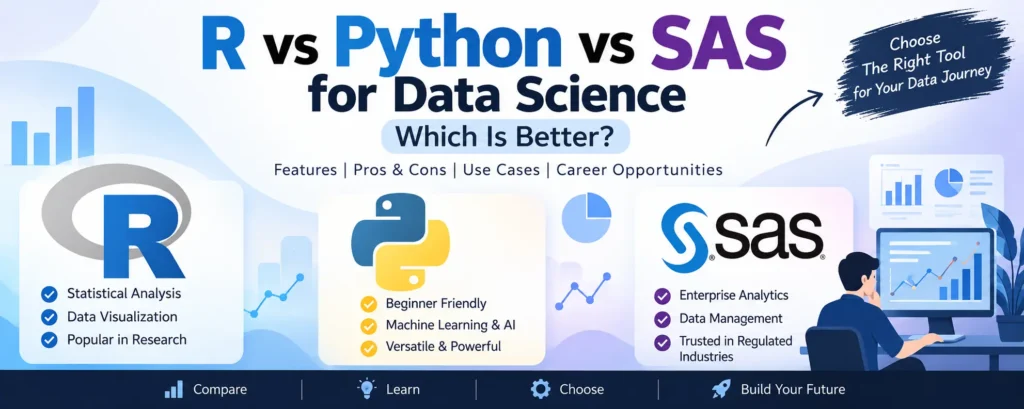
R is well known for statistics and data visualization, Python is widely used for data science, machine learning, and artificial intelligence, while SAS remains a strong choice for enterprise analytics and highly regulated industries.
In this guide, we will compare R vs Python vs SAS for Data Science based on syntax, data manipulation, statistical modeling, visualization, ecosystem, and deployment.
Table of Contents
Complete Advance AI Topics: Click Here
SQL Tutorial: Click Here
Overview of R, Python, and SAS
R
R was developed with statisticians and researchers in mind. It is a powerful programming language and environment for statistical computing, data analysis, and visualization. R is particularly popular in academic research and fields where advanced statistical analysis is important.
Python
Python has become one of the most widely used programming languages in Data Science. Its simple syntax and extensive collection of libraries make it suitable for beginners and experienced professionals. Python is also heavily used for machine learning, artificial intelligence, automation, and data engineering.
SAS
SAS (Statistical Analysis System) is an enterprise-focused analytics platform used for data management, statistical analysis, reporting, and advanced analytics. It is especially common in industries such as healthcare, banking, insurance, and pharmaceuticals where reliability, governance, and regulatory compliance are important.
R vs Python vs SAS: Syntax and Learning Curve
R
R was designed primarily for statistical computing. Its syntax can feel unfamiliar to beginners, especially those without a statistics background. However, packages such as ggplot2 and dplyr make data analysis and visualization easier once the basics are understood.
Python
Python is known for its clean and readable syntax. This makes it one of the easiest programming languages for beginners to learn. Its simple syntax also allows data scientists to move from basic programming to machine learning and AI without switching languages.
SAS
SAS uses a structured and relatively verbose syntax. It can take some time for beginners to become comfortable with it, but its extensive documentation, training resources, and enterprise support make the learning process easier for dedicated users.
Data Manipulation and Analysis
R
R is particularly strong when it comes to data manipulation and statistical analysis. The tidyverse ecosystem provides tools for cleaning, transforming, and analyzing datasets. Packages such as dplyr make data wrangling easier, while ggplot2 is widely used for visualization.
Python
Python primarily uses Pandas for working with structured and tabular data. Pandas DataFrames make it easy to clean, transform, filter, and analyze datasets. NumPy provides numerical computing capabilities, while SciPy supports scientific and mathematical operations.
SAS
SAS uses DATA steps and PROC procedures for data processing and statistical analysis. Although SAS code can sometimes be more verbose than R or Python, it provides a consistent and reliable environment for handling large-scale enterprise data.
Statistical Analysis and Machine Learning
R
R is one of the strongest choices for statistical analysis. It supports techniques ranging from linear and logistic regression to time-series analysis and advanced statistical modeling. Its extensive package ecosystem also allows researchers to implement specialized statistical methods.
Python
Python has developed into a powerful platform for both statistics and machine learning. Libraries such as scikit-learn, TensorFlow, and PyTorch support machine learning and deep learning workflows.
Python also works particularly well with Jupyter Notebooks, making experimentation, data exploration, visualization, and model development convenient within a single environment.
SAS
SAS has a long history of providing reliable statistical analysis for enterprise organizations. It offers strong capabilities for statistical modeling, validation, reporting, and data governance. While Python has a larger ecosystem for newer machine learning technologies, SAS remains valuable in highly regulated business environments.
Data Visualization
R
R is widely recognized for its visualization capabilities. ggplot2 uses the grammar of graphics approach to create highly customizable and publication-quality charts. It is particularly useful for analysts and researchers who need to communicate statistical findings visually.
Python
Python provides several popular visualization libraries. Matplotlib and Seaborn are commonly used for static charts, while Plotly and Bokeh can be used to create interactive visualizations. These tools integrate well with Jupyter Notebooks.
SAS
SAS provides visualization and reporting capabilities through its analytics ecosystem and ODS (Output Delivery System). SAS Visual Analytics also supports interactive reporting and business intelligence. However, many developers and analysts find R and Python more flexible for custom visualization workflows.
Community Support and Ecosystem
R
R has a strong community among statisticians, researchers, academics, and data analysts. The CRAN repository provides a large collection of packages covering statistics, data analysis, visualization, and specialized research applications.
Python
Python has one of the largest programming ecosystems in the world. Its package ecosystem supports everything from Data Science and AI to web development, automation, cloud computing, and data engineering. This broad ecosystem is one of the major reasons Python has become so popular among data professionals.
SAS
SAS has a smaller but highly specialized professional community. It is particularly strong in industries such as healthcare, finance, insurance, and pharmaceuticals. SAS also provides official documentation, training, certifications, and enterprise support.
Integration and Deployment
R
R can integrate with technologies such as Python, Java, and C++. Tools such as Shiny can be used to create interactive web applications and dashboards, while Plumber can expose R functionality through APIs. Production deployment may require additional infrastructure and expertise.
Python
Python is highly suitable for production deployment. Frameworks such as Flask and Django can be used to build applications and APIs, while technologies such as Docker and Kubernetes support modern deployment workflows.
Because Python is also widely used outside Data Science, teams can use the same language across data analysis, machine learning, backend development, automation, and cloud-based applications.
SAS
SAS is designed to work well within enterprise environments. The SAS Viya platform provides capabilities for cloud-based analytics, model management, and deployment. Its enterprise-focused approach can provide strong governance, although it may feel less flexible than open-source alternatives.
R vs Python vs SAS Comparison
| Language | Best For | Key Strengths |
|---|---|---|
| R | Statistical Analysis, Research | Advanced statistics, visualization, data analysis |
| Python | Data Science, AI, Machine Learning | Versatility, simple syntax, extensive libraries |
| SAS | Enterprise and Regulated Industries | Reliability, governance, enterprise support |
YT:- DecodeIT
R vs Python vs SAS: Which Is Better for Data Science?
There is no single answer to the question of whether R, Python, or SAS is better for Data Science. The right choice depends on your career goals and the type of work you want to perform.
- Choose R if your primary focus is statistics, research, data analysis, and advanced visualization.
- Choose Python if you want to work with Data Science, machine learning, AI, automation, and end-to-end applications.
- Choose SAS if you plan to work in enterprise or highly regulated industries where governance, stability, and official support are important.
For many beginners entering Data Science today, Python is a practical starting point because it combines a beginner-friendly syntax with a broad ecosystem. However, learning R or SAS can still be highly valuable depending on your industry and career path.
Can You Learn R, Python, and SAS Together?
Yes. Data professionals often work with more than one technology. Learning all three can help you understand different approaches to data analysis and make it easier to work across research, enterprise analytics, and machine learning environments.
Knowing multiple tools allows you to combine Python’s flexibility, R’s statistical capabilities, and SAS’s enterprise-focused strengths when appropriate.
Conclusion
R vs Python vs SAS for Data Science is not simply a competition between three programming languages. Each tool was designed with different priorities and continues to serve different types of users.
R is an excellent option for statistics and research, Python is a versatile choice for modern Data Science, machine learning, and AI, while SAS remains an important platform for enterprise analytics and regulated industries.
The best approach is to choose the language that matches your goals, industry, and project requirements. As your career develops, learning additional tools can make you more adaptable and open up more opportunities in the growing Data Science field.
Keywords
r vs python vs sas for data science, r vs python vs sas for data science which is better, r vs python vs sas, r vs python for data science, python vs sas, sas vs python, sas vs r, r vs sas vs python, sas python, r python sas, python for data science, R for data science, SAS for data science, data science programming languages, best programming language for data science